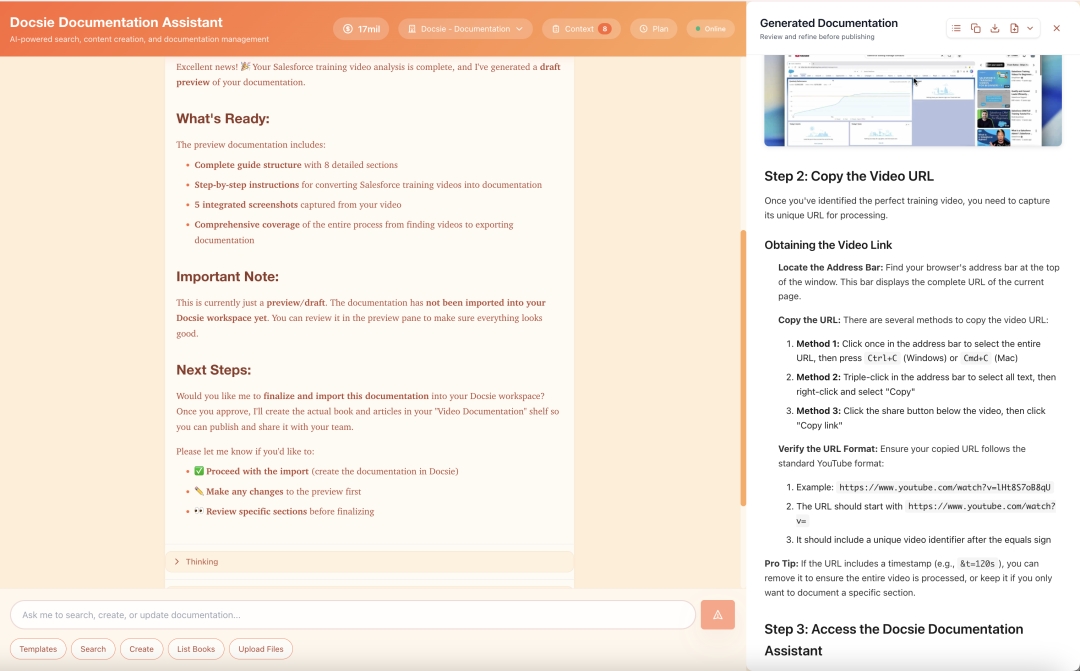
Austin, Texas - February 17, 2026 - A fundamental shift is underway in enterprise e-learning content creation. Rather than investing in new training video production, organizations are turning to AI-powered tools to extract and convert their existing video libraries into searchable, structured documentation. Docsie, the AI document platform serving over 5,000 organizations, reports a surge in enterprise adoption driven by a simple realization: companies are sitting on thousands of hours of recorded knowledge that nobody can find, search, or reuse.
The shift marks a departure from the video-first training model that dominated enterprise learning and development since the pandemic. Between 2020 and 2024, organizations invested heavily in recording training sessions, product walkthroughs, onboarding demos, and compliance briefings through platforms like Zoom, Microsoft Teams, Google Meet, and Loom. The result is massive corporate video libraries that grow daily but deliver diminishing returns.
"The e-learning industry spent five years telling enterprises to record everything," said Philippe Trounev, CEO of Docsie. "They did. Now they have 10,000 videos in a shared drive that nobody watches twice. The training content exists — it's just trapped in a format that can't be searched, updated, or maintained. That's not a content creation problem anymore. It's a content conversion problem."
The Economics of Video-to-Documentation Conversion
Docsie's internal data reveals the scale of the inefficiency. Enterprise clients report spending an average of 4-6 hours manually converting a single one-hour training video into written documentation — extracting key steps, capturing screenshots, formatting procedures, and organizing the content into searchable guides. For organizations with hundreds or thousands of training recordings, the manual documentation backlog represents tens of thousands of labor hours.
The company's video to text AI engine automates this conversion in under 14 seconds per video. The platform analyzes screen content, speaker audio, visual workflows, and on-screen text to generate structured SOPs, step-by-step guides, and knowledge base articles. The output is immediately searchable, editable, and publishable across internal portals and customer-facing documentation sites.
"You can't search a video for 'step 3 of the approval process,'" said Trounev. "But you can search a document. The moment you convert video to documentation, that knowledge becomes findable. That's the shift we're seeing — enterprises moving from 'record more' to 'convert what we have.'"
E-Learning Content Creation Reimagined
The trend is most pronounced among enterprise consulting firms specializing in SAP, Salesforce, and Workday implementations. These organizations face a unique documentation challenge: consultants deliver the same training across dozens of client engagements, recording similar sessions repeatedly rather than converting existing recordings into reusable client-specific documentation.
Docsie reports that consulting firms using the platform's convert video to documentation capabilities have reduced training documentation time by 70% while increasing knowledge base adoption by 67% among end users. The improvement stems from a fundamental behavioral insight: employees search for answers in text, not in video.
Industry data supports the broader trend. Research indicates that 85% of organizational knowledge remains tacit — trapped in people's heads, meeting recordings, and unwatched training videos. Meanwhile, employees spend an estimated 20% of their workweek searching for information, with video-based knowledge being the least accessible format in enterprise search systems.
From Video Production Budgets to Documentation Automation
The economic case for conversion over production is driving budget reallocation within L&D departments. Enterprise video production — including scripting, recording, editing, hosting, and maintaining training videos — costs an estimated $15,000-$40,000 per hour of polished content. Converting existing raw recordings into searchable documentation through AI-powered training documentation software costs a fraction of that investment.
"We're seeing L&D teams cancel planned video production projects and redirect those budgets toward converting their existing libraries," said Trounev. "Why spend $30,000 producing a new training video when you have 500 recorded Zoom sessions covering the same material? Convert what you have. That's the smarter investment."
The platform supports all major video and recording sources including Zoom, Google Meet, Microsoft Teams, Loom, and direct screen recordings. Output formats include structured SOPs, user manuals, quick-reference guides, onboarding checklists, and multi-language documentation — all generated from a single video source.
The Search Behavior Signal
Docsie's analysis of enterprise search behavior reveals another driver of the shift. Search demand for "video to text converter" in enterprise contexts has grown significantly over the past 12 months, with related queries like "convert video to word document," "training video to documentation," and "screen recording to documentation" showing consistent upward trends. The data suggests that individual employees and team leads — not just L&D departments — are independently seeking solutions to convert video content they encounter daily into usable written formats.
"This isn't a top-down procurement decision anymore," said Trounev. "Individual knowledge workers are hitting the same wall every day — they know the answer is somewhere in a training video, but they can't find it. They're searching for video to text AI solutions on their own. That bottoms-up demand is what's driving enterprise adoption."
About Docsie
Docsie is an AI document platform and agentic knowledge orchestration system that transforms how organizations create, manage, and deliver documentation. The platform's AI-powered video to text converter enables enterprises to convert existing video libraries into searchable, structured digital documentation — turning training recordings, meeting captures, and product walkthroughs into knowledge assets that employees can actually find and use. Serving 5,000+ organizations including Fortune 500 enterprise clients, Docsie supports the full documentation lifecycle from e-learning content creation through multi-tenant knowledge delivery.
Learn more at https://www.docsie.io/solutions/video-to-text-converter/
Media Contact
Company Name: Docsie Inc.
Contact Person: Philippe Trounev
Email: Send Email
Phone: 4169028771
Address:701 Tillery Street Unit 1207
City: Austin
State: Texas
Country: United States
Website: https://www.docsie.io