Automation-Driven Irrigation Expansion Accelerates Precision Agriculture Across High-Growth Economies
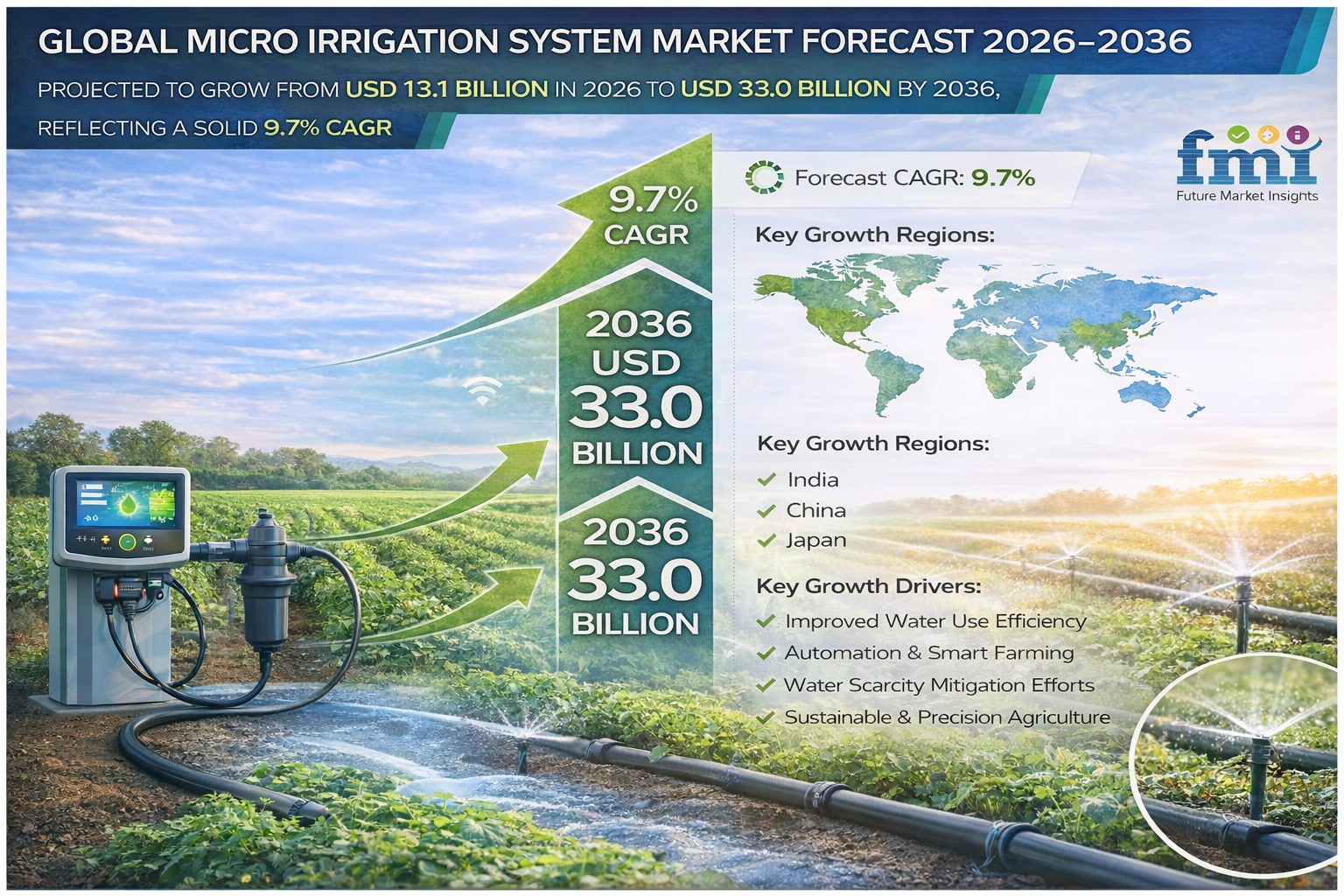
NEWARK, DELAWARE / ACCESS Newswire / February 20, 2026 / The global micro irrigation system market is entering a new era of industrial-scale transformation, driven by the convergence of automation, precision agriculture, and water efficiency mandates. Valued at USD 13.1 billion in 2026, the market is projected to surge to USD 33.0 billion by 2036, expanding at a robust 9.7% CAGR, according to a comprehensive analysis by Future Market Insights (FMI). This growth reflects a structural shift in farming operations, where irrigation is no longer treated as a seasonal input but as a measurable, controllable production layer essential for yield optimization and operational efficiency.
As agricultural enterprises scale operations across dispersed acreage, irrigation infrastructure is increasingly engineered around predictable hydraulic performance, automation-ready control systems, and modular components capable of supporting multi-season reliability. This transformation positions micro irrigation systems as a foundational technology in modern agricultural productivity frameworks.
Irrigation Evolution: From Manual Utility to Automated Production Infrastructure
The industry is witnessing a decisive transition toward automation-enabled irrigation ecosystems, where execution is governed by sensor-driven telemetry, programmable controllers, and standardized hydraulic designs. This shift allows operators to maintain consistent water delivery while minimizing labor variability and operational risk.
"Farm operators are prioritizing irrigation architectures that enable repeatable execution, remote diagnostics, and scalable deployment across estates," notes an FMI analyst. "Investment decisions are increasingly tied to measurable KPIs such as water-use efficiency, yield stability, and labor optimization, reinforcing irrigation's role as a strategic production asset rather than a maintenance function."
This industrialization of irrigation systems is accelerating procurement of components designed for high reliability, integrated filtration, and interoperability with farm management software, ensuring operational continuity and lifecycle cost predictability.
Get Access of Report Sample -
https://www.futuremarketinsights.com/reports/sample/rep-gb-4303
Procurement Transformation: Reliability, Serviceability, and Standardization Take Priority
Procurement frameworks are rapidly evolving, with buyers placing greater emphasis on component durability, installation quality, and service ecosystem maturity. Downtime is now quantified not only in repair costs but also in lost productivity, yield exposure, and labor disruptions.
Key procurement trends include:
Standardized component stacks to simplify maintenance and reduce commissioning complexity
Automation-ready controllers to enable centralized monitoring and remote calibration
Robust filtration systems to maintain consistent hydraulic performance under varying water quality conditions
Structured service models to support preventive maintenance and ensure uptime during peak irrigation cycles
This shift is fostering closer alignment between irrigation infrastructure and broader agricultural automation strategies, reinforcing irrigation as a core pillar of precision farming.
Segment Leadership: Drip Irrigation and Emitters Anchor Market Expansion
Micro irrigation systems are increasingly deployed across diverse agricultural environments, but certain segments continue to dominate due to their performance efficiency and scalability.
Drip irrigation systems lead with a commanding 77% market share, driven by their ability to deliver uniform, targeted water application while supporting scalable zoning across large land areas. These systems enable gradual upgrades in automation sophistication without requiring costly hydraulic redesigns.
On the component side, drippers and emitters account for 27% of total demand, reflecting their central role in ensuring delivery precision and system reliability. Maintenance strategies are increasingly built around emitter performance, particularly in regions with variable water quality.
Orchards and vineyards represent the largest crop segment, accounting for 41% of market share, as perennial crop systems rely heavily on consistent irrigation scheduling to maintain yield quality and long-term productivity.
Meanwhile, open-field cultivation dominates farming techniques with a 45% share, supported by large-scale mechanized agriculture and increasing integration of irrigation automation with precision farming equipment.
Regional Growth Engines: Emerging Markets Accelerate Adoption
Country |
CAGR (2026-2036) |
Key Growth Drivers |
|---|---|---|
India |
12.4% |
Large-scale adoption programs, water conservation initiatives, and increasing automation across commercial farming operations. Government-backed incentives and modernization programs are accelerating deployment across diverse crop systems. |
China |
11.7% |
Infrastructure development, scalable deployment strategies, and growing emphasis on operational efficiency across large agricultural production zones. |
Japan |
9.7% |
Adoption of precision agriculture practices and structured operational frameworks focused on measurable efficiency gains and optimized irrigation execution. |
United States |
9.0% |
Upgrades to automation-enabled irrigation scheduling, remote monitoring systems, and strong focus on lifecycle cost optimization and productivity enhancement. |
Data-Driven Agriculture: Automation and Interoperability Define Competitive Advantage
Automation and interoperability are becoming defining factors in irrigation system selection. Buyers increasingly prioritize systems that integrate seamlessly with enterprise farm management platforms, enabling centralized monitoring, analytics-driven decision-making, and scalable performance management.
Key technological trends shaping the market include:
Closed-loop irrigation execution based on real-time environmental data
Remote monitoring and diagnostics to ensure operational continuity
Standardized controller interfaces to maintain interoperability across vendors
Predictive maintenance programs to reduce downtime and optimize lifecycle performance
These capabilities allow operators to implement repeatable irrigation strategies across multiple sites while maintaining operational consistency.
Competitive Landscape: Deployment Execution and Lifecycle Performance Drive Market Leadership
Competition in the micro irrigation system market is increasingly defined by deployment execution strength, service reliability, and system scalability, rather than mechanism variety alone. Suppliers are strengthening market positioning through standardized product architectures, improved filtration systems, and enhanced field support capabilities.
Key players actively shaping the global market include:
Netafim Ltd.
Jain Irrigation Systems Ltd.
The Toro Company
Rain Bird Corporation
Hunter Industries
Valmont Industries
Rivulis Irrigation Ltd.
Lindsay Corporation
Reinke Manufacturing Co., Inc.
EPC Industries Ltd.
These companies are investing in advanced controller integration, scalable deployment models, and service-driven differentiation to support multi-year infrastructure upgrades without disrupting operational continuity.
Future Outlook: Irrigation Automation to Anchor Sustainable Agricultural Expansion
Looking ahead to 2036, micro irrigation systems are expected to play a central role in enabling sustainable agricultural expansion, particularly as global water constraints intensify and productivity demands increase.
Key long-term trends include:
Expansion of automation-driven irrigation infrastructure
Increased adoption of telemetry and analytics-enabled irrigation systems
Greater emphasis on lifecycle reliability and serviceability
Integration with broader precision agriculture ecosystems
As agriculture transitions toward data-driven, automation-led production models, micro irrigation systems will remain critical in delivering consistent yields, optimizing resource utilization, and ensuring long-term operational resilience.
With sustained investment in automation, infrastructure modernization, and precision water management, the micro irrigation system market is poised to emerge as one of the fastest-growing segments within the global agricultural technology landscape over the next decade.
For an in-depth analysis of evolving formulation trends and to access the complete strategic outlook for the Micro Irrigation System Market through 2036, visit the official report page at:
Related Reports:
Micro-Vent Cap Systems Market - https://www.futuremarketinsights.com/reports/micro-vent-cap-systems-market
Micro-Ultrasound Systems Market - https://www.futuremarketinsights.com/reports/micro-ultrasound-systems-market
Microwave Backhaul System Market - https://www.futuremarketinsights.com/reports/microwave-backhaul-system-market
Microhardness Testing System Market - https://www.futuremarketinsights.com/reports/microhardness-testing-system-market
Pitch Irrigation System Market - https://www.futuremarketinsights.com/reports/pitch-irrigation-system-market
About Future Market Insights (FMI)
Future Market Insights (FMI) is a leading provider of market intelligence and consulting services, serving clients in over 150 countries. Headquartered in Delaware, USA, with a global delivery center in India and offices in the UK and UAE, FMI delivers actionable insights to businesses across industries including automotive, technology, consumer products, manufacturing, energy, and chemicals.
An ESOMAR-certified research organization, FMI provides custom and syndicated market reports and consulting services, supporting both Fortune 1,000 companies and SMEs. Its team of 300+ experienced analysts ensures credible, data-driven insights to help clients navigate global markets and identify growth opportunities.
For Press & Corporate Inquiries
Rahul Singh
AVP - Marketing and Growth Strategy
Future Market Insights, Inc.
+91 8600020075
For Sales - sales@futuremarketinsights.com
For Media - Rahul.singh@futuremarketinsights.com
For web - https://www.futuremarketinsights.com/
SOURCE: Future Market Insights, Inc.
View the original press release on ACCESS Newswire