The Stanford Digital Economy Lab today released “The Digitalist Papers, Volume 2,” a collection of 21 essays exploring the implications of the transformative economic power of artificial intelligence, setting the stage for change comparable to the Industrial Revolution but with far greater speed and scope. At a moment when AI capabilities are advancing faster than institutions can adapt, the volume offers frameworks, scenarios, and open questions to help leaders prepare for the transitions ahead.
This press release features multimedia. View the full release here: https://www.businesswire.com/news/home/20251211080126/en/
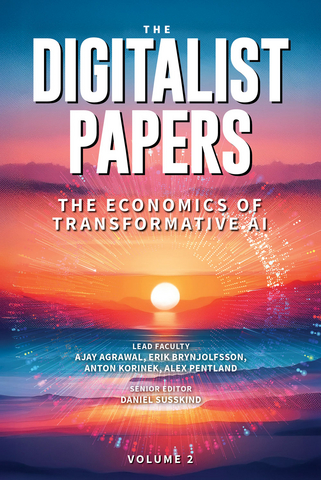
The first volume of the Digitalist Papers, published in September 2024, focused on AI’s impact on American democracy, with contributions from academics, entrepreneurs, and policy practitioners. The second volume shifts focus to the opportunities and risks of “transformative AI,” or TAI, which is expected to drive rapid and far-reaching changes in the global economy.
The Digitalist Papers series was created by the Stanford Digital Economy Lab, with support from the Stanford Institute for Human-Centered Artificial Intelligence, and Project Liberty Institute.
“Progress in AI is advancing faster than our ability to fully understand its economic impact,” said Erik Brynjolfsson, director of the Stanford Digital Economy Lab and The Digitalist Papers series faculty lead, and co-author of the introductory essay in the second volume. “These technologies could unlock large gains in productivity, innovation, and well-being, but they also challenge our existing institutions and raise urgent questions about work, skills, economic opportunity, and how the benefits of AI will be distributed. In this volume, we asked contributors to explore how society can prepare for—and shape—the transitions ahead.”
This volume of The Digitalist Papers contributes to Stanford’s growing body of work on the economics of AI, including new efforts to measure AI’s impact on work and productivity and to produce evidence on how AI adoption is reshaping skills, labor markets, and economic opportunity–insights that equip policymakers, educators, and industry leaders to navigate the economic transitions ahead.
The new collection explores how transformative AI may reshape not only the global economy but also work, institutions, governance, innovation, and international stability:
Vision of the future
- Former Google CEO Eric Schmidt, OpenAI CFO Sarah Friar, MIT computer scientist Daniela Rus, and venture capitalist Steve Jurvetson offer short “vision essays” that sketch potential technological trajectories, disruptions, and opportunities created by TAI.
Global risks
- Yoshua Bengio, computer scientist at Université de Montréal, argues that while transformative AI has the potential to benefit all of us, it also presents serious global risks that demand an international, coordinated response.
The future of work
- Anthropic chief of staff Avital Balwit addresses how to prepare the next generation for a transformed labor market, arguing that traditional skills-based approaches are not sufficient.
- MIT labor economist David Autor and Neil Thompson, director of MIT FutureTech, outline scenarios ranging from gradual augmentation and automation to the possibility of full labor displacement.
Interventions and safety nets
- Berggruen Institute co-founders Nicolas Berggruen and Nathan Gardels explore universal basic capital, a model in which all individuals are given an ownership stake in TAI-driven prosperity.
- Ioana Marinescu, a University of Pennsylvania labor economist, lays out a flexible safety net that can adapt dramatically as labor market disruption accelerates.
Fiscal stability
- University of Virginia economists Anton Korinek and Lee Lockwood examine how to finance responses at the scale that transformative AI may require, arguing for preserving fiscal capacity to address labor displacement and sustain essential public functions.
Meaning, purpose, and social cohesion
- Betsey Stevenson, a professor of public policy and economics at the University of Michigan and former chief economist for the U.S. Department of Labor, argues that if transformative AI devalues or displaces work, the challenge is not simply economic, emphasizing the importance of meaning, purpose, trust, and social cohesion in a transformed society.
Macroeconomic impacts
- The University of Toronto economists Ajay Agrawal and Joshua Gans frame TAI as a “genius supply shock” and argue that regulatory sandboxes and regulatory holidays may help organizations adapt.
- The Nobel Prize-winning economist Joseph Stiglitz and his Columbia University colleague Màxim Ventura-Bolet examine how TAI could lead to an undersupply of good information, an oversupply of mis- and disinformation, and insufficient mechanisms for correction.
- Alex Pentland, a Stanford HAI Center Fellow, and Alexander Lipton, who leads R&D at the Abu Dhabi Investment Authority, focus on the financial system and argue that we must consider TAI’s impact on trade and investment, not only traditional production.
The stakes of today’s choices
- Ramin Toloui, a Stanford SIEPR fellow, explores how impacts depend on who controls TAI, how it is deployed, and how governments respond, offering a framework to distinguish between futures we might intentionally pursue and those we should avoid.
- Gabriel Unger, a postdoctoral fellow at the Stanford Digital Economy Lab, emphasizes that economic outcomes are not set in stone and highlights the mismatch between the stakes of TAI and the limited conversation about it today.
Power concentration
- Susan Athey, Economics of Technology Professor at Stanford, and Fiona Scott Morton, a Yale industrial-organization economist and former chief economist at the U.S. Department of Justice Antitrust Division, explore concerns that TAI may concentrate political and economic power, arguing consumer benefits are far from inevitable and describing policies to help ensure gains are widely shared.
Cross-border spillover
- Anna Yelizarova, COO and co-founder of Windfall Trust, proposes a “global dividend” to share TAI-driven prosperity across borders.
- Nick Bostrom, founder and principal researcher at the Macrostrategy Research Initiative, proposes “open global investment,” where private AI companies operate within government-defined frameworks.
U.S.–China dynamics
- RAND colleagues Lisa Abraham, Joshua Kavner, Alvin Moon, and Jason Matheny use game theory to model the U.S.-China race and explore pathways from competition toward cooperation.
- Alvin Graylin, a Stanford Digital Economy Lab digital fellow, calls for the U.S. and China to go “beyond rivalry,” outlining interventions to bring that about.
Detailed bios on all contributors can be found on the Digital Economy Lab website.
About the Stanford Digital Economy Lab
The Stanford Digital Economy Lab conducts groundbreaking research on the digital economy's impact across societal boundaries. It aims to lower barriers to understanding how digitalization shapes our future through accessible, evidence-based information. The Stanford Digital Economy Lab brings together interdisciplinary researchers to study how digital technologies transform work, organizations, and the economy. Their insights help various stakeholders address challenges and opportunities created by digitization. The Stanford Digital Economy Lab believes in augmenting human capabilities with machine capabilities for mutual benefit. It is part of Stanford's Institute for Human-Centered Artificial Intelligence and co-sponsored by the Stanford Institute for Economic Policy Research. For more information, visit digitaleconomy.stanford.edu/ and follow on LinkedIn and X.
View source version on businesswire.com: https://www.businesswire.com/news/home/20251211080126/en/