As of February 17, 2026, Walmart Inc. (NYSE: WMT) has officially entered a new era of corporate history. Long regarded as the quintessential "brick-and-mortar" giant, the Bentonville-based retailer recently crossed the historic $1 trillion market capitalization milestone on February 3, 2026. This achievement is not merely a reflection of its scale but a validation of a decade-long digital transformation. In a market where high-growth technology stocks often command the spotlight, Walmart has emerged as a "tech-hybrid" juggernaut, blending the defensive stability of consumer staples with the high-margin scalability of digital advertising and membership services. With a crucial Q4 earnings report looming this week, all eyes are on how the world’s largest retailer continues to redefine the boundaries of global commerce.
Historical Background
The Walmart story began in 1962 when Sam Walton opened the first "Wal-Mart" in Rogers, Arkansas, with a simple but disruptive philosophy: "Everyday Low Prices." Walton’s focus on rural markets, sophisticated logistics, and passing savings to the customer allowed the company to grow rapidly, going public in 1970. Over the following decades, Walmart expanded into suburban and urban areas, launched the Sam's Club warehouse model in 1983, and pioneered the "Supercenter" format in 1988.
The 21st century brought new challenges, primarily from the rise of e-commerce. Under the leadership of Doug McMillon (CEO from 2014 to early 2026), the company underwent a radical shift, acquiring Jet.com in 2016 and investing tens of billions of dollars into its digital ecosystem. By 2026, Walmart has successfully transitioned from a store-first retailer to an omnichannel platform where physical locations serve as high-tech fulfillment hubs, marking its most significant transformation since its founding.
Business Model
Walmart operates a massive, diversified business model centered on three primary segments: Walmart U.S., Walmart International, and Sam’s Club. While retail sales of groceries, apparel, and electronics remain the bedrock of the company, the business model has evolved into a "flywheel" of high-margin services:
- Retail & E-commerce: Selling a vast array of goods through 10,500+ stores and a global digital marketplace.
- Walmart Connect: A rapidly growing retail media network (advertising) that leverages Walmart's massive first-party shopper data.
- Walmart+: A membership subscription service offering delivery, fuel discounts, and streaming perks, providing recurring, high-margin revenue.
- Financial & Health Services: Expanding into pharmacy, primary care clinics, and fintech solutions for both customers and associates.
- Logistics-as-a-Service: Utilizing its "GoLocal" platform to provide last-mile delivery services for other businesses.
Stock Performance Overview
Over the past decade, Walmart has transitioned from a steady dividend payer to a growth-oriented market leader.
- 1-Year Performance: In the last 12 months, WMT has gained approximately 35%, significantly outperforming the broader market as investors sought refuge in its recession-resistant earnings.
- 5-Year Performance: Since 2021, the stock has more than doubled, fueled by the acceleration of e-commerce and the strategic 3-for-1 stock split executed in 2024, which enhanced liquidity for retail investors.
- 10-Year Performance: On a total return basis, Walmart has outperformed the S&P 500 over the last decade, proving that legacy retailers can successfully pivot to digital-first models.
The recent surge to the $1 trillion mark has been driven by a significant "re-rating" of the stock, as analysts move away from valuing it as a traditional grocer and toward a tech-service multiple.
Financial Performance
Walmart’s financial health in early 2026 is characterized by robust top-line growth and expanding margins. For the fiscal year ending January 2025, the company reported revenue of $681 billion. Current projections for the full fiscal year 2026 suggest a climb toward $715 billion.
- Earnings per Share (EPS): Walmart has consistently beaten analyst estimates over the last four quarters, driven by lower logistics costs and a shift toward high-margin advertising revenue.
- Margins: Operating margins, which historically hovered around 4-5%, have seen a notable uptick as the share of advertising and membership income grows.
- Debt & Cash Flow: The company maintains an AA credit rating with strong free cash flow, allowing it to fund massive capital expenditures in automation while continuing its 50-year streak of dividend increases.
Leadership and Management
On February 1, 2026, John Furner officially took the helm as President and CEO of Walmart Inc., succeeding Doug McMillon. Furner, a Walmart veteran who previously led the U.S. division, is credited with the successful rollout of the company’s automation strategy.
- John David Rainey (CFO): A former PayPal executive, Rainey continues to be the architect of Walmart’s shift toward a tech-driven financial model.
- David Guggina (CEO, Walmart U.S.): Formerly the Chief eCommerce Officer, Guggina’s promotion signals the company’s "digital-first" priority.
The leadership transition has been viewed as a seamless "passing of the torch," with McMillon remaining as an advisor through 2027 to ensure strategic continuity.
Products, Services, and Innovations
Innovation is the primary driver behind Walmart’s current valuation.
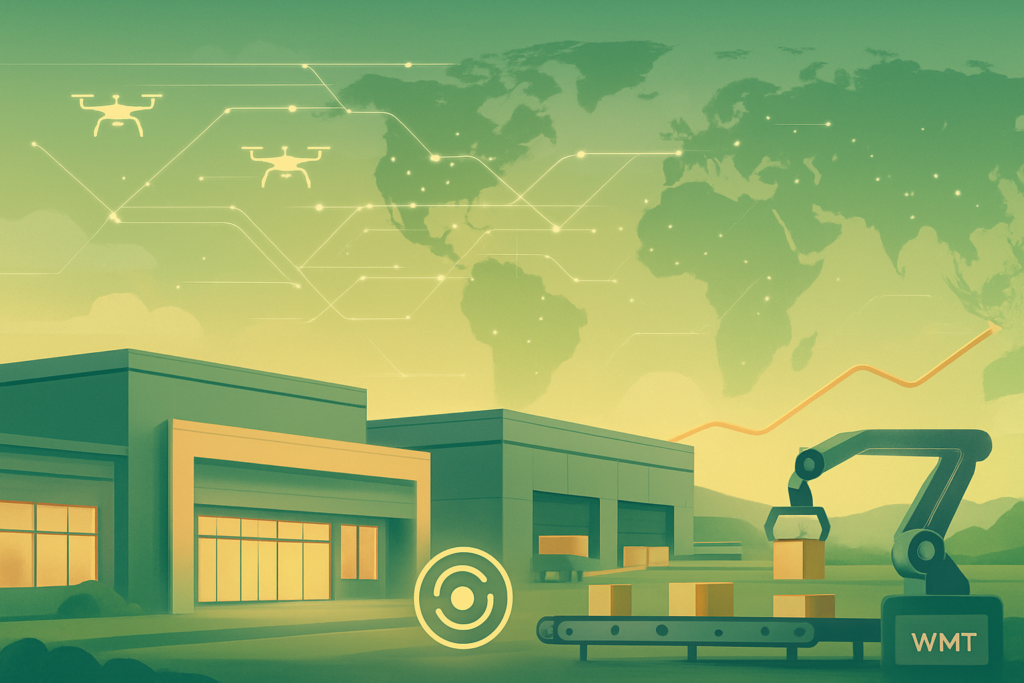
- Supply Chain Automation: By early 2026, 65% of Walmart’s stores are serviced by automated facilities. This "Supply Chain of the Future" has reduced unit costs by over 20%.
- AI-Powered Commerce: Walmart’s proprietary GenAI search allows customers to shop by "intent" (e.g., "plan a 5-year-old’s birthday party") rather than just keywords.
- Drone Delivery: In partnership with Wing and Zipline, drone delivery is now available to over 75% of the population in major U.S. metropolitan areas.
- Connected TV: The integration of VIZIO’s SmartCast system has turned Walmart into a major player in the streaming ad space, rivaling Amazon (NASDAQ: AMZN) and Roku (NASDAQ: ROKU).
Competitive Landscape
Walmart sits in a unique competitive position. In the grocery sector, it remains the undisputed leader, holding a market share nearly double that of its nearest rival, Kroger (NYSE: KR).
- Vs. Amazon: Walmart has narrowed the gap in e-commerce by leveraging its physical stores as delivery hubs, often offering faster "last-mile" delivery than Amazon in rural and suburban areas.
- Vs. Costco (NASDAQ: COST) & Target (NYSE: TGT): Walmart has successfully defended its market share against Target by maintaining price leadership during inflationary periods, and against Costco by enhancing its Sam’s Club value proposition.
The company's scale and $1 trillion valuation now place it in direct competition with the "Magnificent Seven" for investor capital.
Industry and Market Trends
The retail industry in 2026 is defined by "Value and Convenience." Despite cooling inflation, consumer "trade-down" behavior persists, benefiting Walmart’s grocery and private-label (Great Value) business.
- Defensive Rotation: Early 2026 has seen a massive rotation of capital out of pure-play tech and into "Defensive Growth" stocks. WMT has been the primary beneficiary of this trend.
- Retail Media: The industry is seeing a shift where retailers are becoming media companies. Walmart’s advertising arm is now a key growth engine for the entire Consumer Staples sector (NYSE Arca: XLP).
Risks and Challenges
Despite its momentum, Walmart faces significant headwinds:
- Labor Costs: As a massive employer, rising minimum wages and labor unionization efforts remain a persistent threat to margins.
- International Volatility: Economic slowdowns in key markets like China and regulatory hurdles in India (Flipkart) could dampen global growth.
- E-commerce Profitability: While e-commerce revenue is soaring, the cost of "last-mile" delivery and heavy investments in automation continue to weigh on the segment’s bottom line.
- Cybersecurity: As a data-driven giant, the risk of large-scale data breaches is a top-tier concern for the board.
Opportunities and Catalysts
The upcoming Q4 earnings report (expected this week) is the most immediate catalyst. Investors are looking for:
- Holiday Performance: Early data suggests a record-breaking holiday season for Walmart+, potentially leading to an earnings beat.
- Advertising Growth: Any update on the scale of Walmart Connect post-VIZIO integration could spark a further rally.
- International IPOs: Rumors of a potential IPO for Flipkart in 2026 could unlock significant value for shareholders.
- Share Buybacks: With its massive cash reserves, the company is expected to announce an expanded share repurchase program in mid-2026.
Investor Sentiment and Analyst Coverage
Wall Street remains overwhelmingly bullish on Walmart. As of February 2026, over 85% of analysts covering the stock maintain a "Buy" or "Strong Buy" rating.
- Institutional Holdings: Hedge funds and large asset managers like Vanguard and BlackRock have increased their positions, viewing WMT as a "must-own" stock for both stability and growth.
- Retail Sentiment: On social media platforms and retail trading forums, Walmart is increasingly discussed alongside "Big Tech" rather than traditional retailers, reflecting a fundamental shift in how the public perceives the brand.
Regulatory, Policy, and Geopolitical Factors
Walmart operates in a complex regulatory environment.
- Antitrust Scrutiny: As Walmart’s advertising and data segments grow, it faces increased scrutiny from the FTC regarding data privacy and competition.
- Trade Policy: Given its global supply chain, any shifts in tariffs or trade relations with China directly impact its cost of goods sold.
- Sustainability Mandates: New federal reporting requirements for Scope 3 emissions have forced Walmart to accelerate its transition to a zero-emissions delivery fleet, a move that is costly in the short term but may yield long-term tax incentives.
Conclusion
Walmart’s ascent to a $1 trillion market cap is a testament to the power of reinvention. By successfully marrying the world’s most efficient physical supply chain with a high-margin digital ecosystem, the company has insulated itself from the volatility that has plagued other retail sectors.
For investors, Walmart represents a rare "all-weather" stock. It offers the defensive safety of a grocery giant during economic downturns and the high-growth potential of a tech platform during market upswings. As we look toward the Q4 earnings report, the key question is no longer whether Walmart can survive the digital age, but how much further it can pull ahead of its peers. In the current macro environment, Walmart isn't just a retail stock; it is a global infrastructure play for the 21st century.
This content is intended for informational purposes only and is not financial advice.