As of February 19, 2026, Walmart Inc. (NYSE: WMT) stands at a historic crossroads. After decades of being defined by its massive physical footprint and "Everyday Low Price" (EDLP) philosophy, the world’s largest retailer has officially evolved into a tech-driven omnichannel powerhouse. Having recently crossed the $1 trillion market capitalization threshold, Walmart is no longer just competing for grocery bags—it is fighting for digital dominance, advertising dollars, and high-margin service revenue. This report examines the fundamental shift in Walmart’s business model and its investment outlook for 2026 and beyond.
Historical Background
Founded by Sam Walton in 1962 in Rogers, Arkansas, Walmart’s early mission was simple: offer the lowest prices to rural communities that were underserved by larger department stores. The company went public in 1970 and spent the next three decades expanding aggressively, becoming the largest retailer in the world by the early 1990s.
The most significant transformation, however, began in the mid-2010s under Doug McMillon. Recognizing the existential threat posed by Amazon.com (NASDAQ: AMZN), Walmart invested billions in e-commerce infrastructure, acquired Jet.com in 2016, and revamped its supply chain. By the 2020s, Walmart had integrated its 4,700+ U.S. stores into "local fulfillment centers," blurring the lines between physical and digital shopping.
Business Model
Walmart operates through three primary segments:
- Walmart U.S.: The largest segment, accounting for roughly 68% of revenue, focused on retail, grocery, and pharmacy.
- Walmart International: Operations in 19 countries, with a heavy focus on high-growth markets like India (via Flipkart and PhonePe) and Mexico (Walmex).
- Sam’s Club: A membership-only warehouse club that competes directly with Costco (NASDAQ: COST).
The "Alternative Profit Flywheel":
In 2026, Walmart’s business model has shifted toward high-margin services. While retail remains the core, the company now generates significant profit from:
- Advertising (Walmart Connect): Using first-party shopper data to sell ads to suppliers.
- Data Ventures: Selling insights to brands about consumer behavior.
- Fulfillment Services (WFS): Charging third-party sellers to store and ship their goods.
- Membership Fees: Recurring revenue from the Walmart+ program.
Stock Performance Overview
Walmart’s stock has seen a dramatic re-rating over the last decade:
- 1-Year Performance: The stock has outperformed the S&P 500, buoyed by the $1T market cap milestone and the successful integration of Vizio’s advertising technology.
- 5-Year Performance: WMT has seen a steady climb, accelerated by the 3-for-1 stock split in February 2024, which increased retail investor participation.
- 10-Year Performance: Investors have enjoyed a total return exceeding 250%, as the market transitioned from valuing Walmart as a "slow-growth retailer" to a "compounding tech-retail leader."
Financial Performance
Walmart’s Fiscal Year 2026 results (ending Jan 31, 2026) demonstrated remarkable resilience:
- Revenue: Reached a record $713.2 billion, up 4.7% year-over-year.
- Adjusted EPS: Reported at $2.64, beating analyst expectations.
- Operating Income: Grew at a faster rate than sales (5.4% growth), a key metric proving that automation and advertising are boosting the bottom line.
- Cash Flow: Generated $41.6 billion in operating cash flow, allowing for a 53rd consecutive year of dividend increases (now $0.99 annually) and a new $30 billion share repurchase program.
- Valuation: The stock currently trades at a forward P/E of approximately 44x, a premium that reflects its "defensive growth" status but raises questions about near-term upside.
Leadership and Management
The 2026 transition to John Furner as CEO represents a "continuity of vision." Furner, a 33-year Walmart veteran, was the architect of the "Store of the Future" initiative. He is supported by CFO John David Rainey, whose background at PayPal and United Airlines has been instrumental in shifting Walmart’s financial narrative toward tech and margins. The board remains heavily influenced by the Walton family, who control nearly 40% of the company, ensuring a long-term strategic horizon that prioritizes stability over quarterly volatility.
Products, Services, and Innovations
Innovation in 2026 is centered on "Agentic Commerce":
- Generative AI: Walmart’s "Sparky" AI assistant now handles complex shopping missions (e.g., "Plan a keto-friendly birthday party for 10 people for under $200").
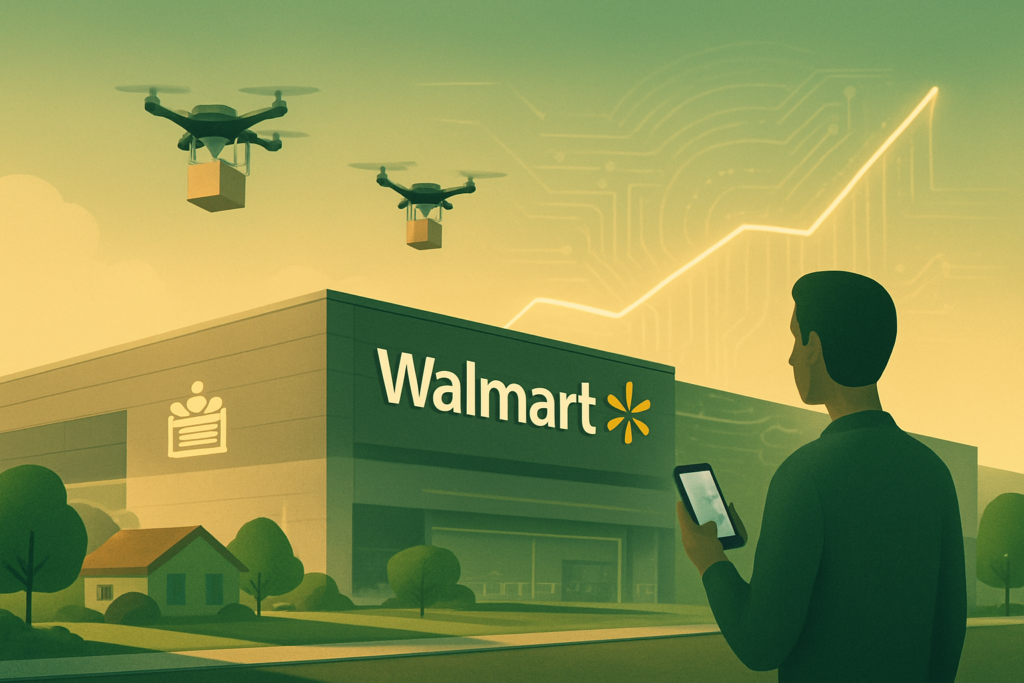
- Drone Delivery: In partnership with Wing, Walmart now offers 30-minute drone delivery from 150+ stores in major metro areas.
- Shoppable TV: Following the acquisition of Vizio, Walmart has integrated its checkout directly into the SmartCast OS, allowing viewers to buy products directly from commercials.
- Automation: By late 2026, 75% of Walmart’s stores will be serviced by automated distribution centers, significantly reducing logistics costs.
Competitive Landscape
Walmart remains in a fierce battle with three primary rivals:
- Amazon: While Amazon dominates pure e-commerce, Walmart’s 4,700 stores serve as local hubs that allow for cheaper and faster grocery delivery—a sector where Amazon still struggles for scale.
- Costco: Costco leads in membership loyalty, but Walmart’s digital experience and Walmart+ program are narrowing the gap.
- Target (NYSE: TGT): Target has struggled with discretionary spending lulls, whereas Walmart’s heavy grocery mix (nearly 60% of U.S. sales) provides a more defensive hedge against inflation.
Industry and Market Trends
The "Bifurcated Consumer" is the dominant trend of 2026. Low-income households are struggling with the cumulative effects of inflation, while high-income households are seeking value. Walmart has successfully captured both ends of the spectrum. Furthermore, the "Retail Media" trend is exploding, with Walmart Connect leading the way as brands shift spending away from traditional TV toward platforms where they can see an immediate "closed-loop" sale.
Risks and Challenges
- Discretionary Spending: While groceries sell well, sales of "wants" (electronics, home goods) remain muted, which carries higher profit margins.
- Labor Friction: The aggressive push toward AI and warehouse automation has led to corporate layoffs and friction with labor advocates.
- Tariff Exposure: Proposed and implemented tariffs on imports from China and Southeast Asia threaten Walmart’s "Everyday Low Price" model, potentially forcing price hikes.
- Valuation Risk: At 44x earnings, the stock is "priced for perfection," leaving little room for error in execution.
Opportunities and Catalysts
- India Monetization: The expected mid-2026 IPO of PhonePe (India’s leading payments app) could unlock billions in value for Walmart shareholders.
- Vizio Synergy: The full integration of Vizio’s ad platform is expected to accelerate Walmart Connect’s growth to 30%+ annually.
- Market Share Gains: Continued "trade-down" from affluent shoppers provides a new, sticky customer base that Walmart can upsell into its membership and financial services.
Investor Sentiment and Analyst Coverage
Wall Street remains broadly optimistic, with a consensus "Moderate Buy" rating. Analysts from firms like Mizuho and RBC have raised price targets to the $135–$145 range. Hedge funds have treated Walmart as a "safe haven" during recent market volatility, viewing it as a defensive stock with the growth characteristics of a tech firm. However, some value-oriented analysts caution that the current valuation is historically stretched.
Regulatory, Policy, and Geopolitical Factors
Walmart is under increased scrutiny from the FTC regarding "Robinson-Patman Act" violations—allegations that large retailers use their scale to demand unfairly low prices from suppliers that smaller competitors cannot access. Internationally, Walmart must navigate India’s complex FDI (Foreign Direct Investment) rules, which frequently change the landscape for its Flipkart and PhonePe subsidiaries.
Conclusion
Walmart in 2026 is a far cry from the "discount store" of the 20th century. It has successfully leveraged its physical proximity to 90% of the U.S. population to build a digital ecosystem that rivals the world’s largest tech companies. For investors, Walmart offers a unique combination of defensive stability (grocery dominance) and aggressive growth (advertising and AI). While the current valuation requires a belief in continued flawless execution, Walmart’s pivot to a high-margin service model suggests that its journey to $1 trillion may only be the beginning of a new chapter in retail history.
This content is intended for informational purposes only and is not financial advice. Today's Date: February 19, 2026.