As of March 2, 2026, the era of Urban Air Mobility (UAM) is no longer a futuristic concept found in science fiction—it is a tangible reality taxiing onto the world’s runways. At the center of this transportation revolution is Archer Aviation (NYSE: ACHR), a company that has spent the last half-decade navigating the grueling gauntlet of aerospace certification and high-volume manufacturing setup. With its signature "Midnight" electric vertical takeoff and landing (eVTOL) aircraft now entering the final stages of FAA Type Certification, Archer stands at a critical inflection point.
Investors are closely watching Archer as it transitions from a high-burn R&D firm into a commercial aerospace manufacturer and service provider. With major hubs planned for New York, Abu Dhabi, and New Delhi, Archer is attempting to solve the "last mile" problem of urban congestion by moving commuters from the gridlock of the ground to the efficiency of the sky.
Historical Background
Founded in 2018 by Adam Goldstein and Brett Adcock, Archer Aviation set out with a singular mission: to advance the benefits of sustainable air mobility. The company quickly distinguished itself by focusing on a "capital-light" philosophy, prioritizing strategic partnerships over building every component from scratch.
In 2021, Archer went public via a merger with Atlas Crest Investment Corp, a Special Purpose Acquisition Company (SPAC), raising approximately $857 million. This capital infusion was pivotal, allowing the company to move from its initial "Maker" demonstrator to its production-ready "Midnight" aircraft. While early years were marked by legal disputes with rival Joby Aviation (now settled) and management shifts—including the departure of co-founder Brett Adcock in 2022—Archer solidified its path under Goldstein’s leadership. By 2024, the company had successfully shifted its focus toward the "Midnight" platform, a four-passenger aircraft designed for rapid, back-to-back 20-mile flights with minimal charge time.
Business Model
Archer’s business model is bifurcated into two primary revenue streams, providing both diversification and scalability:
- Archer Direct: This is the manufacturing arm. Archer sells its Midnight aircraft to third-party operators. Key customers include United Airlines (NYSE: UAL), which has placed a provisional order for up to 200 aircraft, and InterGlobe Enterprises in India. These sales provide upfront capital and long-term service and maintenance revenue.
- Archer Air: This is the company’s proprietary ride-sharing network. Much like a premium Uber in the sky, Archer plans to operate its own fleet in high-traffic corridors (e.g., Manhattan to Newark). By owning the ecosystem—from the app to the vertiport partnerships—Archer aims to capture the high-margin per-seat revenue of urban commuting.
The model is underpinned by a deep partnership with Stellantis (NYSE: STLA), the automotive giant behind Chrysler and Jeep, which serves as Archer's exclusive contract manufacturer, allowing the company to scale production without the typical overhead of a traditional aerospace firm.
Stock Performance Overview
Over the past five years, ACHR has been a barometer for investor appetite in the "green tech" and aerospace sectors.
- 1-Year Performance: In the last 12 months (March 2025–March 2026), the stock has seen significant volatility, trading in a range of $4.50 to $12.00. The successful opening of the Covington, Georgia facility in late 2024 provided a floor for the stock, while recent "Launch Edition" deliveries in the UAE have spurred periodic rallies.
- 5-Year Performance: Since its SPAC debut, the stock has experienced the classic "S-curve." An initial post-merger slump was followed by a long consolidation phase during the R&D years. However, the stock has trended upward since 2024 as the company met its FAA milestones.
- 10-Year Outlook: While Archer has not been public for a decade, its current trajectory suggests it is positioning itself as a "Legacy 2.0" aerospace player, aiming to eventually rival the market caps of mid-sized regional jet manufacturers.
Financial Performance
In its most recent quarterly filings (Q4 2025), Archer reported a liquidity position of approximately $1.1 billion. While the company remains in a net-loss position—typical for aerospace firms in the pre-commercial phase—the "cash burn" has stabilized at roughly $100 million per quarter.
A critical highlight of the 2025 fiscal year was the $400 million manufacturing credit and labor support agreement with Stellantis, which significantly reduced Archer’s direct capital expenditure requirements. Revenue, while still nominal in 2025, is projected to scale exponentially in 2026 and 2027 as the $6 billion backlog of indicative orders begins to convert into firm deliveries and international flight operations commence.
Leadership and Management
CEO Adam Goldstein remains the driving force behind Archer, known for his ability to secure massive institutional backing. The leadership team is a "who’s who" of aerospace and tech veterans, including Chief Operating Officer Tom Muniz (formerly of Wisk) and Chief Safety Officer Billy Nolen (former Acting FAA Administrator).
The board’s reputation was significantly bolstered by the inclusion of Stellantis CEO Carlos Tavares, ensuring that Archer’s manufacturing strategy is aligned with world-class automotive precision. This governance structure has given Wall Street confidence that Archer can avoid the "production hell" that often plagues hardware startups.
Products, Services, and Innovations
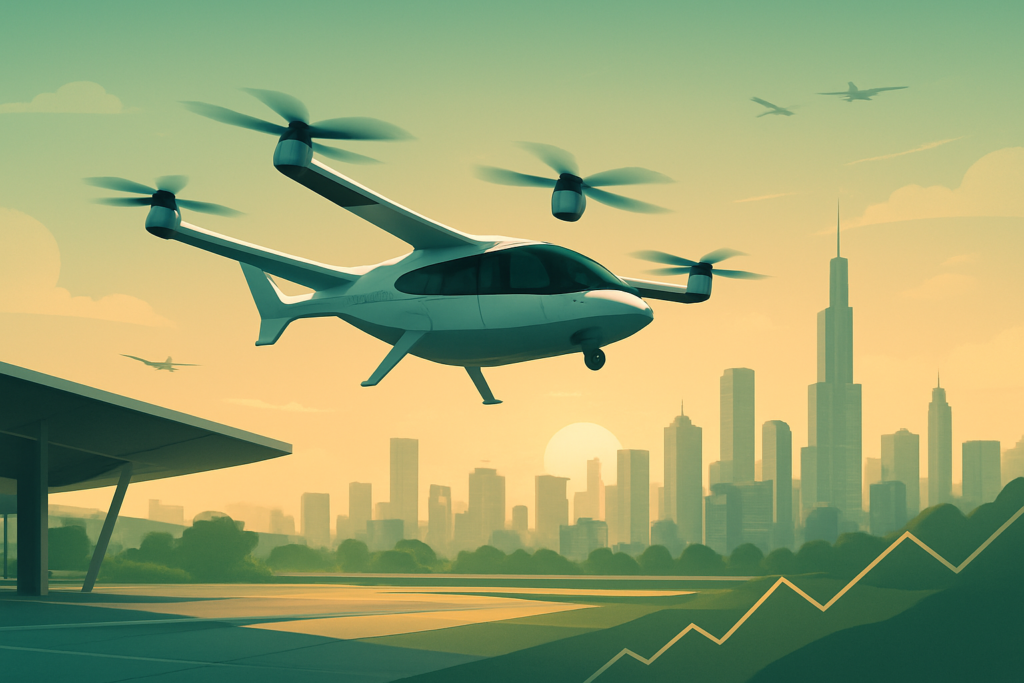
The flagship Midnight aircraft is Archer’s primary asset. It features a proprietary "tilt-rotor" design, using six tilting rotors for both vertical lift and forward propulsion.
- Innovation: Archer’s electric powertrain is designed for "rapid-cycle" charging, allowing the aircraft to recharge in the roughly 10 minutes it takes to swap passengers.
- Manufacturing: The "ARC" facility in Covington, Georgia, which received its certificate of occupancy in late 2024, is capable of producing up to 650 aircraft annually. This facility is the first of its kind in the eVTOL space, utilizing automotive-style assembly lines to drive down unit costs.
Competitive Landscape
The eVTOL sector is crowded, but Archer occupies the "top tier" alongside Joby Aviation (NYSE: JOBY).
- Joby Aviation: Often considered Archer's closest rival, Joby is vertically integrated (making almost all parts in-house) and has a slight lead in total flight hours.
- Vertical Aerospace (NYSE: EVTL) & Eve Holding (NYSE: EVEX): These competitors focus more on the European and South American markets, respectively.
Archer’s competitive edge lies in its partnerships. By aligning with Stellantis for manufacturing and United for demand, Archer has offloaded significant execution risk compared to peers trying to build both the plane and the factory entirely on their own.
Industry and Market Trends
The broader Urban Air Mobility (UAM) market is driven by three macro trends:
- Decarbonization: Governments are mandating net-zero targets for regional transportation, making electric aircraft a necessity rather than a luxury.
- Urbanization: With 70% of the world population expected to live in cities by 2050, ground-based infrastructure cannot keep pace.
- Battery Density: Improvements in lithium-ion and solid-state batteries are finally making the 20–50 mile "hop" commercially viable for electric motors.
Risks and Challenges
Investing in Archer is not without significant peril.
- Certification Risk: While Archer is close to the finish line, any last-minute "non-conforming" issues found during FAA Type Inspection Authorization (TIA) testing could delay commercial launch by years.
- Infrastructure: The "vertiport" network is still in its infancy. Without enough places to land and charge, the utility of Midnight is limited.
- Public Acceptance: Noise concerns and safety perceptions remain hurdles. One high-profile accident in the early stages of commercialization could derail the entire industry.
Opportunities and Catalysts
The near-term catalysts for Archer are plentiful:
- FAA Type Certification: Expected in the second half of 2026, this would be the "holy grail" for the stock.
- UAE Commercial Launch: Archer’s "Launch Edition" program in Abu Dhabi is set to begin revenue-generating flights later this year.
- Military Contracts: Archer’s work with the U.S. Air Force’s AFWERX program (valued at up to $142 million) provides a non-dilutive revenue stream and validates the tech for defense applications.
Investor Sentiment and Analyst Coverage
Wall Street remains cautiously optimistic. As of early 2026, the consensus rating is a "Moderate Buy."
- Bull Case: Analysts at Needham and H.C. Wainwright point to the $6 billion backlog as evidence of massive pent-up demand.
- Bear Case: JPMorgan analysts have raised concerns about the ongoing cash burn and the potential for a "crowded trade" if multiple eVTOL companies certify simultaneously.
Institutional ownership remains high, with BlackRock and ARK Invest holding significant positions, signaling long-term conviction from growth-oriented fund managers.
Regulatory, Policy, and Geopolitical Factors
The regulatory environment is shifting in Archer’s favor. The FAA’s "Innovate28" plan aims to have eVTOLs flying at scale in time for the 2028 Los Angeles Olympics, creating a federal mandate for Archer’s success. Geopolitically, Archer’s aggressive moves into the UAE and India have de-risked its reliance on the U.S. regulatory timeline. By securing design approvals in the Middle East, Archer has created a "regulatory bridge" that allows it to operate even if domestic approvals face political headwinds.
Conclusion
Archer Aviation stands at the precipice of a new era in flight. By March 2026, the company has successfully transitioned from the drawing board to a fully operational, high-volume manufacturing plant in Georgia. While the financial losses are still substantial and the final FAA stamp of approval remains the ultimate gatekeeper, Archer’s strategic alliances with Stellantis and United Airlines provide a level of industrial and commercial support that few of its peers can match.
For investors, Archer represents a "high-beta" bet on the future of transportation. It is a company that has traded the safety of the ground for the vast, uncrowded potential of the skies. The next 12 to 18 months will determine if Archer becomes the "Boeing of the 21st Century" or a cautionary tale of aerospace ambition.
This content is intended for informational purposes only and is not financial advice.