As of March 2, 2026, NVIDIA Corporation (NASDAQ: NVDA) stands not merely as a semiconductor company, but as the foundational utility of the global intelligence economy. While the initial "AI gold rush" of 2023 and 2024 focused on the frantic acquisition of compute power to train Large Language Models (LLMs), 2026 has ushered in the era of "Agentic AI"—where autonomous software agents perform complex, multi-step reasoning tasks across every industry.
NVIDIA remains the primary architect of this transition. Having recently surpassed $215 billion in annual revenue for fiscal year 2026, the company is navigating a pivotal moment. With its Blackwell architecture currently sold out and the next-generation "Vera Rubin" platform looming on the horizon, NVIDIA is attempting to maintain its near-monopoly on high-end AI training and inference while fending off an increasingly sophisticated group of rivals ranging from traditional competitors like AMD to its own largest customers.
Historical Background
Founded in 1993 by Jensen Huang, Chris Malachowsky, and Curtis Priem, NVIDIA’s journey began with a focus on PC graphics and gaming. The company’s 1999 invention of the Graphics Processing Unit (GPU) redefined visual computing. However, the most consequential moment in NVIDIA's history was the 2006 launch of CUDA (Compute Unified Device Architecture). By allowing researchers to use GPUs for general-purpose parallel processing, Huang bet the company on a future where accelerated computing would eventually supersede the traditional CPU-centric model of Moore’s Law.
For over a decade, this bet seemed speculative. It wasn't until the 2012 "AlexNet" breakthrough in deep learning—trained on NVIDIA GPUs—that the world realized the GPU’s potential for artificial intelligence. By the time ChatGPT launched in late 2022, NVIDIA had already spent a decade building the full-stack software and networking ecosystem (notably through the $7 billion acquisition of Mellanox) required to link thousands of GPUs into a single "giant AI supercomputer."
Business Model
NVIDIA’s business model has evolved into a "full-stack" accelerated computing platform. Revenue is primarily generated through four segments:
- Data Center (91.5% of Revenue): The engine of the company. This includes AI accelerators (H100, B200, R100), networking hardware (NVLink, InfiniBand, Spectrum-X), and specialized AI supercomputers like the DGX GH200.
- Gaming: High-performance GPUs (GeForce RTX series) for PC gaming and creative work. While once the primary driver, it is now a stable, secondary cash flow generator.
- Professional Visualization: Workstation GPUs (RTX) and the Omniverse platform, which enables "digital twins" for industrial design and robotics.
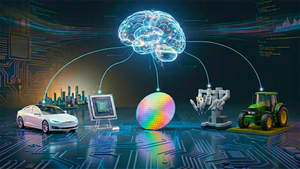
- Automotive and Robotics: Providing the "brains" for autonomous vehicles (DRIVE platform) and humanoid robots (Isaac platform).
Crucially, NVIDIA has successfully pivoted toward a software-recurring revenue model through NVIDIA AI Enterprise and NVIDIA Inference Microservices (NIMs). These tools allow enterprises to deploy and manage AI agents with optimized "one-click" configurations, creating a software "moat" that makes switching to a competitor’s hardware significantly more difficult.
Stock Performance Overview
NVDA has been one of the most prolific wealth-creation engines in market history.
- 10-Year Performance: Over the last decade, the stock has returned over 35,000%, transforming from a mid-cap chip designer into a multi-trillion-dollar titan.
- 5-Year Performance: Driven by the AI inflection point, the stock has risen roughly 1,500%, surviving the 2022 "crypto-winter" correction before beginning its historic 2023 rally.
- 1-Year Performance: The last 12 months (March 2025–March 2026) have seen increased volatility. After hitting an all-time high of approximately $280 (post-split equivalent) in January 2026, the stock has retraced to the $175–$195 range as of early March 2026. This "multiple compression" reflects a transition from speculative growth toward a more mature, though still rapid, valuation.
Financial Performance
For the fiscal year 2026 (ended January 2026), NVIDIA delivered financial results that would have been unimaginable a few years ago:
- Revenue: $215.9 billion, a staggering 65% increase year-over-year.
- Net Income: GAAP net income surged as margins remained historically high, with gross margins hovering around 75–77% due to the premium pricing of the Blackwell B200 systems.
- Data Center Growth: The segment generated $193.7 billion. Networking revenue alone crossed the $11 billion quarterly mark in Q4.
- Cash Flow and Debt: NVIDIA holds a massive cash position, with over $60 billion in cash and equivalents, allowing for aggressive R&D and shareholder returns (buybacks) while maintaining a negligible debt-to-equity ratio.
- Valuation: As of March 2, 2026, NVDA trades at a trailing Price-to-Earnings (P/E) ratio of approximately 48x. While high compared to the S&P 500 average, it is significantly lower than its peak 2023 multiples, suggesting the market is now pricing in more "normal" (though still high) growth rates.
Leadership and Management
Founder and CEO Jensen Huang remains the face of the company and is widely regarded as one of the most effective leaders in the world. His management style—flat organizational structures, "no-status" meetings, and a focus on "first principles"—has allowed NVIDIA to pivot with the speed of a startup despite its massive size.
The leadership team, including CFO Colette Kress, has been lauded for its disciplined capital allocation and conservative yet transparent guidance. The board remains focused on long-term technological dominance, prioritizing R&D spend (which has doubled since 2023) over short-term dividend hikes.
Products, Services, and Innovations
NVIDIA has moved from a two-year product cycle to an annual hardware cadence.
- Blackwell (B200/GB200): The current flagship, delivering a 10x throughput improvement for inference over the previous Hopper generation. It is the primary engine behind the 2025 "Agentic AI" wave.
- Vera Rubin (R100): Unveiled in early 2026, the Rubin platform features the Vera CPU (custom Arm cores) and is the first to utilize HBM4 memory. Scheduled for volume shipments in H2 2026, it promises a 5x leap in inference performance.
- Spectrum-X: NVIDIA’s high-performance Ethernet networking for AI, which has seen massive adoption among enterprises that prefer Ethernet over InfiniBand for their data centers.
Competitive Landscape
NVIDIA currently holds an estimated 90% share of the AI accelerator market, but the competitive landscape is shifting:
- AMD (NASDAQ: AMD): With its MI400 series, AMD is positioning itself as the high-memory, cost-effective alternative. AMD has gained traction with customers looking to reduce their dependence on the "NVIDIA tax," currently holding about 7% of the market.
- Custom Silicon (ASICs): NVIDIA's largest customers—Alphabet (Google), Amazon, and Meta—are increasingly using their own chips (TPUs, Trainium, MTIA) for specific internal workloads. While they still buy NVIDIA GPUs in bulk, their internal chips represent a long-term "cap" on NVIDIA’s total addressable market within hyperscalers.
Industry and Market Trends
The dominant trend in early 2026 is Sovereign AI. Nations like Saudi Arabia, Japan, and France are investing billions in "national AI sovereign clouds" to host their own data and cultural LLMs. This has created a new $30 billion+ revenue stream for NVIDIA that is less sensitive to the spending cycles of US big tech companies.
Additionally, the shift from Training to Inference is now complete. In 2024, most revenue came from training models; today, over 70% of NVIDIA's data center revenue is driven by inference (the actual running of AI applications), which requires massive, distributed compute clusters.
Risks and Challenges
- Supply Chain Concentration: Over 90% of NVIDIA’s chips are manufactured by TSMC in Taiwan. Any disruption in the Taiwan Strait would be catastrophic.
- Purchase Commitments: NVIDIA has nearly $95 billion in non-cancellable purchase commitments with suppliers like TSMC and HBM makers. If demand for AI compute were to suddenly stall, these liabilities could create a severe cash crunch.
- The "Inference Economics" Wall: As AI models become more efficient (using techniques like quantization and MoE), some fear that the need for massive GPU clusters will eventually peak.
Opportunities and Catalysts
- The Rubin Ramp (H2 2026): The launch of the Rubin platform in the second half of 2026 is expected to trigger another massive upgrade cycle.
- Edge AI and Robotics: As AI moves from the data center into robots (humanoids and warehouse bots), NVIDIA’s Jetson and Isaac platforms could represent the next "multi-billion dollar" segments.
- Software Monetization: If NIMs become the "operating system" for AI agents, NVIDIA’s high-margin software revenue could grow from a few billion dollars to tens of billions by 2030.
Investor Sentiment and Analyst Coverage
Wall Street remains overwhelmingly bullish, with an average price target in the $255–$270 range as of March 2026. Institutional ownership remains at record highs, though some "value-oriented" hedge funds have trimmed positions, citing concerns about a potential "cyclical peak" in data center spending. Retail sentiment remains high, bolstered by NVIDIA’s frequent stock splits and Jensen Huang’s "rockstar" status in popular culture.
Regulatory, Policy, and Geopolitical Factors
Geopolitics is NVIDIA’s most significant "tail risk."
- China Export Controls: US regulations have effectively banned the sale of NVIDIA’s most advanced chips to China. NVIDIA has "de-risked" its guidance to assume zero revenue from China, but the loss of this 20-25% historical market remains a structural drag.
- Antitrust Scrutiny: Regulators in the EU and US are closely monitoring NVIDIA’s dominance in the AI software stack (CUDA) to ensure the company isn't using its hardware monopoly to stifle software competition.
Conclusion
As we look across the landscape of 2026, NVIDIA remains the undisputed king of the AI era. The company has successfully transitioned from a hardware component maker to a full-stack AI platform provider. While the "easy money" of the 2023–2024 surge may be in the past, the underlying fundamentals—record revenue, industry-leading margins, and an aggressive innovation roadmap (Rubin)—suggest that NVIDIA will remain the central nervous system of the global technology sector for years to come.
Investors should watch for three key indicators in the coming months: the specific shipment dates for the Rubin platform, the growth rate of software-related recurring revenue, and any shifts in the geopolitical stability of the Taiwan Strait.
This content is intended for informational purposes only and is not financial advice.