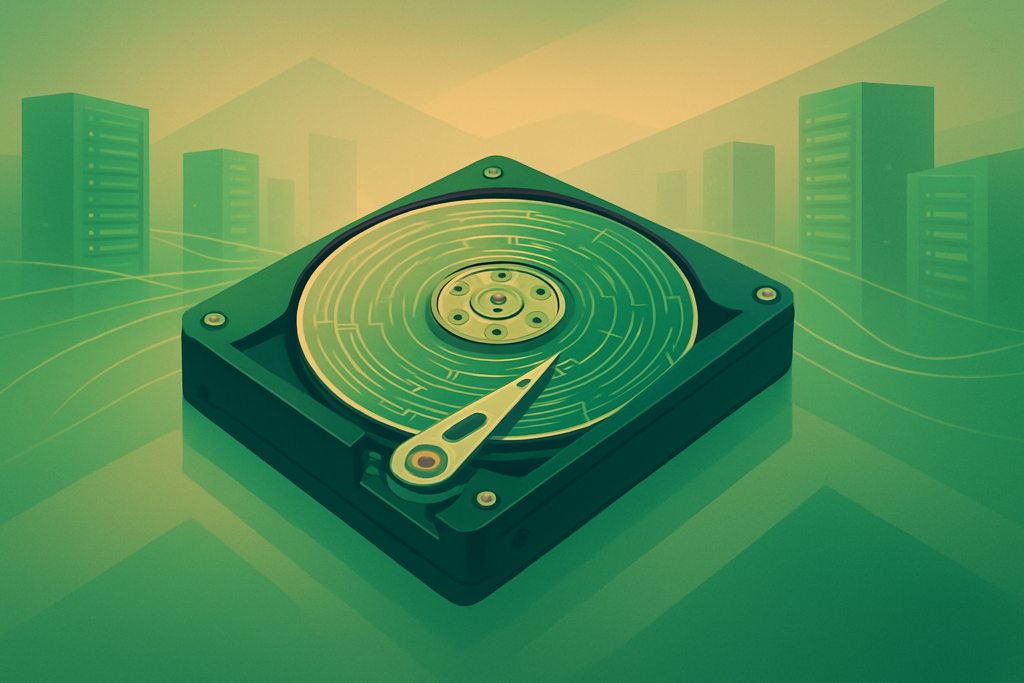
As of March 2, 2026, the global technology landscape has been redefined by the insatiable data requirements of generative artificial intelligence. At the heart of this infrastructure revolution stands Western Digital Corporation (NASDAQ: WDC), a legacy hardware giant that has successfully reinvented itself. Following the historic spin-off of its flash memory business in early 2025, Western Digital has emerged as a streamlined, high-margin "pure-play" leader in the hard disk drive (HDD) market. Once viewed as a cyclical commodity play, WDC is now a central pillar of the AI "storage tiering" strategy, with its production capacity reportedly sold out through the end of the year. This report explores how strategic separation and a pivot toward high-capacity nearline drives have propelled the company to record valuations.
Historical Background
Founded in 1970 as a specialized semiconductor manufacturer, Western Digital has survived and thrived through multiple eras of computing. The company’s journey to its current form was defined by aggressive consolidation, most notably the 2012 acquisition of HGST (Hitachi Global Storage Technologies) and the 2016 acquisition of SanDisk for $19 billion. These moves created a storage behemoth that controlled both the HDD and Flash (NAND) markets.
However, the synergy between these two distinct technologies proved difficult to manage under one roof, often leading to valuation discounts compared to specialized rivals. In late 2023, under pressure from activist investors and shifting market dynamics, the company announced a plan to split. This culminated on February 24, 2025, with the official spin-off of the Flash business into an independent public entity, SanDisk Corporation. Today, the "new" Western Digital focuses exclusively on the magnetic recording technology that remains the bedrock of massive data centers.
Business Model
Western Digital’s business model is now focused on one core objective: providing the highest capacity storage at the lowest total cost of ownership (TCO) for cloud service providers and enterprise data centers.
The company generates revenue primarily through:
- Nearline HDDs: High-capacity drives used by "Hyperscalers" (AWS, Microsoft Azure, Google Cloud) to store the vast amounts of data generated by AI training and inference.
- Enterprise/Cloud Storage: Direct sales to large-scale data center operators.
- Client/Consumer HDD: A shrinking but still profitable segment for retail and legacy PC applications.
By shedding the volatile NAND flash business, Western Digital has shifted from a capital-intensive, price-sensitive memory model to a specialized engineering model where proprietary magnetic recording technologies—like OptiNAND and UltraSMR—provide a significant competitive moat.
Stock Performance Overview
The past year has been nothing short of meteoric for Western Digital shareholders. As of March 2, 2026, the stock has delivered a staggering 1-year return of approximately 481%. This surge was driven by the successful spin-off and a subsequent re-rating by analysts who now view the company as an "AI infrastructure" play rather than a legacy hardware provider.
Over a 5-year horizon, WDC has posted a total return of 332.3%, recovering sharply from the semiconductor downturn of 2022-2023. Looking back a decade, the stock has returned over 937%, largely due to the explosive growth in cloud computing and the recent AI-driven "Sold-out Era" of 2025. With a market capitalization now hovering near $95 billion, WDC has firmly established itself as a mega-cap technology leader.
Financial Performance
Western Digital’s recent financial results reflect its newfound efficiency. In its Q2 FY2026 report (released in early 2026), the company posted:
- Quarterly Revenue: $3.017 billion, a 25% year-over-year increase.
- Gross Margin: A record 46.1%, up significantly from the mid-20s range seen before the spin-off.
- Net Income: $1.8 billion for the quarter, reflecting massive operating leverage.
- Dividends: Signaling a new era of capital return, the Board recently authorized a 25% increase in the quarterly dividend to $0.125 per share.
The company’s balance sheet has also strengthened, with the liquidation of its remaining stake in SanDisk in February 2026 providing a final influx of cash to further reduce debt and fund R&D.
Leadership and Management
The post-split Western Digital is led by CEO Irving Tan, who took the helm in late 2024 as the separation process neared completion. Tan, a veteran of global operations, has been credited with the company’s aggressive focus on manufacturing efficiency and the securing of "Long-Term Agreements" (LTAs) with major cloud providers.
Working alongside him is CFO Kris Sennesael, formerly of Skyworks, whose disciplined approach to margins and capital allocation has been a favorite of Wall Street analysts. The leadership team’s strategy has centered on "predictable scaling," moving away from the "boom-and-bust" cycles that historically plagued the storage industry.
Products, Services, and Innovations
Innovation at Western Digital is currently centered on exceeding the 32TB (terabyte) threshold for single-drive capacity. The company’s competitive edge lies in three key technologies:
- HAMR (Heat-Assisted Magnetic Recording): Using laser-assisted heating to write data at higher densities.
- UltraSMR (Shingled Magnetic Recording): A technique that overlaps data tracks like roof shingles to increase capacity by up to 20% without increasing physical drive size.
- Epoxy-Free Design and Recycling: In response to supply chain risks, WDC has pioneered large-scale recycling of rare earth elements (Neodymium) from retired drives, a major innovation in sustainable hardware manufacturing.
Competitive Landscape
The HDD market is effectively a duopoly between Western Digital and Seagate Technology (NASDAQ: STX). Together, they control over 85% of the global market.
- Western Digital currently holds a slight edge in market share (approx. 45%), particularly in the lucrative "nearline" segment.
- Seagate remains a formidable rival, competing fiercely on HAMR technology rollouts.
- Toshiba maintains a distant third position, focusing primarily on niche enterprise and consumer markets.
In 2026, the competition is less about price and more about allocation. With both WDC and Seagate reporting that their 2026 capacities are fully committed, the competitive battle has shifted to who can scale next-generation 40TB+ drives the fastest.
Industry and Market Trends
The dominant trend of 2026 is the AI Storage Hierarchy. While AI models are trained using high-speed HBM (High-Bandwidth Memory) and SSDs, the "output" and historical data from these models are so massive that they cannot be cost-effectively stored on flash.
Industry data suggests that enterprise SSDs currently cost roughly 16 times more per gigabyte than high-density HDDs. This has led to a massive resurgence in demand for "cold" and "warm" storage, where WDC’s high-capacity drives are the industry standard. This trend has effectively decoupled the HDD market from the broader, more volatile PC and smartphone markets.
Risks and Challenges
Despite the current euphoria, Western Digital faces several significant risks:
- Cyclicality: While the "AI boom" has extended the current cycle, the storage industry has historically been prone to oversupply once new capacity comes online.
- Technological Execution: The transition to HAMR and beyond involves complex physics; any manufacturing yield issues could allow Seagate to gain the upper hand.
- NAND Substitution: While HDDs currently hold a cost advantage, a breakthrough in 3D-NAND layering that significantly lowers SSD costs could threaten long-term HDD demand for "warm" storage.
Opportunities and Catalysts
- Sovereign AI: Governments are increasingly building their own localized AI data centers to ensure data sovereignty, creating a new wave of demand outside the traditional "Big Tech" hyperscalers.
- Long-Term Agreements (LTAs): WDC has successfully transitioned many of its customers to LTAs extending into 2027 and 2028. This provides a level of revenue visibility that the company has never had in its 50-year history.
- Strategic Partnerships: Collaborations with firms like Microsoft for circular economy initiatives (rare earth recycling) could insulate WDC from future Chinese export restrictions.
Investor Sentiment and Analyst Coverage
Wall Street is overwhelmingly bullish on WDC as of March 2026. The consensus "Buy" rating is supported by the company’s massive margin expansion. Hedge funds have significantly increased their positions, viewing WDC as a "purer" and more valuation-attractive way to play the AI infrastructure trade compared to high-multiple chipmakers like NVIDIA.
Retail sentiment is also high, driven by the stock’s inclusion in several high-profile AI and Infrastructure ETFs following the 2025 spin-off.
Regulatory, Policy, and Geopolitical Factors
Geopolitics remain a "wildcard" for Western Digital.
- China: As a major manufacturing hub and market, any further escalation in US-China trade tensions could impact component sourcing. WDC has mitigated this by diversifying its assembly lines into Southeast Asia.
- Antitrust: With the Flash business now separate, the regulatory hurdles that once prevented a merger with Kioxia have shifted. While WDC is no longer the suitor, the industry is closely watching its former sibling (SanDisk) for a potential mega-merger that could further consolidate the global storage landscape.
Conclusion
Western Digital Corporation has successfully navigated one of the most complex corporate transformations in recent memory. By spinning off its Flash business and focusing on the high-capacity HDD needs of the AI era, the company has unlocked significant shareholder value and achieved record profitability.
For investors, WDC represents a unique proposition: a 56-year-old company that has found its second wind as a critical utility for the AI revolution. While the storage industry remains fundamentally cyclical, the current era of "sold-out" capacity and disciplined leadership suggests that Western Digital’s record-breaking run may have more room to go. Investors should keep a close eye on the transition to 40TB+ drives and the stability of the AI infrastructure build-out as the primary indicators of future performance.
This content is intended for informational purposes only and is not financial advice. Today’s date is 3/2/2026.