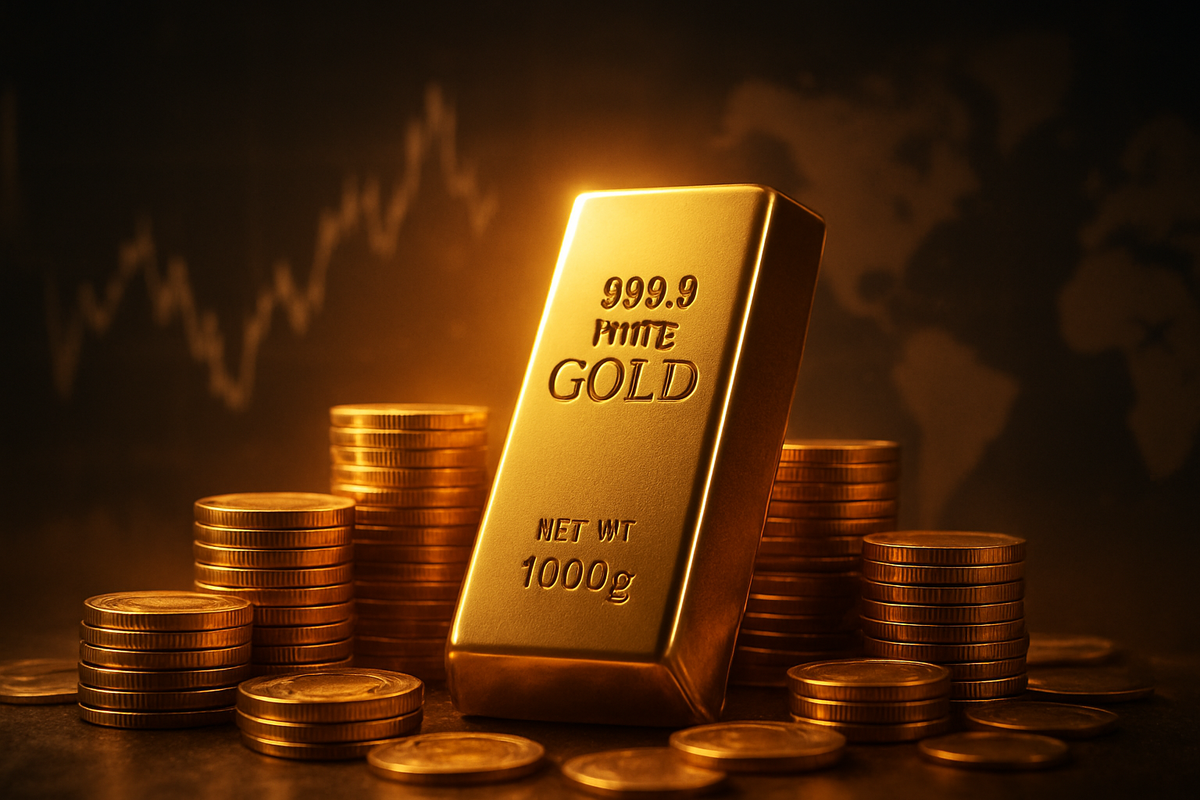
Gold, the timeless safe-haven asset, is currently experiencing a spectacular "Glittering Rally," with prices soaring to near-record highs as of December 12, 2025. This significant surge underscores the precious metal's enduring appeal amidst a landscape characterized by profound global uncertainty, persistent inflationary pressures, and a palpable desire for portfolio stability. The rally, which has seen gold's value climb over 60% year-to-date, is not merely a fleeting market phenomenon but rather a robust indicator of deep-seated investor anxieties and strategic shifts in global financial architecture.
The immediate implications of this sustained ascent are far-reaching, reinforcing gold's critical role in portfolio diversification and signaling potential re-evaluations in monetary policy. For the mining sector, this rally presents a substantial boost, promising improved commodity pricing and renewed access to capital for project development. Crucially, the surge in gold prices also serves as a potent barometer of investor concerns regarding potential US dollar weakness and the long-term sustainability of escalating global government debt burdens, highlighting a structural shift in how central banks and institutional investors are managing their reserves.
The Confluence of Factors Fueling Gold's Ascent
The precious metal's remarkable performance throughout 2025, culminating in spot gold prices hovering around $4,285.78 per ounce by December 12, and having touched an all-time high of $4,381.58 in October, is a testament to a powerful confluence of macroeconomic and geopolitical drivers. This sustained upward trajectory, marking gold's best annual performance since 1979, has been meticulously observed by market participants and analysts alike.
A primary catalyst for this rally has been the pervasive geopolitical tensions gripping the global stage. Ongoing trade policy uncertainties, regional conflicts in areas like Ukraine and the South China Sea, and broader political unrest have significantly amplified gold's traditional role as a safe haven. The World Gold Council estimates that geopolitical risk alone contributed approximately 12 percentage points to gold's impressive year-to-date returns in 2025, as investors sought refuge from an increasingly unpredictable world.
Furthermore, inflationary pressures and concerns over currency debasement have propelled gold's appeal as a hedge. With central banks globally pursuing expansionary monetary policies, anxieties about the erosion of purchasing power and the sustainability of mounting government debt burdens have driven both institutional and retail investors towards the perceived stability of gold. This is compounded by the Federal Reserve's dovish monetary policy throughout 2025, including three interest rate cuts, which has reduced the opportunity cost of holding non-yielding assets like gold, making it more attractive compared to bonds or cash. The anticipation of further rate cuts in 2026 continues to bolster this trend.
Adding to these drivers, a weaker US Dollar has made gold more affordable for international buyers, naturally increasing its dollar-denominated price. Perhaps most significantly, global central banks have been aggressively accumulating gold, diversifying their reserves away from traditional dollar-denominated holdings. This structural shift, alongside strong inflows into gold-backed Exchange Traded Funds (ETFs) from both private and institutional investors, underscores a profound change in global financial architecture. Market sentiment remains overwhelmingly bullish, with major financial institutions like Goldman Sachs (NYSE: GS) and Bank of America (NYSE: BAC) upwardly revising their 2026 forecasts, some projecting prices to reach $4,900-$5,000 per ounce, indicating a widespread belief that this rally is structurally driven rather than merely cyclical.
Companies That Might Win or Lose from the Gold Rally
The sustained and robust rally in gold prices presents a clear dichotomy for public companies: a significant boon for those intricately linked to the precious metal, and potential indirect pressures for others. The most direct beneficiaries are, unequivocally, gold mining companies. Higher gold prices translate directly into increased revenues and expanded profit margins, assuming production costs remain relatively stable. Miners with substantial proven reserves and efficient operations stand to gain the most. Companies like Barrick Gold Corporation (NYSE: GOLD), Newmont Corporation (NYSE: NEM), and Agnico Eagle Mines Limited (NYSE: AEM) are prime examples. These firms will likely see enhanced free cash flow, enabling them to reduce debt, increase dividends, or invest in new exploration and development projects, thereby solidifying their long-term growth prospects. Improved commodity pricing also facilitates easier access to capital markets for these companies, allowing for accelerated project development and expansion.
Beyond direct miners, companies specializing in gold-backed financial products, such as Exchange Traded Funds (ETFs), also stand to win. Funds like the SPDR Gold Shares (NYSEARCA: GLD) and iShares Gold Trust (NYSEARCA: IAU) experience increased investor interest and inflows during gold rallies, leading to higher assets under management and corresponding fee revenues. Precious metals royalty and streaming companies, such as Franco-Nevada Corporation (NYSE: FNV) and Wheaton Precious Metals Corp. (NYSE: WPM), benefit immensely as their revenues are tied to a percentage of production or sales from mining operations, which become more valuable with rising gold prices. Furthermore, manufacturers of gold jewelry and other gold products may see mixed effects; while the value of their inventory increases, sustained high prices could dampen consumer demand for discretionary items, particularly in price-sensitive markets.
Conversely, companies that might indirectly "lose" or face challenges are those whose business models are negatively impacted by the underlying drivers of the gold rally. For instance, financial institutions heavily exposed to fiat currencies or government bonds might experience pressure if the gold rally signifies broader concerns about currency debasement or sovereign debt sustainability. Companies in sectors that thrive on stable economic conditions and low inflation, such as certain consumer discretionary companies or those reliant on robust consumer spending, could face headwinds if the inflationary pressures driving gold's surge lead to reduced purchasing power or economic slowdowns. While not direct "losers" in the traditional sense, their growth trajectories could be less favorable compared to the booming precious metals sector.
Wider Significance and Historical Context
The current glittering rally in gold extends far beyond mere price appreciation; it signifies profound shifts in global financial sentiment and broader industry trends. This event fits squarely into a growing narrative of de-dollarization and reserve diversification among central banks worldwide. The aggressive accumulation of gold by national treasuries, particularly from emerging economies, is a strategic pivot away from an over-reliance on the U.S. dollar, reflecting a desire for greater financial autonomy and a hedge against geopolitical leverage. This trend suggests a more fragmented global financial system emerging, where gold plays an increasingly prominent role as a universally accepted store of value, independent of any single nation's economic policy.
The rally also highlights the persistent and perhaps escalating concerns regarding global inflation and fiscal dominance. Despite efforts by central banks to manage price stability, the market's embrace of gold indicates a deep-seated apprehension about the long-term inflationary consequences of unprecedented government spending and expansive monetary policies. This situation creates potential ripple effects on competitors and partners across various industries. For instance, the robust performance of gold could draw investment away from other commodities or asset classes that typically thrive in periods of strong economic growth, thereby impacting their valuations. Furthermore, the emphasis on gold as a safe haven could indirectly pressure cryptocurrencies, which have also marketed themselves as alternative stores of value, by offering a more historically proven and less volatile option during times of extreme uncertainty.
Historically, gold rallies have often coincided with periods of significant economic or geopolitical stress. The 1970s, marked by oil shocks, high inflation, and geopolitical instability, saw gold achieve its best annual performance. Similarly, the aftermath of the 2008 financial crisis witnessed a substantial surge in gold prices as investors sought safety amidst systemic risk. The current rally shares characteristics with these historical precedents, particularly the blend of geopolitical tensions, inflationary fears, and a flight to safety. However, a distinguishing factor in 2025 is the sheer scale and consistency of central bank buying, suggesting a more structural, rather than purely cyclical, shift in demand. Regulatory or policy implications could emerge if the rally is perceived to be driven by excessive speculation or if it signals uncontrolled inflation, potentially leading to increased scrutiny of gold markets or adjustments in monetary policy stances globally.
What Comes Next: Navigating the Golden Horizon
Looking ahead, the trajectory of gold's glittering rally presents a fascinating array of short-term and long-term possibilities, demanding strategic pivots and adaptations from investors and market participants. In the short term, the prevailing bullish sentiment suggests that gold prices are likely to remain elevated, with many analysts forecasting further upside. However, the market might experience periods of consolidation or minor corrections, particularly if the current "overextended" conditions lead to some profit-taking. Investors should watch for key support and resistance levels, as well as any shifts in the Federal Reserve's rhetoric regarding future interest rate adjustments, which could introduce volatility. The ongoing geopolitical landscape will also be a critical determinant, with any escalation or de-escalation of conflicts directly impacting safe-haven demand.
In the long term, the structural drivers behind gold's rally—namely, central bank diversification, persistent inflation concerns, and a global environment of elevated uncertainty—are expected to provide sustained support for prices. This suggests that gold may not merely revert to pre-rally levels but rather establish a new, higher baseline. Potential strategic pivots for investors include increasing allocations to gold as a core component of a diversified portfolio, recognizing its enhanced role as a hedge against systemic risks and currency debasement. For mining companies, the sustained high prices offer market opportunities for accelerated exploration, merger and acquisition activities, and significant capital expenditure on new projects, provided they can manage cost inflation effectively.
Emerging challenges could include potential regulatory scrutiny if gold's ascent is deemed too rapid or speculative, or if it signals broader financial instability. Furthermore, a significant global economic recovery or a decisive shift towards tighter monetary policies by major central banks could temper gold's appeal. However, the current consensus points towards a continued environment conducive to gold's strength. Potential scenarios include a "gold standard lite" where the metal informally plays a larger role in international settlements, or a continued decoupling of gold from traditional risk assets, allowing it to perform strongly even during periods when equities also see gains, as has been observed recently. Investors should closely monitor central bank policies, inflation data, and geopolitical developments in the coming months, as these will be crucial in shaping gold's future trajectory.
A Comprehensive Wrap-Up: Gold's Enduring Significance
The "Glittering Rally" in gold throughout 2025 is far more than a transient market event; it represents a profound recalibration of value in the face of unprecedented global complexities. The key takeaways from this period are clear: gold's role as the ultimate safe-haven asset has been unequivocally re-emphasized, its power as an inflation hedge has proven vital, and its appeal as a strategic reserve asset for central banks is undergoing a monumental, structural shift. With prices reaching near-record highs and year-to-date gains exceeding 60%, gold has solidified its position as a cornerstone of prudent portfolio management in an era defined by geopolitical volatility, persistent economic uncertainties, and evolving monetary policies.
Moving forward, the market's assessment of gold remains overwhelmingly bullish. Analysts widely anticipate that the underlying drivers—from geopolitical tensions and inflation concerns to dovish monetary policies and aggressive central bank accumulation—will continue to provide robust support for prices. This suggests that the current rally is not merely cyclical but indicative of a deeper, more enduring transformation in how global financial players perceive and utilize the precious metal. The sustained interest from both institutional and retail investors, coupled with the upward revisions of price forecasts by major financial institutions, paints a picture of continued strength for gold in the foreseeable future.
The lasting impact of this rally will likely be a reinforced understanding of gold's intrinsic value and its critical function as a diversifier in turbulent times. It underscores a growing global apprehension about the stability of fiat currencies and the long-term implications of sovereign debt. For investors, the message is to remain attentive: while the outlook is largely positive, potential for short-term volatility exists. Key indicators to watch in the coming months include further developments in global geopolitical hotspots, shifts in central bank interest rate policies, and any new data regarding inflation trends. Gold's sustained shine is a powerful signal—one that every investor should heed as they navigate the complexities of the modern financial landscape.
This content is intended for informational purposes only and is not financial advice