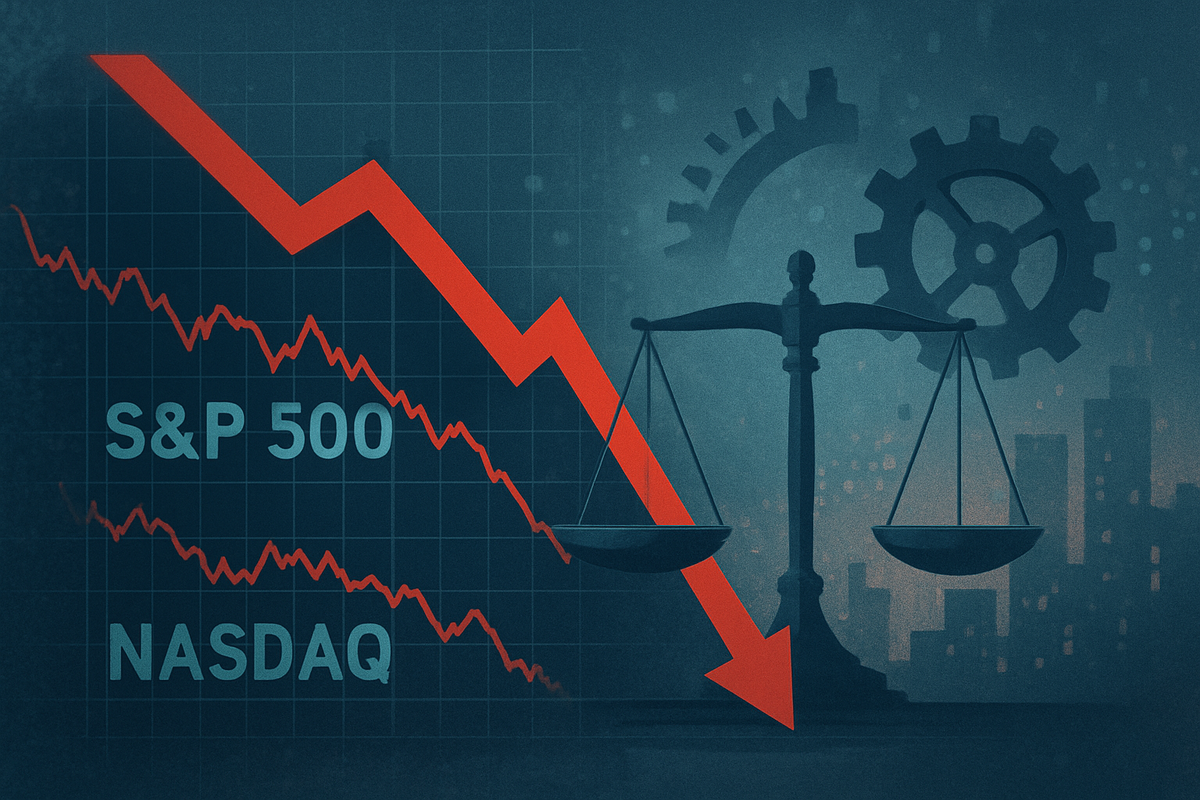
As of December 2025, the financial markets are grappling with a significant shift, as the S&P 500 and Nasdaq Composite indices experience heightened volatility driven by a pronounced tech stock correction and ongoing market rebalancing efforts. This period of adjustment, while a natural part of market cycles, presents immediate challenges for investors and companies alike, particularly those heavily weighted in the technology sector. The recent downturn in tech valuations is prompting a re-evaluation of growth prospects and risk appetites, leading to a broader market recalibration that could redefine investment strategies for the coming year.
The immediate implications of this tech-led slump are widespread, extending beyond the tech giants to impact related industries and investor sentiment. As capital potentially rotates out of high-flying technology stocks, other sectors may see renewed interest, while the overall market grapples with the unwinding of previously exuberant valuations. This scenario underscores the dynamic nature of financial markets and the continuous need for adaptability in the face of evolving economic landscapes and investor behaviors.
The Unfolding Tech Correction and Market Rebalancing
The current market turbulence, particularly affecting the S&P 500 (SPX) and Nasdaq (NDX), stems from a confluence of factors, primarily centered around a tech stock correction. This correction, characterized by a decline of 10% or more from recent peaks in technology shares, is a response to various pressures. Overvaluation concerns, where stock prices outpaced fundamental growth, have been a significant catalyst. Furthermore, an environment of potential economic slowdown, inflationary pressures, and rising interest rates has prompted investors to de-risk their portfolios, leading to a sell-off in growth-oriented tech stocks. The Nasdaq Composite, with its substantial concentration of technology and innovation-driven companies, has naturally borne the brunt of this correction, exhibiting greater volatility compared to the more diversified S&P 500.
The timeline leading up to this moment has seen a period of sustained growth in the technology sector, fueled by innovation, low interest rates, and increased digital adoption. However, signs of potential overheating began to emerge earlier in the year, with some analysts pointing to stretched valuations and a disconnect between share prices and earnings potential. This paved the way for the current correction, which intensified as major institutional investors began to rebalance their portfolios. Market rebalancing, a routine process for funds to maintain target asset allocations, has amplified selling pressure on overweighted tech holdings. Index rebalancing, specifically for major indices like the S&P 500, has also played a role, as funds tracking these indices adjust their holdings to match new compositions, further contributing to significant trading volumes and price movements around these dates.
Key players involved in this scenario include the dominant technology companies, whose valuations significantly influence the overall market indices. Companies like Apple (AAPL), Microsoft (MSFT), Amazon (AMZN), Alphabet (GOOGL), and Meta Platforms (META) are often at the forefront of such movements due to their sheer market capitalization and influence. Fund managers, institutional investors, and retail traders are also critical stakeholders, as their collective buying and selling decisions drive market dynamics. Initial market reactions have seen a clear shift in investor sentiment, with a noticeable rotation of capital out of high-growth tech into more defensive sectors or value-oriented stocks, signaling a more cautious approach to market exposure.
Companies Navigating the Headwinds and Opportunities
In the wake of the tech stock correction and market rebalancing, a clear delineation emerges between companies that may face significant headwinds and those that could potentially find new opportunities. On the losing side, highly-valued technology companies with ambitious growth projections and limited profitability are particularly vulnerable. Companies that rely heavily on discretionary consumer spending or have significant debt burdens may also struggle as economic uncertainties persist. For instance, some software-as-a-service (SaaS) firms (NYSE: CRM), (NASDAQ: ADBE) that traded at extremely high multiples relative to their earnings could see continued pressure on their stock prices as investors prioritize profitability and stable cash flows over pure growth. Similarly, hardware manufacturers (NASDAQ: NVDA), (NASDAQ: AMD) that experienced boom cycles during periods of high demand might see a slowdown if consumer and business spending on new devices or infrastructure tightens. These companies may need to revise their growth forecasts, cut costs, or even scale back expansion plans to adapt to the new market reality, potentially affecting their stock performance and future valuations.
Conversely, the market rebalancing could create opportunities for companies in more defensive sectors or those with strong fundamentals and attractive valuations. Value stocks, often found in industries like utilities (NYSE: DUK), consumer staples (NYSE: PG), and healthcare (NYSE: JNJ), tend to perform better during periods of market uncertainty as investors seek stability and consistent dividends. Furthermore, companies with robust balance sheets, strong free cash flow, and a history of profitability, regardless of their sector, are likely to be viewed favorably. This rotation could also benefit certain industrial (NYSE: CAT) or materials companies (NYSE: BHP) if infrastructure spending or commodity prices remain resilient. These "winners" might see increased investor interest and capital inflows, potentially leading to an uplift in their stock prices as investors seek safer havens and more predictable returns in a volatile market. The event could also spur mergers and acquisitions, as stronger companies look to acquire undervalued assets or struggling competitors.
Wider Significance and Historical Context
This period of tech stock correction and market rebalancing is not an isolated event but rather fits into broader industry trends emphasizing sustainability, profitability, and prudent capital allocation over speculative growth. The past few years have witnessed an unprecedented surge in technology valuations, driven by a combination of innovation, low interest rates, and a "growth at all costs" mentality. The current correction serves as a natural market mechanism to temper these excesses, bringing valuations back to more sustainable levels. This trend suggests a maturation of the tech sector, where investors are increasingly scrutinizing business models, competitive advantages, and the path to profitability, rather than merely revenue growth. The ripple effects extend beyond the immediate tech ecosystem, influencing venture capital funding, initial public offerings (IPOs), and mergers and acquisitions activity across various sectors, as a more cautious investment climate prevails.
The implications for competitors and partners are significant. For direct competitors, a downturn in a leading tech company's stock might offer an opportunity to gain market share if they can demonstrate greater resilience or a clearer path to profitability. For partners, particularly those heavily reliant on the success or spending of major tech players, there could be a period of adjustment as budgets are tightened and strategic priorities shift. Regulatory bodies are also closely observing these market dynamics. Concerns around market concentration, data privacy, and antitrust issues, particularly within the dominant tech platforms, could intensify if the correction highlights vulnerabilities or systemic risks. This might lead to increased scrutiny, potential new regulations, or even further antitrust actions, shaping the future operating environment for technology companies.
Historically, market corrections, especially those led by a specific sector, are not uncommon. Comparisons can be drawn to the dot-com bubble burst of the early 2000s, where an overvaluation of internet companies led to a significant market downturn. While the current scenario differs in many aspects, including the maturity and diversification of today's tech companies, the underlying principle of speculative exuberance followed by a market correction remains a powerful parallel. Such events often lead to a "flight to quality," where investors move towards companies with strong balance sheets and proven business models. Understanding these historical precedents provides valuable context, suggesting that while painful in the short term, such corrections often pave the way for more sustainable and fundamentally sound market growth in the long run.
What Comes Next: Navigating the Evolving Landscape
Looking ahead, the short-term outlook for the S&P 500 and Nasdaq suggests continued volatility as the market fully digests the tech stock correction and the implications of ongoing rebalancing. Investors should anticipate further price discovery in the technology sector, with potential for both continued downward pressure on overvalued assets and opportunistic buying in fundamentally strong companies that have been unfairly penalized. In the long term, this period of adjustment is likely to foster a healthier, more sustainable market environment. Companies that can demonstrate adaptability, innovation, and a clear path to profitability will be best positioned for future growth. We may see a strategic pivot among tech companies towards more disciplined spending, focusing on core competencies, and exploring new revenue streams that are less reliant on aggressive growth at all costs.
Emerging market opportunities are likely to surface in sectors that offer stability, value, or are poised for growth independent of the tech sector's immediate fortunes. This could include renewed interest in renewable energy, biotechnology, or even traditional industrials that are undergoing digital transformations. Furthermore, the correction could create attractive entry points for long-term investors looking to acquire high-quality tech stocks at more reasonable valuations. Challenges will undoubtedly persist, including navigating potential economic headwinds, managing investor sentiment, and adapting to an evolving regulatory landscape. Companies might need to consider strategic adaptations such as divesting non-core assets, optimizing supply chains, or forging new partnerships to enhance resilience.
Several potential scenarios and outcomes could unfold. One scenario involves a relatively swift "V-shaped" recovery, where the market quickly rebounds after the initial correction, driven by strong underlying economic fundamentals and renewed investor confidence. Another possibility is a more prolonged "U-shaped" recovery, characterized by an extended period of sideways trading and gradual gains as the market slowly rebuilds. A less optimistic "L-shaped" scenario, though less likely given the overall strength of many underlying businesses, would involve a sustained downturn. The most probable outcome lies somewhere between a V and a U, with sectors and individual companies experiencing varied recovery timelines based on their specific fundamentals and market positioning. Investors will need to remain agile, focusing on diversified portfolios and a long-term investment horizon.
Comprehensive Wrap-up and Investor Outlook
The current tech stock correction and market rebalancing represent a critical juncture for the S&P 500 and Nasdaq, marking a shift from an era of exuberant growth to one prioritizing fundamental strength and sustainable profitability. The key takeaways from this event underscore the cyclical nature of markets, the importance of valuation discipline, and the ongoing rotation of capital as investors adapt to new economic realities. While the immediate impact has brought increased volatility and pressure on growth-oriented tech stocks, it also serves as a necessary recalibration, weeding out weaker business models and rewarding those with robust financial health and clear competitive advantages.
Moving forward, the market is likely to exhibit a more discerning approach, with greater scrutiny placed on earnings, cash flow, and realistic growth projections. This environment favors companies that can demonstrate resilience, efficient capital management, and a clear value proposition. Investors should prepare for a potentially more fragmented market, where broad-based sector gains may be less common, and stock-picking based on rigorous fundamental analysis becomes paramount. The era of simply buying "big tech" and expecting consistent outperformance may be evolving, giving way to a more nuanced investment landscape.
Final thoughts on the significance and lasting impact suggest that this correction, while challenging, is ultimately a healthy development for the long-term integrity of the market. It encourages a more rational allocation of capital and fosters an environment where innovation is paired with profitability. What investors should watch for in the coming months includes corporate earnings reports, particularly from major tech players, for signs of stabilization or further weakness. Monitoring inflation data, interest rate policies from central banks, and broader economic indicators will also be crucial in gauging the pace and direction of market recovery. Furthermore, observing any new regulatory developments concerning the technology sector could provide insights into future operating conditions and potential impacts on corporate strategies.
This content is intended for informational purposes only and is not financial advice