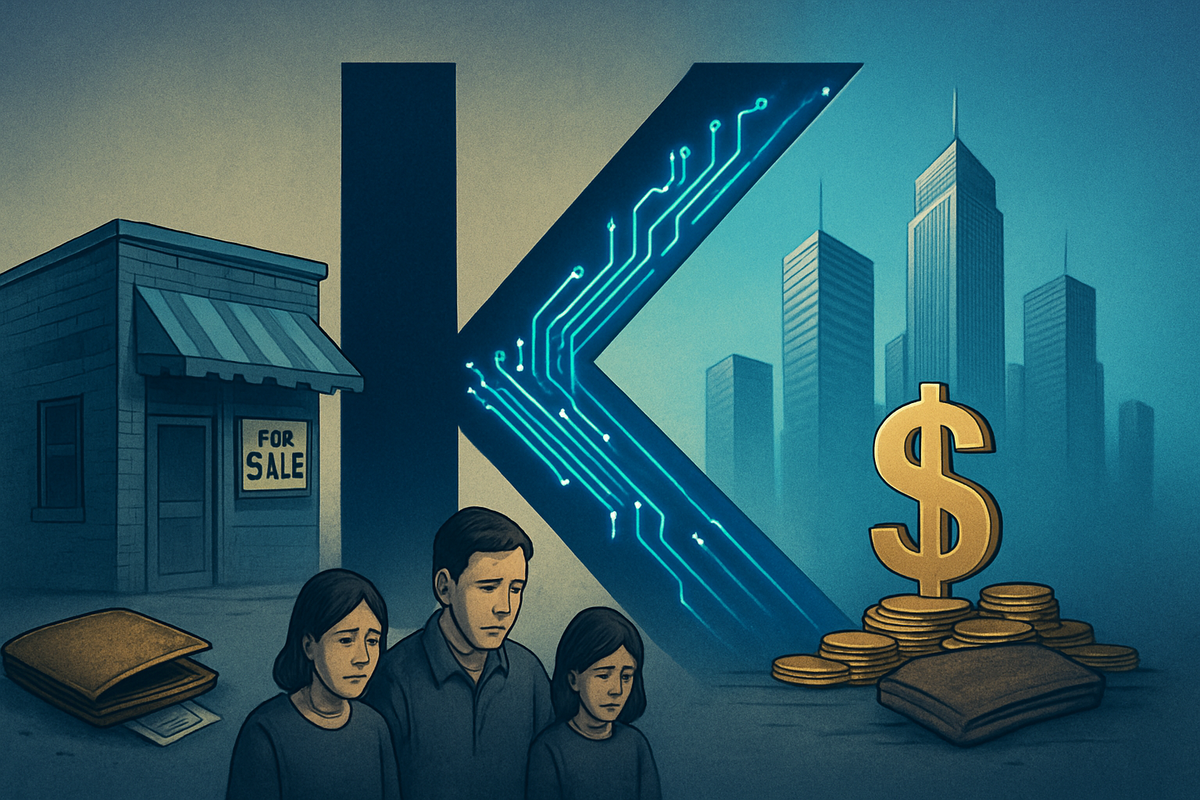
The United States economy is increasingly characterized by a "K"-shaped recovery, a phenomenon where different segments of the economy and society recover at vastly different rates following a downturn. This uneven trajectory is starkly reflected in the U.S. stock market, creating a dichotomy where certain sectors and large corporations are experiencing robust growth, while others, particularly small businesses and industries catering to middle- and lower-income households, continue to struggle or stagnate. This divergence not only signals a potentially fragmented economic future but also presents a complex landscape for investors seeking to navigate the market's varied performance.
The immediate implications of this K-shaped market are profound, exacerbating wealth inequality and raising questions about the sustainability of overall economic growth. While headline stock market indexes might suggest a booming economy, a deeper dive reveals that much of this strength is concentrated in a select few, predominantly technology-driven, companies. This creates a scenario where the rising tide is not lifting all boats, leading to significant challenges for a substantial portion of the population and specific industry sectors.
A Tale of Two Recoveries: Unpacking the K-Shape
The concept of a "K"-shaped recovery vividly illustrates the current economic environment. On one arm of the "K," a powerful surge in specific sectors, particularly those leveraging technological advancements like Artificial Intelligence (AI), has propelled market capitalization and corporate profits to new heights. The "Magnificent 7" tech giants—Meta (NASDAQ: META), Apple (NASDAQ: AAPL), Amazon (NASDAQ: AMZN), Alphabet (NASDAQ: GOOGL), Microsoft (NASDAQ: MSFT), NVIDIA (NASDAQ: NVDA), and Tesla (NASDAQ: TSLA)—stand as prime examples, their shares surging and their influence on major indices becoming increasingly dominant. These companies, often with substantial R&D budgets and global reach, have capitalized on shifting consumer behaviors and the accelerating digital transformation.
This upward trajectory is not limited to tech alone; luxury services and experiential consumption are also thriving, benefiting from the sustained demand and robust spending power of higher-income households. Advanced manufacturing, defense, and industries focused on energy independence further contribute to this upper arm, aligning with broader macroeconomic tailwinds and strategic national priorities. The timeline leading to this moment has seen a rapid acceleration post-pandemic, as remote work, e-commerce, and digital services became entrenched, providing a fertile ground for these sectors to flourish.
Conversely, the "lower arm" of the "K" represents a segment of the economy grappling with persistent headwinds. Service-based industries such as restaurants, travel, and hospitality, while showing signs of recovery, still face challenges related to labor shortages, evolving consumer habits, and increased operating costs. Traditional consumer staples and discretionary retailers are struggling as middle- and lower-income households contend with stagnant wage growth, persistent inflation in essential goods like rent and groceries, and a tightening of discretionary spending.
Small businesses and labor-intensive industries, which often lack the capital and technological infrastructure of their larger counterparts, are particularly vulnerable. They face higher financing costs, increased unit labor costs, and a more constrained demand environment. The initial market reactions have been a continuous divergence: record highs for the major tech-heavy indices contrasted with more modest gains or even declines for broader market segments, highlighting the growing disparity in economic performance and investor sentiment across the board.
The Market's Divide: Winners and Losers in the K-Shape
The K-shaped recovery has created a clear delineation of winners and losers in the corporate landscape, fundamentally altering business models, revenue streams, and market positions. At the apex of the "K" are the technology behemoths and companies catering to affluent consumers, who have not only weathered recent economic turbulence but have often thrived. Companies like NVIDIA (NASDAQ: NVDA) and Microsoft (NASDAQ: MSFT) exemplify the tech winners, benefiting immensely from the insatiable demand for Artificial Intelligence infrastructure, cloud computing, and enterprise software. Their robust balance sheets and ability to innovate rapidly have allowed them to expand their ecosystems, acquire smaller players, and solidify their market dominance, driving significant revenue growth and increasing their pricing power.
Beyond core technology, large corporations with diversified operations and strong financial health have also demonstrated resilience. Their scale enables them to absorb increased costs, adapt supply chains more effectively, and leverage economies of scale. Furthermore, companies serving higher-income demographics, such as luxury brands like LVMH (EPA: MC) or premium service providers like Marriott International (NASDAQ: MAR) and Delta Air Lines (NYSE: DAL), continue to see sustained demand. Affluent consumers, whose wealth is often tied to appreciating stock and real estate markets, have maintained or even increased their spending on high-end goods and experiences, providing a stable revenue base for these businesses. This allows these companies to maintain strong brand loyalty and implement price increases without significant loss of volume.
Conversely, the downward stroke of the "K" is populated by businesses heavily reliant on physical presence, lower-income consumer spending, or traditional models that struggled to adapt. The service industry, encompassing restaurants, hospitality, and entertainment venues, has been disproportionately affected. Many, particularly small and medium-sized enterprises (SMEs) in these sectors, faced massive revenue drops due prolonged closures and shifts in consumer behavior. Companies like Krispy Kreme (NASDAQ: DNUT), which relies heavily on lower-income consumers, have struggled as their target demographic faces stagnant wages and increased financial strain, leading to reduced discretionary spending.
Brick-and-mortar retailers, especially those selling non-essential goods, have also faced intense pressure from e-commerce giants and reduced foot traffic, leading to declining sales and store closures. SMEs across various sectors, often lacking the digital infrastructure, financial reserves, and access to capital of larger firms, have found it difficult to pivot or compete effectively. The challenges for these "losing" companies include high fixed costs, limited pricing power, vulnerability to supply chain disruptions, and a shrinking customer base with constrained disposable income. This stark divergence underscores how the K-shaped recovery is reshaping competitive landscapes and accelerating structural changes within the economy.
Broader Implications: A Shifting Economic Paradigm
The K-shaped recovery is more than just a temporary market anomaly; it signifies a profound and potentially enduring shift in the economic paradigm, aligning with and amplifying several broader industry trends. Foremost among these is the accelerated digital transformation that has swept across sectors. Industries capable of leveraging technology, embracing remote work, and offering digital solutions—such as technology, e-commerce, and finance—have flourished, further solidifying their positions. This trend is particularly evident in the "Magnificent 7" tech giants, whose growth is heavily driven by massive investments in Artificial Intelligence (AI) and equity market appreciation, creating a self-reinforcing cycle of wealth concentration. Conversely, traditional sectors, particularly those reliant on physical presence and outdated business models, face immense pressure to adapt or risk further decline.
The ripple effects of this bifurcated recovery are far-reaching, impacting competitors, partners, and the very structure of market competition. The robust growth of companies in the "upper K" often leads to increased market concentration, as dominant players acquire struggling competitors or expand their market share through sheer financial might and technological superiority. This can stifle innovation from smaller entities and create formidable barriers to entry for new businesses. Furthermore, global supply chains are experiencing re-evaluation; a slowdown in consumer spending among lower and middle-income households in the U.S. can directly impact international partners and suppliers reliant on American demand, potentially forcing a restructuring of complex global networks. This leads to a divergent fortune among business partners, where those tied to thriving sectors flourish, while those linked to struggling industries face continued contraction.
From a regulatory and policy standpoint, the K-shaped recovery presents a formidable challenge. Traditional, broad-brush stimulus measures, while effective in some scenarios, may inadvertently exacerbate inequalities by disproportionately benefiting already thriving segments without adequately addressing the woes of the lagging ones. Policymakers are grappling with the need for highly targeted interventions, such as selective tax breaks or incentives for struggling industries, while also confronting the wider implications of wealth and income inequality. Concerns are mounting that an economy primarily driven by the wealthiest segments is not sustainable, and if unemployment and financial struggles worsen for middle- and lower-income Americans, their reduced spending could trigger a broader economic downturn, potentially impacting even the "Magnificent 7."
While the term "K-shaped recovery" gained prominence recently, historical precedents reveal similar patterns of unequal economic outcomes following recessions. The "Jobless Recovery" following the 1990-91 recession, for instance, saw GDP growth coupled with continued job losses in certain sectors, highlighting an earlier form of uneven recovery. The economic concept of "creative destruction," where new technologies and industries displace older ones during downturns, also provides a theoretical framework for understanding how such divergences naturally occur. The wider significance lies in the K-shape's capacity to reshape industry landscapes, create uneven competitive dynamics, demand targeted policy responses, and potentially sow seeds of social and political instability if left unaddressed.
Navigating the Future: What Comes Next
The trajectory of the K-shaped recovery points to a future defined by continued divergence, with significant short-term and long-term implications for the economy and its participants. In the immediate future, the momentum driving the "upper K" — propelled by robust investments in Artificial Intelligence, technological innovation, and sustained spending by higher-income households — is likely to persist. This will continue to buoy equity markets, particularly for leading tech firms. However, the "lower K" will likely endure its struggles, with lower and middle-income households facing ongoing challenges from inflation, stagnant real wages, and rising household debt, leading to reduced consumer spending in sectors reliant on broad-based demand. The labor market, while showing overall normalization, may experience significant job cuts in specific industries as companies restructure and embrace AI-driven automation.
Looking further ahead, the K-shaped recovery threatens to solidify structural economic inequalities. We can anticipate a widening wealth gap, persistent long-term unemployment in certain service-based industries, and the accelerated adoption of technology reshaping the nature of work, potentially displacing lower-skilled jobs while creating new demands for specialized skills. For businesses, strategic pivots are paramount: prioritizing digital transformation, adopting targeted market strategies for diverse consumer segments, and aligning with secular growth themes like industrial electrification and an aging population will be crucial. Investors, too, must adapt by diversifying portfolios, focusing on quality growth stocks (especially in AI), and considering defensive assets and emerging markets to mitigate risk and capture opportunities.
Potential scenarios range from a persistent divergence, where the K-shape becomes a more permanent feature of the economy, to a less likely "broader catch-up" where policy interventions or widespread technological benefits eventually stimulate broader growth. However, a significant risk remains: a "top of the K" collapse, where market shocks or weakening labor conditions among the affluent cause a broader economic downturn, potentially impacting even the resilient sectors. Navigating this complex landscape demands vigilance and adaptability, as the market presents both significant opportunities in high-growth areas and substantial challenges for those unable to adapt to the evolving economic structure.
The Enduring K: A Fractured Future and What Investors Must Watch
The "K"-shaped economic recovery is not merely a temporary phase but a defining feature of the contemporary financial landscape, underscoring a profound and persistent divergence in economic fortunes. Key takeaways from this phenomenon highlight a bifurcated reality: one segment, propelled by technological innovation, AI investments, and the spending power of affluent consumers, experiences robust growth. The other, encompassing service-based industries, small businesses, and lower-income households, grapples with stagnation, rising debt, and affordability pressures. This structural shift exacerbates wealth inequality, reinforces corporate monopolies, and fundamentally alters the nature of work, driven by accelerated automation and digitalization.
Moving forward, the market will likely remain complex and deeply divided. The "three A-pillars" – affluent consumers, AI-fueled investment, and asset price gains – will continue to drive economic expansion, particularly for large-cap tech companies. However, this concentrated growth creates vulnerabilities; any weakness in these pillars could trigger broader economic consequences. Sticky inflation, uneven labor market conditions, and rising household debt, particularly for those in the "lower K," will continue to pose significant challenges. The lasting impact of this K-shape is a societal fragmentation and long-term inequality that will demand innovative policy responses and strategic adaptations from businesses and individuals alike.
For investors, navigating this fractured future requires a highly strategic and discerning approach. The coming months will reward selectivity and a focus on quality over broad market exposure. Investors should prioritize companies with strong fundamentals, robust earnings, and pricing power, particularly those benefiting from AI innovation across various sectors beyond just mega-cap tech, such as financials, healthcare, and industrials. Strategic diversification across regions and asset classes, including defensive assets like real estate anchored by necessity retail and gold, will be crucial for mitigating risk. Finally, vigilance is paramount: closely monitor key economic indicators like consumer spending patterns, delinquency rates, and unemployment figures among vulnerable demographics, alongside policy developments that could influence the K-shape's trajectory. Success will hinge on understanding these divergent paths and adopting an agile strategy to adapt to an inherently fractured economic future.
This content is intended for informational purposes only and is not financial advice