NEW YORK — In a holiday-shortened session that felt more like a victory lap than a typical trading day, the U.S. stock market surged to unprecedented heights this Christmas Eve. The S&P 500 and the Dow Jones Industrial Average both notched all-time closing highs on Wednesday, December 24, 2025, capping off a year defined by the relentless expansion of the artificial intelligence "supercycle" and a significant shift in federal fiscal policy. As traders headed home for the holiday at 1:00 PM ET, the mood on the floor of the New York Stock Exchange was undeniably electric, fueled by a rare "Goldilocks" combination of cooling inflation and a resilient, albeit evolving, labor market.
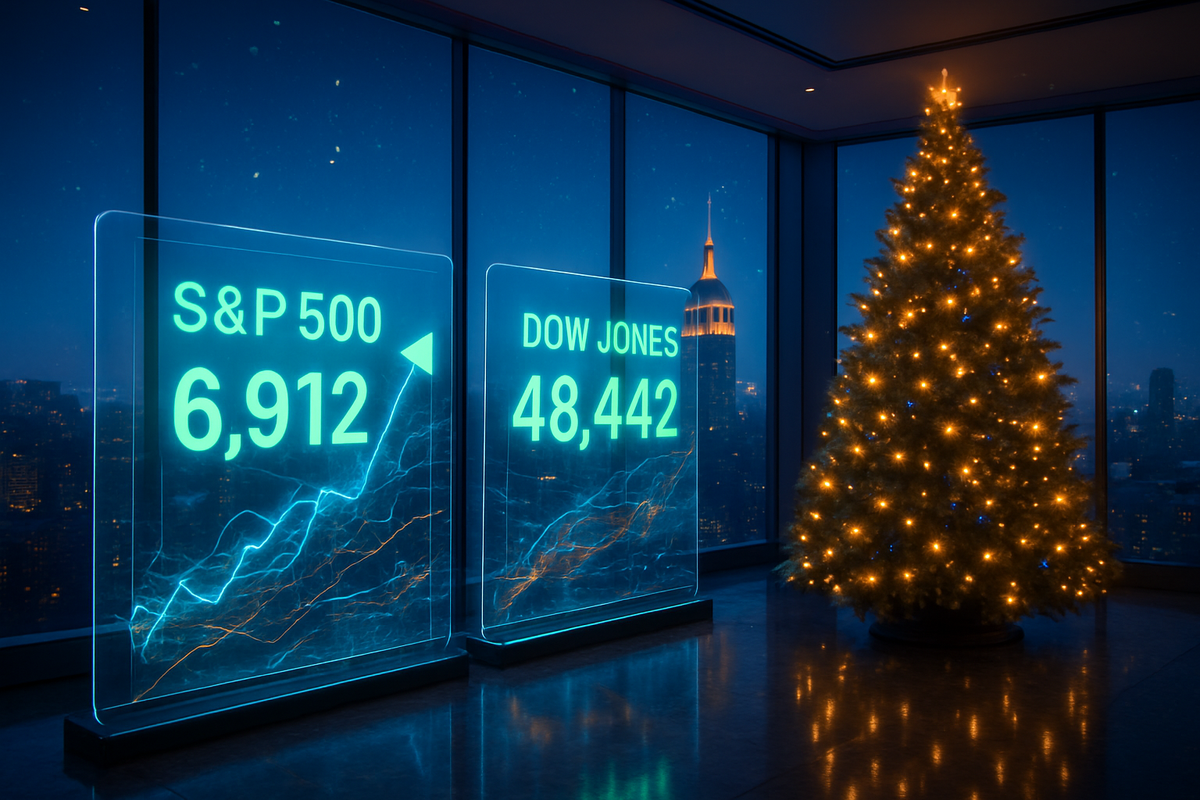
The S&P 500 closed the day at approximately 6,912, marking a staggering 17% gain for the year 2025. Meanwhile, the Dow Jones Industrial Average (DJIA) finished at 48,442, a testament to the broadening of the market rally beyond the tech giants into industrials and financials. This record-breaking performance comes on the heels of the Federal Reserve’s decision earlier this month to trim the benchmark interest rate to a range of 3.5%–3.75%, providing the liquidity injection that many analysts believe will carry the current bull market well into 2026.
A Year of Policy Triumphs and Technological Transformation
The path to today’s record highs was paved by a series of pivotal events throughout 2025. The most significant catalyst arrived on July 4, 2025, with the signing of the "One Big Beautiful Bill Act" (OBBBA). This sweeping legislation permanently extended the 2017 tax cuts and introduced new deductions for domestic manufacturing, providing a massive tailwind for corporate earnings. When combined with the Federal Reserve’s aggressive pivot from its "higher for longer" stance in 2024 to a series of rate cuts in 2025, the macro environment became a fertile ground for equity growth.
Throughout the autumn, investors kept a close eye on the labor market, which showed signs of "multidimensional polarization." While the unemployment rate ticked up to 4.6% in November 2025, the data revealed a "low hiring, low firing" environment. Productivity gains driven by generative AI allowed firms to expand their output without the traditional need for massive headcount increases. This shift in the labor-capital dynamic has been a primary driver of the S&P 500’s margin expansion this year, as companies like Microsoft Corp. (NASDAQ: MSFT) and Nvidia Corp. (NASDAQ: NVDA) successfully transitioned from AI experimentation to full-scale enterprise monetization.
Initial market reactions to today's session were overwhelmingly positive, with the "Santa Claus Rally" appearing in full force. Volume was light, as is typical for a Christmas Eve session, but the buying pressure was consistent across sectors. Traders noted that the 2025 rally has been remarkably durable, surviving multiple "tariff scares" and geopolitical tensions, largely because the underlying earnings power of the U.S. corporate sector remained intact.
The Winners and Losers of the 2025 Rally
The 2025 market was a tale of two economies: those who embraced the AI infrastructure build-out and those who fell victim to shifting trade policies. Nvidia Corp. (NASDAQ: NVDA) emerged as the undisputed titan of the year, becoming the first company in history to surpass a $5 trillion market capitalization in October. Its shares have risen nearly 40% year-to-date, driven by insatiable demand for its Blackwell and H200 chips. Joining the winner's circle was Caterpillar Inc. (NYSE: CAT), which saw its stock surge over 60% this year. Caterpillar’s growth was not fueled by its traditional construction business, but by its Energy & Transportation segment, which became the primary supplier of backup power and turbines for the massive AI data centers sprouting across the country.
In the financial sector, Goldman Sachs Group Inc. (NYSE: GS) reclaimed its crown, with shares up 61% in 2025. The bank benefited from a massive resurgence in M&A activity and the successful integration of its own proprietary AI risk platforms. Similarly, JPMorgan Chase & Co. (NYSE: JPM) posted record equities trading revenue, gaining over 30% on the year. Walmart Inc. (NYSE: WMT) also stood out as a winner, rising 23% by leveraging its massive scale and AI-driven inventory systems to create a "tariff moat" that protected its margins from the 2025 trade levies.
Conversely, the year was punishing for retailers heavily reliant on discretionary imports. Target Corp. (NYSE: TGT) saw its shares plunge more than 30% as it struggled to absorb the 25% levies on imports from Mexico and Canada introduced early in the year. Nike Inc. (NYSE: NKE) also faced significant headwinds, reporting a $1 billion drag from tariff costs that forced unpopular price hikes. In the education sector, Chegg Inc. (NYSE: CHGG) faced an existential crisis, with its stock plummeting as students abandoned human tutoring services in favor of free AI-driven alternatives, highlighting the "displacement" risk that continues to haunt certain industries.
Historical Precedents and the AI "Supercycle"
The current market environment draws comparisons to the late 1990s, but with a critical difference: the current "AI Supercycle" is backed by massive capital expenditures that are already yielding tangible productivity gains. In 2025, capital spending by tech "hyperscalers" reached an estimated $500 billion. This investment has created a ripple effect across the utilities and logistics sectors, as the demand for power and physical infrastructure to support AI models has skyrocketed. This trend fits into a broader historical pattern where foundational technologies—like the steam engine or the internet—initially drive a speculative bubble before settling into a long-term period of structural economic growth.
From a regulatory standpoint, the OBBBA has fundamentally altered the landscape for domestic manufacturing, encouraging a "reshoring" trend that has benefited companies like General Electric Vernova (NYSE: GEV). However, the aggressive trade policies that defined 2025 have also introduced a level of "tariff inflation" that the Federal Reserve is still struggling to contain. While GDP growth reached a surprising 4.3% in the third quarter of 2025, the disconnect between high market levels and low consumer sentiment—often referred to as "vibepression"—suggests that the benefits of the current boom are not being felt equally across the population.
The Road to 2026: Opportunities and Risks
As we look toward 2026, Wall Street analysts are maintaining a posture of "cautious optimism." Major firms like Goldman Sachs and Morgan Stanley are projecting the S&P 500 could reach between 7,500 and 8,000 by the end of next year. The theme for 2026 is expected to be "The Year of the Risk Reboot," where the market shifts its focus from macroeconomic anxiety over interest rates to the micro-fundamentals of company-specific earnings. Investors will be looking for "ROI on AI"—tangible proof that the billions spent on infrastructure are translating into bottom-line profits for non-tech companies.
However, several challenges loom on the horizon. The 2026 midterm elections are expected to bring increased volatility, and the "tariff inflation" of 2025 could lead to a "cyclical weakening" of the labor market. JPMorgan has estimated a 35% probability of a recession in late 2026 if consumer spending finally buckles under the weight of higher goods prices. Strategic pivots will be required for companies like Salesforce Inc. (NYSE: CRM), which is currently navigating a complex transition as its AI "Agentforce" platform begins to cannibalize its traditional per-seat licensing revenue model.
A Resilient Market in a Changing World
The record-breaking close on this Christmas Eve serves as a powerful reminder of the U.S. economy's ability to reinvent itself. The transition from a focus on inflation and interest rates to a focus on AI-driven productivity has created a new paradigm for investors. The key takeaway from 2025 is that scale and technological integration have become the ultimate competitive advantages. Companies that can navigate the complexities of new trade barriers while simultaneously harnessing the power of AI are the ones leading the charge into the new year.
As the market moves into 2026, investors should keep a close watch on corporate earnings reports in January for signs of AI monetization and the impact of the OBBBA tax benefits. While the "Santa Claus Rally" has provided a festive end to the year, the lasting impact of 2025 will be measured by how effectively the U.S. economy can balance its technological ambitions with the realities of a shifting global trade landscape. For now, Wall Street can enjoy the holiday with the knowledge that the bulls remain firmly in control.
This content is intended for informational purposes only and is not financial advice.