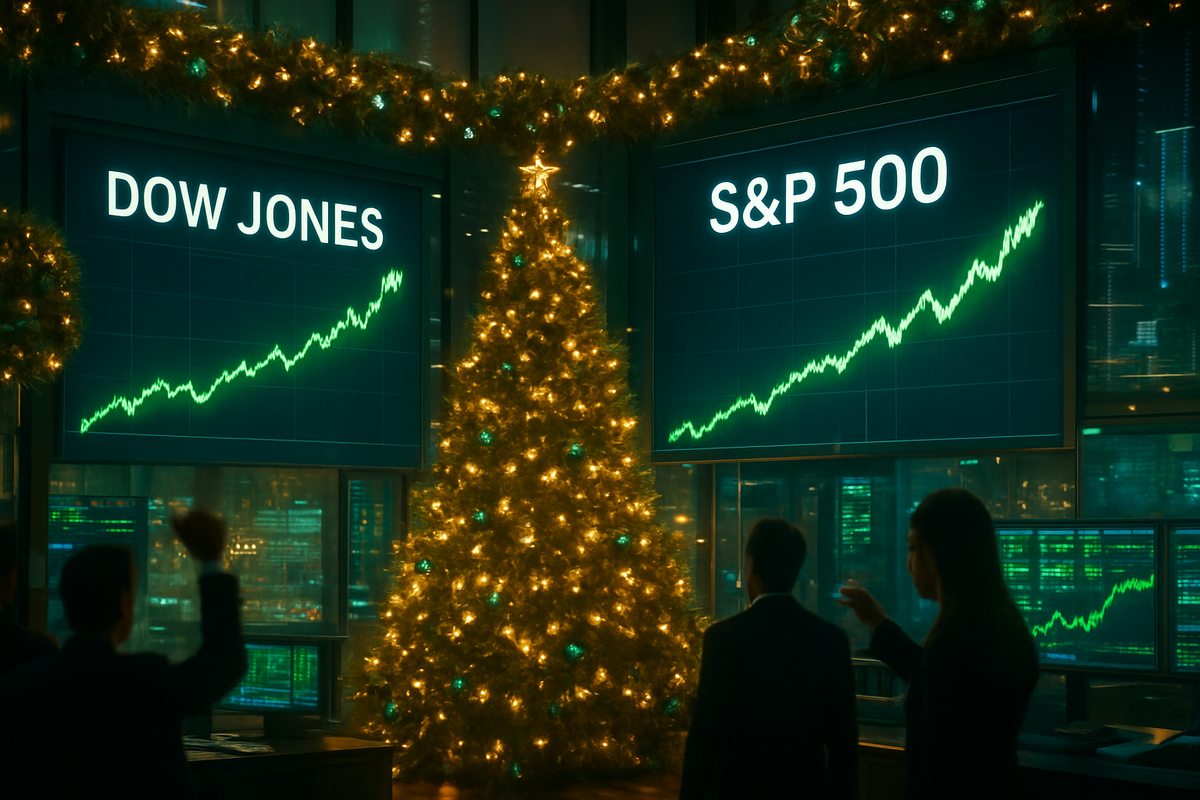
As the world pauses for the Christmas holiday, investors in the United States are celebrating a historic milestone in the financial markets. On the final full trading day before the break, both the Dow Jones Industrial Average and the S&P 500 reached unprecedented record highs, capping off a resilient 2025 that defied early-year skepticism and geopolitical turbulence. The surge reflects a profound shift in market sentiment, transitioning from a period of high-interest-rate anxiety to a robust "soft landing" narrative underpinned by a maturing artificial intelligence sector.
The immediate implications of this rally are significant for the 2026 outlook. With the S&P 500 closing at a staggering 6,910 and the Dow Jones Industrial Average hovering near 48,730, the "Santa Claus Rally" has provided a powerful tailwind for 401(k) balances and institutional portfolios alike. This year-end momentum suggests that despite "sticky" inflation and global trade adjustments, the appetite for U.S. equities remains insatiable, setting a high bar for the coming year.
A Resilient Path to the Summit
The journey to these record levels was anything but linear. The market faced a severe "Tariff Shock" in April 2025, which briefly wiped trillions off global valuations and stoked fears of a renewed inflationary spiral. However, as trade negotiations stabilized and selective pauses were implemented by the summer, the focus shifted back to corporate earnings and the Federal Reserve’s long-awaited policy pivot. The Fed, led by Jerome Powell, successfully navigated a cooling labor market—which saw unemployment tick up to 4.4% in September—to justify three consecutive 25-basis-point rate cuts in the latter half of the year.
The timeline of this year-end surge was ignited in late October, following a stellar third-quarter earnings season where major tech and industrial firms demonstrated they could maintain margins despite higher costs. By mid-December, the momentum became undeniable. The S&P 500’s 17.5% gain for the year significantly outperformed the conservative 6,000–6,500 targets set by major investment banks last January. Stakeholders, from retail traders to pension fund managers, have largely embraced the "Goldilocks" environment: an economy that is cool enough to warrant rate cuts but warm enough to sustain growth.
The Titans of the Rally: Winners and Losers
The primary engines of this historic climb remain the mega-cap technology firms, though the rally has notably broadened. Apple (NASDAQ: AAPL) reclaimed its throne as the world’s most valuable company during the fourth quarter, peaking at a $4.10 trillion market capitalization. The successful rollout of the iPhone 17 and the deepening monetization of "Apple Intelligence" have driven its share price to approximately $274. Analysts at firms like Wedbush, led by Dan Ives, now suggest a $5 trillion valuation is within reach by late 2026.
NVIDIA (NASDAQ: NVDA) also continued its meteoric rise, reaching a $3.5 trillion market cap with shares trading near $189. The successful deployment of its Blackwell architecture and a dominant 88% market share in high-performance GPUs have made it the indispensable backbone of the AI era. Meanwhile, Microsoft (NASDAQ: MSFT) has leveraged its Azure AI and Copilot integration to reach a $3.63 trillion valuation, with shares trading at $488. However, the year was not without its challenges; companies heavily reliant on low-cost global supply chains or those in the traditional retail sector struggled to keep pace with the tech-heavy indices as they grappled with the lingering effects of the April tariff disruptions.
AI Integration and the New Economic Reality
This market milestone is more than just a numerical achievement; it represents the structural integration of artificial intelligence into the broader economy. In 2025, total AI capital expenditure from big tech reached an estimated $405 billion. Unlike the speculative bubbles of the past, this rally is increasingly supported by tangible infrastructure monetization. The broader significance lies in how AI is now boosting productivity across non-tech sectors, including financials and healthcare, helping to offset the "sticky" 3% inflation that has persisted throughout the year.
Historically, this period draws comparisons to the late 1990s productivity boom, yet with a key difference: the Federal Reserve's active management of the "neutral rate." The shift from a restrictive 5% interest rate environment in 2024 to the current 3.50%–3.75% range has provided the liquidity necessary for this expansion. While Alphabet (NASDAQ: GOOGL) faces increasing competition from internal chip developments and rival TPUs, the overall trend toward decentralized AI processing is creating a ripple effect that benefits hardware providers and energy utility companies alike.
Looking Ahead to 2026: Opportunities and Headwinds
As we head into 2026, the market faces a delicate balancing act. Short-term forecasts suggest the Fed may implement two to three additional rate cuts, targeting a terminal rate of 3.0%–3.25% by mid-year. This potential easing could further fuel equity gains, but it also risks reigniting inflation if the economy overheats. Investors will need to watch for a potential "strategic pivot" from growth to value stocks if the AI infrastructure build-out begins to plateau and companies are forced to prove the long-term ROI of their massive CapEx investments.
The challenges for 2026 include navigating a more fragmented global trade landscape and the potential for increased regulatory scrutiny on AI monopolies. However, the market opportunities remain vast, particularly in "Applied AI" and the energy sector, which must expand to meet the power demands of massive data centers. Scenarios for the coming year range from a continued "melt-up" as sidelined cash enters the market to a period of consolidation as the reality of 3% inflation becomes a permanent fixture of the economic landscape.
Summary and Investor Takeaways
The record highs of Christmas 2025 serve as a testament to the resilience of the American economy and the transformative power of technological innovation. The key takeaways for investors are clear: the "soft landing" has been achieved, but the path forward requires a focus on quality and sustainable growth. The dominance of the "Magnificent Seven" remains, but the broadening of the rally into mid-cap and industrial sectors suggests a healthier market than many anticipated a year ago.
Moving forward, the market’s trajectory will be dictated by the Fed’s ability to find the "neutral rate" and the corporate sector's ability to turn AI potential into consistent profit. Investors should keep a close eye on quarterly earnings reports in early 2026 and any shifts in FOMC rhetoric regarding the 2% inflation target. While the record levels of late 2025 are a cause for celebration, the coming year will demand a disciplined approach to risk management as the market seeks its next major catalyst.
This content is intended for informational purposes only and is not financial advice.