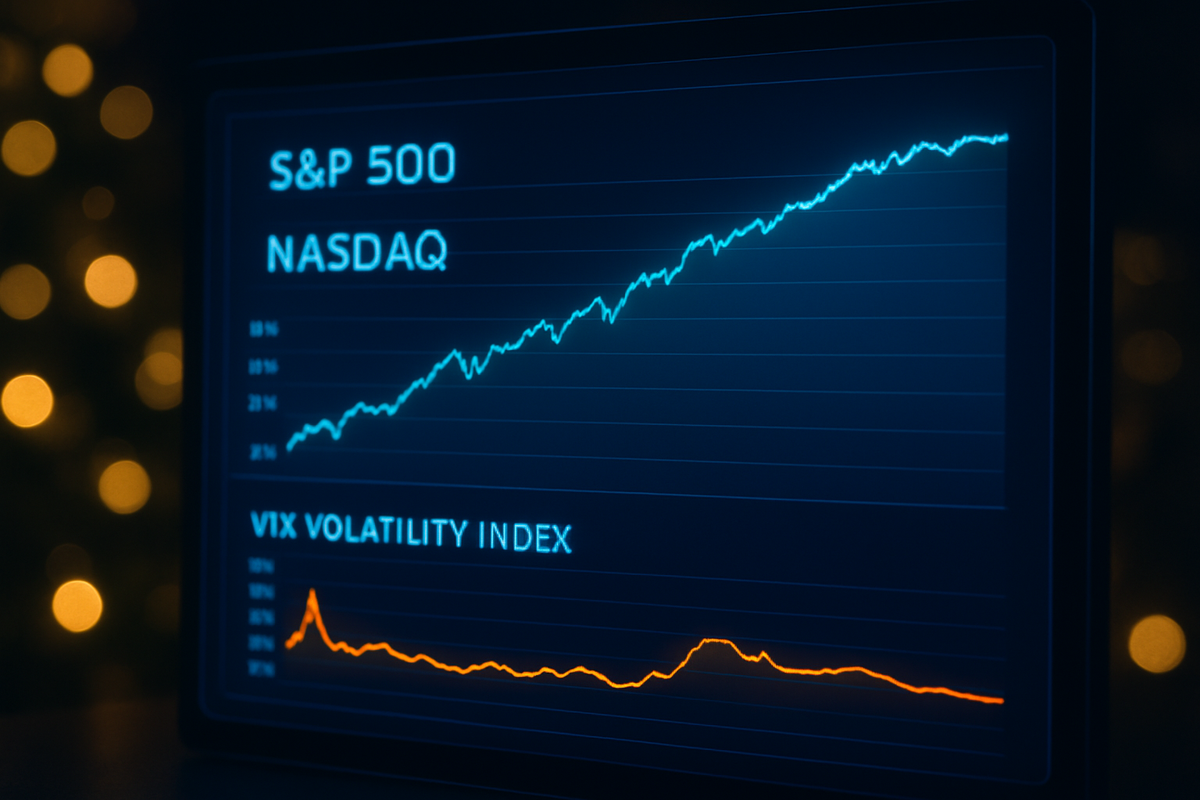
As the final trading days of 2025 approach, the relentless momentum that propelled major U.S. indices to historic heights has entered a period of measured consolidation. After a year defined by the "AI-acceleration" trade and a late-season pivot by the Federal Reserve, the S&P 500 (NYSEARCA:SPY) and the Nasdaq Composite (NASDAQ: IXIC) are taking a well-earned breather. While the "Santa Claus rally" remains technically intact, the market's trajectory has flattened in the final week of December, with investors weighing record valuations against a cooling labor market.
The CBOE Volatility Index (INDEXCBOE:VIX), often referred to as the market’s "fear gauge," has retreated to a complacent range of 13.5 to 14.2 after a sharp mid-month spike. This recent volatility, which saw the VIX surge above 21 in mid-December, served as a wake-up call for a market that had perhaps grown too comfortable with its own ascent. As of December 29, 2025, the indices are hovering just below their all-time highs, reflecting a cautious optimism as portfolio managers lock in gains and prepare for the uncertainties of 2026.
The path to this year-end pause was anything but linear. Throughout December 2025, the market navigated a complex landscape of macroeconomic data and geopolitical shifts. The month began with significant anxiety surrounding a 43-day federal government shutdown, which created a "blackout" of critical economic reporting. During this period, the VIX spiked to 21.89 as uncertainty peaked. However, the resolution of the shutdown and a subsequent 25-basis-point rate cut by the Federal Reserve on December 10—bringing the federal funds rate to a range of 3.5%–3.75%—provided the necessary liquidity to ignite a mid-month surge.
The S&P 500 reached a fresh intraday record of 6,952.84 just before the Christmas holiday, but the current week has seen a shift toward sideways trading. Trading volumes have thinned to approximately 10 billion shares per day, well below the annual average of 16 billion, leading to choppy price action. This "holiday pause" is largely attributed to institutional investors closing their books on a banner year; the S&P 500 is currently up approximately 18% year-to-date, while the Nasdaq has surged over 22%.
Key stakeholders, including major hedge funds and retail investors, are now parsing the latest labor data, which showed unemployment ticking up to a four-year high of 4.6%. While Q3 GDP growth was a robust 4.3%, the softening job market has introduced a note of caution into the year-end narrative. The market is currently in a "wait-and-see" mode, digesting the gains from the Fed’s third consecutive rate cut while keeping a close eye on the 10-year Treasury yield, which has stubbornly remained at 4.16%.
The year-end consolidation has highlighted a sharp divergence between the year's clear victors and those struggling to keep pace. Nvidia (NASDAQ: NVDA) continues to stand as the primary beneficiary of the AI era, with its shares trading near $190.53 and closing out the year with a 42% gain. A late-December announcement of a strategic partnership with Groq and a multibillion-dollar investment in OpenAI further cemented its dominance. Similarly, Alphabet (NASDAQ: GOOGL) emerged as a top performer in 2025, up 66% year-to-date, buoyed by the success of its Gemini 3 model and major cloud contracts with international organizations like NATO.
In the financial sector, JPMorgan Chase (NYSE: JPM) has been a standout winner, with shares surging 44% over the year to trade near $327. The bank benefited immensely from a "regulatory thaw" as Basel III Endgame capital requirements were scaled back, allowing the firm to announce a massive $30 billion share buyback program for the coming year. On the other end of the spectrum, Amazon (NASDAQ: AMZN) has been a relative loser in the "Magnificent Seven" cohort. Despite a 6% year-to-date gain, it has significantly underperformed the broader market as investors fretted over slowing AWS growth and massive capital expenditures on AI infrastructure.
Traditional retail and healthcare have also seen mixed results during this volatility. Walmart (NYSE: WMT), despite a strong year, saw shares drop 3.5% in the final week of December as investors rotated out of defensive staples. Meanwhile, Moderna (NASDAQ: MRNA) and Kohl's (NYSE: KSS) faced steep year-end declines, with the former struggling to find new revenue streams post-pandemic and the latter reporting disappointing holiday sales data. Conversely, Tesla (NASDAQ: TSLA) reached record highs near $500 in December, driven by breakthroughs in its autonomous software.
The current market pause is more than just a seasonal breather; it reflects a broader shift in the 2025 investment landscape. The year has been defined by a transition from "growth at any cost" to a more nuanced focus on "AI realization." Investors are no longer satisfied with the mere mention of artificial intelligence; they are now scrutinizing whether massive capital expenditures—such as the $34.9 billion spent by Microsoft (NASDAQ: MSFT) in the final quarter—are translating into tangible margin expansion.
This event also highlights the ongoing tension between fiscal and monetary policy. While the Federal Reserve has moved toward a more accommodative stance, the rising 10-year Treasury yield suggests that the bond market remains wary of long-term inflationary pressures or the sheer volume of government debt. This disconnect has historically preceded periods of heightened volatility in the first quarter of the following year, as seen in the "reverse Santa Rally" of late 2024.
Furthermore, the regulatory environment is undergoing a significant transformation. The scaling back of capital requirements for major banks and the continued scrutiny of big tech mergers have created a bifurcated environment where "fortress" balance sheets like JPM are rewarded, while smaller, debt-heavy companies in the Russell 2000 continue to languish. This trend suggests that the "K-shaped" recovery of the post-pandemic era has evolved into a "K-shaped" expansion, where the gap between AI-enabled leaders and traditional laggards continues to widen.
Looking ahead to the first quarter of 2026, several scenarios could unfold. The most immediate concern for investors is the potential for a "volatility reset" in January. Historically, a very low VIX in late December often precedes a spike in the new year as portfolio managers rebalance and tax-loss harvesting concludes. If the 10-year Treasury yield continues to climb toward 4.5%, it could trigger a more significant correction in tech valuations, forcing a strategic pivot toward value-oriented sectors.
Strategic adaptations will likely be required for companies that have underperformed in 2025. For instance, Amazon's ambitious plan to automate 600,000 jobs by 2027 reflects a necessary shift toward operational efficiency to offset slowing cloud growth. Meanwhile, the healthcare sector may see a resurgence if companies like Novo Nordisk (NYSE: NVO) continue to innovate with new delivery methods for high-demand treatments, such as their recently approved "Wegovy Pill."
The primary market opportunity in early 2026 lies in the "AI secondary" market—companies that provide the infrastructure, cooling, and power necessary to sustain the AI boom. As the primary chipmakers reach astronomical valuations, investors may begin to look deeper into the supply chain for untapped value. However, the challenge remains the cooling labor market; if unemployment continues its upward trend, consumer discretionary spending could become the next major headwind for the S&P 500.
In summary, the late-December pause in the 2025 market rally is a healthy consolidation after a year of extraordinary gains. The S&P 500’s proximity to the 7,000 milestone and the Nasdaq’s tech-led dominance have set a high bar for 2026. While the VIX indicates a current state of complacency, the mid-month spike serves as a reminder that the transition to a lower-rate environment is rarely a smooth ride.
Investors should move into the new year with a focus on "quality and execution." The winners of 2025 were those who successfully integrated AI into their core business models, but the winners of 2026 will likely be those who can demonstrate sustained earnings growth in the face of a softening economy. Key metrics to watch in the coming months include the January labor report, the Fed’s commentary on the neutral rate, and the Q4 2025 earnings season, which will provide the first real look at the ROI on this year's massive tech investments.
As we close the book on 2025, the market stands at a crossroads: one path leads to a continued AI-driven melt-up, while the other suggests a return to fundamental reality as the "easy money" of the year-end rally fades. For now, the benchmarks remain in a holding pattern, waiting for the first spark of the new year to determine the next major move.
This content is intended for informational purposes only and is not financial advice.