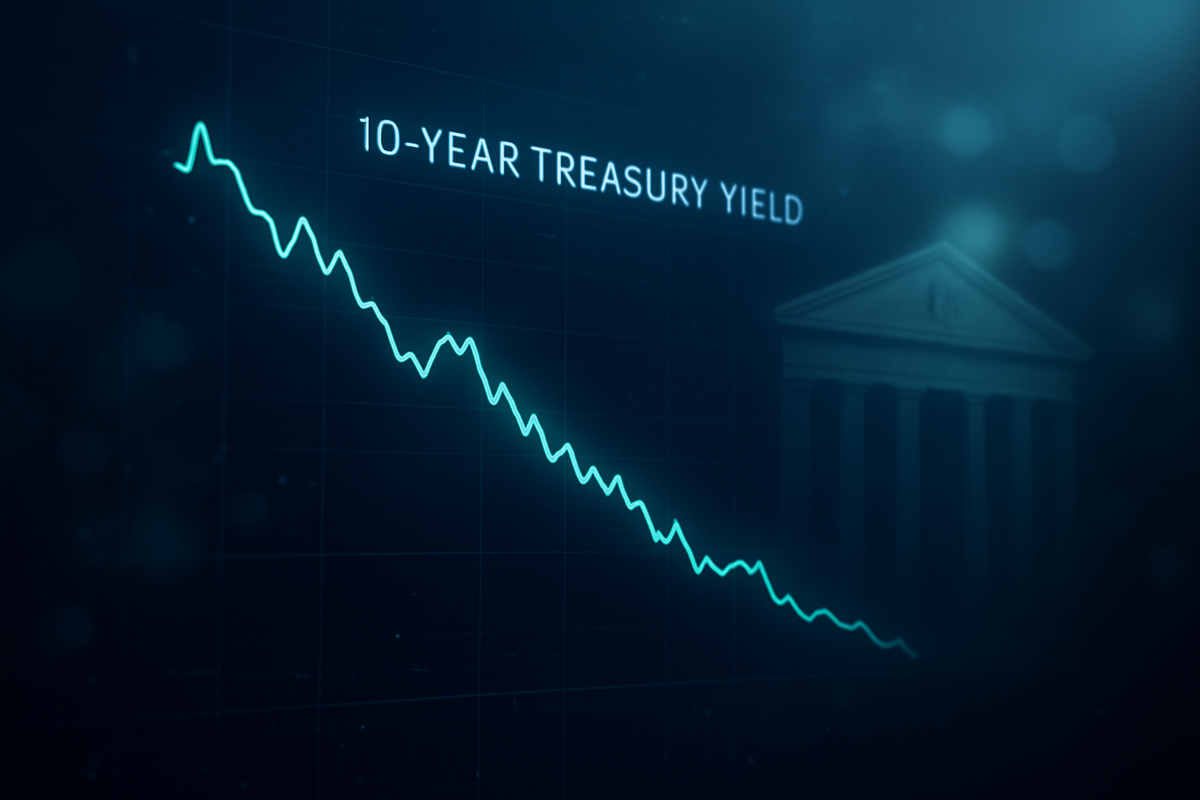
As the final trading days of 2025 wind down, the fixed-income market has sent a clear signal regarding the economic landscape for the year ahead. Following the release of the Federal Reserve’s December meeting minutes on December 30, 2025, U.S. Treasury yields experienced a notable pullback from their intraday highs. This movement suggests that while the central bank remains deeply divided, investors are increasingly pricing in a "soft landing" scenario characterized by moderating inflation and resilient, albeit slowing, economic growth.
The immediate reaction in the bond market saw the benchmark 10-year Treasury yield retreat to approximately 4.125%, paring gains made earlier in the session. Simultaneously, the policy-sensitive 2-year yield edged lower to 3.459%. This downward drift in yields reflects a market that is breathing a sigh of relief; despite a highly contentious 9–3 vote for the December rate cut, the minutes confirmed the Fed’s commitment to a restrictive-to-neutral transition, even as internal dissent reached its highest level in six years.
Internal Strife at the Eccles Building
The release of the December minutes provided a rare glimpse into a Federal Open Market Committee (FOMC) at a crossroads. The meeting, which concluded on December 10, resulted in a 25-basis-point reduction of the federal funds rate to a target range of 3.50% to 3.75%. However, the minutes revealed that this was far from a unanimous endorsement of easier policy. Three members dissented, with the debate described as "finely balanced" between the risks of a cooling labor market and the threat of "stalled progress" on the 2% inflation target.
The timeline leading up to this moment was fraught with technical challenges. A 43-day government shutdown in late 2025 had created a "data fog," delaying critical employment and inflation statistics. This forced the Fed to rely on outdated information and unusual methodologies for its year-end projections. Key players in this drama included Federal Reserve Chair Jerome Powell, who navigated the split committee, and Stephen Miran, a prominent committee member who advocated for a more aggressive 50-basis-point "jumbo" cut to preemptively bolster the economy. Conversely, hawks like Austan Goolsbee and Jeffrey Schmid expressed concerns that universal 10% tariffs and persistent service-sector inflation could reignite price pressures in 2026.
Market participants reacted to the minutes by tempering their expectations for the coming year. While the "dot plot" now suggests only one additional rate cut for the entirety of 2026, the bond market's yield decline indicates that investors believe the Fed may be forced to act more decisively if the unemployment rate, currently at 4.6%, continues its upward trajectory.
Corporate Impact: Tech Gains While Banks and Builders Braced
The shift in yields has created a bifurcated landscape for public companies, with clear winners emerging in sectors sensitive to borrowing costs and global growth. Meta Platforms (NASDAQ: META) saw its shares rise by over 1% as the tech giant benefited from the stabilizing rate environment, coinciding with its strategic acquisition of AI startup Manus. Similarly, the decline in yields provided a tailwind for the materials sector, with Newmont Corporation (NYSE: NEM) gaining 2% as investors sought hedges against long-term inflationary risks.
However, the "hawkish cut" narrative and the prospect of fewer cuts in 2026 have weighed on other sectors. Nvidia (NASDAQ: NVDA) experienced a slight decline, closing near $187.88, as investors re-evaluated the capital expenditure cycles of AI hardware in a higher-for-longer interest rate environment. The financial sector also faced headwinds; JPMorgan Chase (NYSE: JPM) saw a marginal dip to $323.45, as narrowing net interest margins (NIM) remain a primary concern for major lenders when the yield curve stabilizes at lower levels. While Bank of America (NYSE: BAC) managed a slim gain, the broader banking industry remains cautious about the Fed's "pause" signal for early 2026.
The housing market continues to be a point of friction. Despite the slight dip in Treasury yields, homebuilders like D.R. Horton (NYSE: DHI) remained under pressure. With mortgage rates hovering near 6% and the Fed signaling a slower pace of easing, the anticipated rebound in residential construction has been pushed further into 2026.
Macro Significance and the "Data Fog" of 2025
The current movement in Treasury yields is more than just a holiday-season fluctuation; it marks the end of the "aggressive easing" narrative that dominated mid-2025. This event fits into a broader trend of "macro-uncertainty" where fiscal policy—specifically potential tariffs and deficit spending—is beginning to take precedence over traditional monetary policy in the eyes of bond vigilantes. The 10-year yield’s floor at 4.1% suggests that the market is still wary of long-term structural inflation, even as the Fed lowers short-term rates.
Historically, such a wide split in the FOMC (9-3) has often preceded a period of policy inertia. Similar to the pivot seen in late 2018 and early 2019, the Fed is attempting to find the "neutral rate" without overshooting and causing a recession. The "data fog" from the government shutdown adds a layer of complexity that mirrors the post-pandemic recovery period, where traditional economic models struggled to predict consumer behavior. The ripple effect on global markets is also significant, as the stabilization of U.S. yields has provided a much-needed anchor for the U.S. dollar, impacting trade partners in Europe and Asia who are grappling with their own growth slowdowns.
The Road Ahead: 2026 Strategic Pivots
Looking ahead to the first quarter of 2026, the market must navigate a landscape where the "Fed Put"—the idea that the central bank will always step in to save the market—is being tested. The short-term possibility is a period of consolidation, with yields range-bound as the market waits for "clean" data post-shutdown. If the January and February inflation prints show a re-acceleration due to trade policies, we could see a sharp reversal in yields, potentially pushing the 10-year back toward 4.5%.
In the long term, corporations will likely need to adapt their capital structures to a "3.5% floor" for the federal funds rate. The era of zero-interest-rate policy (ZIRP) is firmly in the rearview mirror. Strategic pivots will be required for companies in the real estate and automotive sectors, which must find ways to stimulate demand without the crutch of ultra-low financing. Market opportunities may emerge in "quality" growth stocks that can generate high free cash flow without relying on cheap debt, a shift that favors established tech leaders over speculative startups.
Summary: A Market in Transition
The decline in Treasury yields following the December minutes serves as a final 2025 reality check for investors. The key takeaway is that while the Fed is willing to support the economy, it is doing so with extreme caution and a watchful eye on a potential second wave of inflation. The 2026 forecast of 2.3% GDP growth and 2.4% PCE inflation paints a picture of a "steady-as-she-goes" economy, but the internal divisions at the Fed suggest that the path will be anything but smooth.
Moving forward, the market will be hyper-focused on the labor market. Should the unemployment rate breach the 5% mark, the hawkish dissenters at the Fed may be forced to capitulate, leading to a more rapid decline in yields. Conversely, if the 10% universal tariffs mentioned in the minutes become a reality, the bond market could see a significant "re-pricing" of inflation expectations. For now, investors should maintain a balanced portfolio, watching for the first "clean" economic data sets of 2026 to confirm whether the current retreat in yields is a temporary reprieve or the start of a new trend.
This content is intended for informational purposes only and is not financial advice.