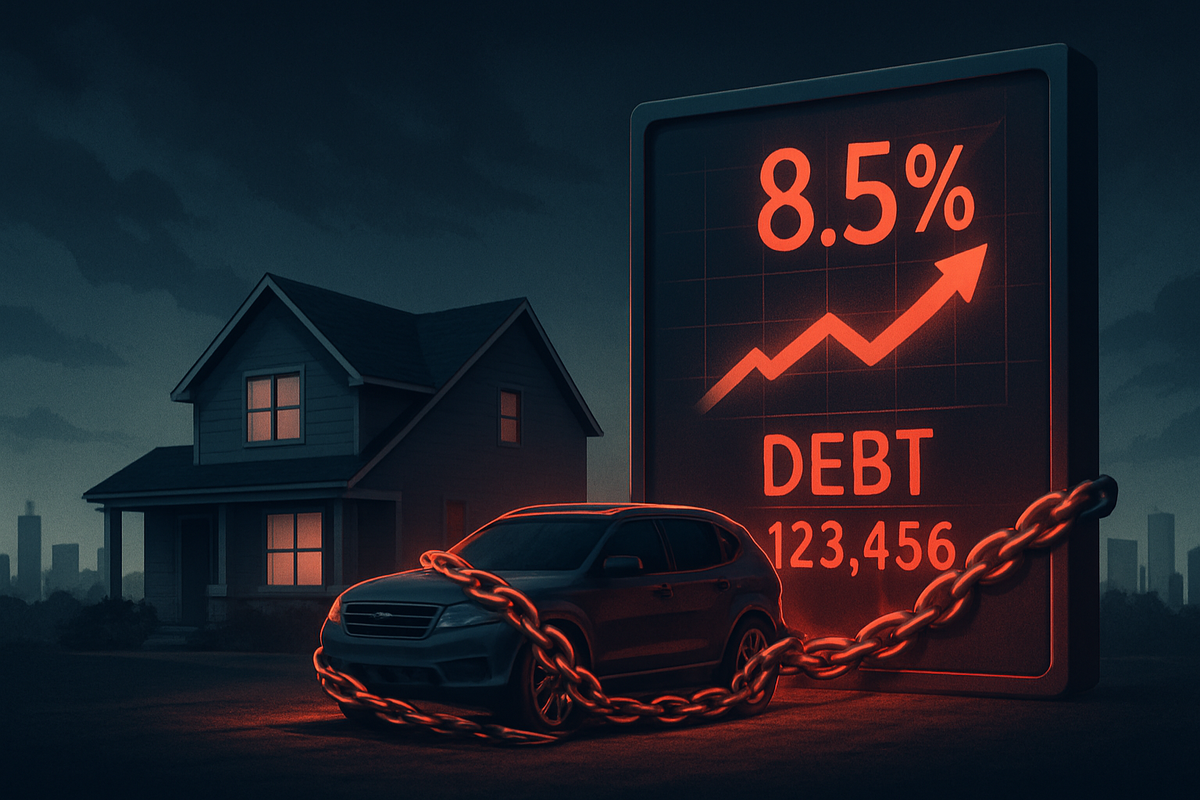
As the calendar turns toward 2026, the American consumer is facing a "perfect storm" of financial pressures that experts warn could stifle economic growth for years to come. Despite a cooling inflation rate and a cautious Federal Reserve easing cycle, the legacy of high interest rates has manifested in a record $18.59 trillion in total household debt, leaving many families—particularly those in the lower and middle-income brackets—on the brink of a fiscal cliff.
The immediate implications are stark: a "bifurcated" economy where high-income earners continue to spend, while a growing segment of the population is squeezed by monthly payments that have reached historic highs. With auto loan delinquencies hitting 15-year peaks and the housing market remaining frozen by the "lock-in effect," the resilience of the U.S. economy is being put to its most significant test since the 2008 financial crisis.
The current debt crisis is the culmination of a multi-year trend that began with the aggressive interest rate hikes of 2022-2023. By the end of 2025, mortgage debt reached a staggering $13.07 trillion, while credit card balances hovered near $1.23 trillion. However, it is the auto loan sector that has become the "canary in the coal mine." According to data from Cox Automotive and TransUnion (NYSE: TRU), the average monthly car payment has surged to $750, requiring the average consumer to work 38 weeks out of the year just to afford a new vehicle.
The timeline leading to this moment was marked by a late-2025 spike in subprime auto delinquencies, which hit 6.65%—surpassing levels seen during the Great Recession. This volatility was exacerbated by the bankruptcy of major subprime lenders like Tricolor, which sent shockwaves through the non-bank lending sector. Meanwhile, the housing market remains paralyzed; with 30-year fixed mortgage rates forecast to stay between 6.00% and 6.40% throughout 2026, millions of homeowners are refusing to sell, trapped by the 3% or 4% rates they secured during the pandemic.
Key stakeholders, including the Federal Reserve and major credit rating agencies like Moody’s (NYSE: MCO), are now monitoring the situation with increasing alarm. Initial market reactions in late 2025 saw a cooling in consumer discretionary stocks as retail data showed a sharp divide in spending habits. While luxury goods remained stable, mid-tier retailers began reporting a significant drop-off in foot traffic, signaling that the "debt squeeze" is finally beginning to curb the primary engine of U.S. GDP: consumer spending.
The financial fallout of this debt burden will create a clear set of winners and losers across the corporate landscape. Major automotive manufacturers like Ford Motor Company (NYSE: F) and General Motors (NYSE: GM) are among the most vulnerable. As affordability gaps widen and new tariffs on imported parts threaten to add up to $5,500 to the price of a new car, these giants are facing a downward revision in sales forecasts to 15.6 million units for 2026. Their reliance on high-margin trucks and SUVs may no longer be enough to offset the volume decline from priced-out middle-class buyers.
Conversely, large, diversified financial institutions like JPMorgan Chase & Co. (NYSE: JPM) and Bank of America (NYSE: BAC) are better positioned to weather the storm, though not without challenges. While they face "net interest income" compression as loan yields decline, their fortress balance sheets and diversified revenue streams from wealth management and investment banking provide a cushion. However, regional banks with high exposure to auto loans and commercial real estate may face "asset quality challenges" as defaults continue to rise through the first half of 2026.
In the retail sector, the "bifurcation" of the consumer will likely benefit discount giants like Walmart (NYSE: WMT). As households prioritize "needs over wants," Walmart’s value proposition becomes even more attractive to families struggling with debt service. On the other end of the spectrum, real estate platforms like Redfin (NASDAQ: RDFN) may continue to struggle as the "lock-in effect" keeps housing inventory at historic lows, limiting the volume of transactions that drive their commission-based business models.
This event fits into a broader industry trend of "credit tightening" and the end of the "easy money" era. For over a decade, the U.S. economy was fueled by near-zero interest rates; the transition to a "higher-for-longer" environment has fundamentally changed the math for household balance sheets. The current situation mirrors the late-1970s stagflation era more than 2008, as the primary issue today is not a collapse in asset values, but rather an inability to service the high cost of debt amidst sticky inflation.
The ripple effects on competitors and partners are significant. As consumers pull back, the "buy now, pay later" (BNPL) sector is seeing a surge in usage, but also a corresponding rise in defaults. Regulatory scrutiny is expected to intensify, with the Consumer Financial Protection Bureau (CFPB) likely to introduce new rules in 2026 aimed at capping late fees and increasing transparency in auto lending. This policy shift could further squeeze the margins of FinTech firms and non-bank lenders who have traditionally operated with less oversight than major commercial banks.
Historical precedents suggest that when consumer debt service ratios hit these levels, a period of economic stagnation usually follows. While a "hard landing" is not yet the consensus forecast, the "One Big Beautiful Bill Act" (OBBBA) and shifting trade policies are wildcards that could either provide relief through tax incentives or further strain the consumer through increased costs of imported goods. The 2026 landscape will be defined by how well the economy can deleverage without triggering a full-scale recession.
Looking ahead, the short-term outlook for 2026 is one of cautious defense. The Federal Reserve is expected to implement one or two minor rate cuts, but these are unlikely to provide immediate relief to those already underwater on high-interest auto loans or credit cards. Strategic pivots will be required from both corporations and consumers; we are already seeing a shift toward "hybrid" vehicle portfolios as manufacturers realize pure EVs remain out of reach for the debt-laden average buyer.
Market opportunities may emerge in the debt restructuring and financial advisory sectors. Companies that provide AI-driven credit monitoring and debt management tools will likely see increased demand. However, the potential scenario of a "consumer recession" remains a lingering threat if unemployment begins to tick upward alongside high debt levels. Investors should prepare for a volatile year where "cash is king" and companies with low debt-to-equity ratios will be the preferred safe havens.
The key takeaway for 2026 is that the American consumer is no longer a monolith. The "bifurcated" economy has created two distinct realities: one of resilience for the wealthy and one of high-interest hardship for the rest. As mortgage and auto loan costs continue to consume a larger share of disposable income, the broader economy's growth will inevitably slow. The record $18.59 trillion debt wall is not just a statistic; it is a fundamental constraint on the future of American prosperity.
Moving forward, the market will be defined by asset quality and consumer endurance. Investors should watch for the Q1 2026 earnings reports from major lenders and retailers to gauge the true depth of the spending slowdown. While the U.S. financial system remains more robust than it was in 2008, the "slow burn" of high-interest debt could be just as damaging to long-term economic vitality. The coming months will reveal whether the consumer can bend without breaking.
This content is intended for informational purposes only and is not financial advice.