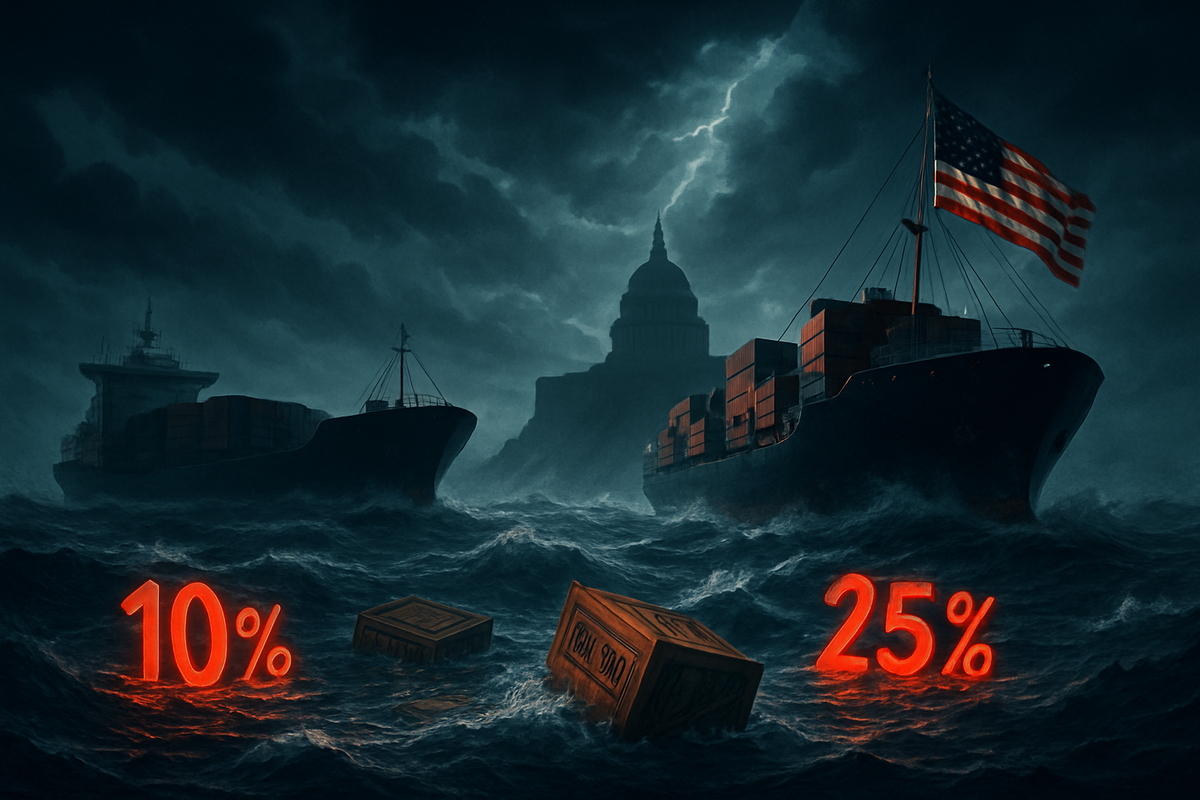
As the final bells ring for 2025, the American financial landscape looks fundamentally different than it did just twelve months ago. The transition from a rules-based global trade system to a "tariff-first" protectionist model has sent shockwaves through Wall Street, creating what traders have dubbed the "Tariff Chaos of 2025." This shift, anchored by aggressive executive actions and a dramatic spike in effective import duties, has forced a massive rotation in equity markets, rewarding domestic producers while punishing multinational giants reliant on integrated global supply chains.
The immediate implications have been a mixture of historic volatility and a localized industrial renaissance. While the S&P 500 faced a brutal correction in the second quarter following the announcement of universal baseline tariffs, the year is ending with a market that is more bifurcated than ever. Investors are no longer just looking at earnings per share; they are scrutinizing "geographic cost exposure" and "supply chain resilience" as the primary metrics for valuation in a world where the average U.S. tariff rate has surged from 2.5% to nearly 19%.
The 'Liberation Day' Shock and the 2025 Timeline
The defining moment of the year occurred on April 2, 2025, a date now referred to by the administration as "Liberation Day." Through a sweeping executive order leveraging the International Emergency Economic Powers Act (IEEPA), the U.S. government imposed a 10% baseline universal tariff on all imports. The move was justified as a "national emergency" response to persistent trade deficits and a tool for border security leverage. The market reaction was swift and merciless: the S&P 500 plummeted 11% in just 48 hours, erasing approximately $6.6 trillion in market value as algorithms struggled to price in a sudden, permanent increase in the cost of goods sold.
The timeline of 2025 was marked by a series of "whiplash" events. Following the April shock, the administration suspended the long-standing "De Minimis" exemption on August 29, 2025. This ended the $800 duty-free threshold for low-value shipments, a move that specifically targeted e-commerce giants and added standard duties or flat fees of $80 to $200 per parcel. By the fourth quarter, the trade war had escalated further with China, where average rates reached a staggering 47.5%, including targeted levies as high as 145% on specific electronics and machinery.
Key stakeholders, including the U.S. Chamber of Commerce and major retail lobbying groups, spent much of the year in legal battles. The chaos reached the highest levels of the judiciary with the Supreme Court taking up Learning Resources v. Trump, a case challenging the executive's authority to use emergency powers for broad-based economic tariffs. As of December 31, 2025, the market remains in a state of "suspended animation" awaiting a ruling that could either cement this new protectionist era or trigger billions of dollars in duty refunds.
The Corporate Divide: Strategic Winners and Vulnerable Giants
The 2025 tariff regime has created a stark divide between "winners" who benefit from domestic protection and "losers" caught in the crossfire of international retaliation. Intel Corp (NASDAQ: INTC) emerged as a primary beneficiary of the administration’s "Strategic Autonomy" push. In August, the U.S. government took an $8.9 billion equity stake in the company, providing a "too-strategic-to-fail" lifeline to ensure domestic semiconductor production. Similarly, Tesla Inc (NASDAQ: TSLA) proved resilient; because a high percentage of its parts are sourced within the U.S., it largely avoided the 25% tariffs that hit rivals like Ford Motor Co (NYSE: F) and General Motors (NYSE: GM), both of whom are heavily reliant on Mexican assembly lines.
On the other side of the ledger, the retail and industrial sectors have faced an uphill battle. Five Below Inc (NASDAQ: FIVE), which sources nearly 70% of its inventory from China, saw its business model threatened by a "tariff tsunami." In a desperate move in mid-2025, the company halted all Chinese shipments already in transit to avoid being underwater on its $1–$5 price points. Walmart Inc (NYSE: WMT) and Target Corp (NYSE: TGT) have fared slightly better by accelerating their "China+1" strategies, shifting billions in sourcing to India and Mexico, though Target still reported a massive plunge in EBITDA as it struggled to absorb the 25% tariff on Mexican grocery imports.
In the industrial space, the pain has been compounded by foreign retaliation. Caterpillar Inc (NYSE: CAT) and Deere & Co (NYSE: DE) have been hit twice: once by rising domestic steel costs and again by retaliatory duties from China. Caterpillar flagged a $1.5 billion annual hit to its bottom line, while Deere saw a sharp decline in demand for its high-tech tractors as U.S. farmers—hit by Chinese tariffs on soybeans and corn—slashed their capital expenditures. Conversely, domestic steelmakers like Nucor Corp (NYSE: NUE) and Steel Dynamics Inc (NASDAQ: STLD) have enjoyed record pricing power, with Nucor implementing nine consecutive weeks of price hikes as foreign competition was effectively priced out of the market.
A Fundamental Shift in Global Trade Dynamics
The "Tariff Chaos" of 2025 is more than a series of tax hikes; it represents the final dismantling of the post-Cold War globalization era. This event fits into a broader trend of "friend-shoring," where trade is no longer dictated by the lowest cost but by geopolitical alignment. The ripple effects have been felt globally, forcing allies like Canada and Mexico to navigate a 35% and 25% tariff wall, respectively. This has accelerated the regionalization of supply chains, with the U.S. using tariffs as a blunt instrument to demand stricter "Rules of Origin" in the upcoming 2026 USMCA review.
Historically, this period draws comparisons to the Smoot-Hawley Tariff Act of 1930, though with a modern twist. Unlike the 1930s, the 2025 tariffs are being used as dynamic bargaining chips for non-trade issues like fentanyl trafficking and migration. This has introduced a new level of "policy risk" into equity valuations. The Federal Reserve has also been forced into a corner, as the inflationary pressure from higher import costs (with November CPI hovering at 2.7%) complicates their ability to lower interest rates, even as manufacturing growth begins to stagnate under the weight of high input costs.
The Road Ahead: 2026 and Beyond
Looking toward 2026, the market is bracing for several potential scenarios. The most immediate catalyst will be the Supreme Court’s ruling on executive trade powers. A decision against the administration could lead to a massive "tariff relief rally," but it would also create a vacuum in trade policy that Congress may struggle to fill. Long-term, companies will likely continue their "de-risking" from China, but the 2025 experience has shown that moving supply chains is a multi-year, multi-billion dollar endeavor that cannot be solved by executive order alone.
Strategic pivots are already underway. We expect to see more "on-shoring" announcements in the first half of 2026, as companies like Apple Inc (NASDAQ: AAPL) and Nvidia Corp (NASDAQ: NVDA) seek to qualify for "domestic content" exemptions. Nvidia's $5 billion partnership with Intel to move production of its Blackwell GPUs to U.S. soil is likely just the beginning of a massive domestic capital expenditure cycle. Investors should look for opportunities in companies that provide the infrastructure for this reshoring—construction, domestic logistics, and automated manufacturing technology.
Conclusion: A New Paradigm for Investors
As 2025 draws to a close, the "Tariff Chaos" has redefined the relationship between the U.S. government and the private sector. The key takeaway for the year is that the era of "just-in-time" global supply chains has been replaced by "just-in-case" domestic manufacturing. While the initial shock caused significant pain for diversified portfolios, it has also cleared the way for a more localized, albeit more expensive, industrial base.
Moving forward, the market will likely remain volatile as it digests the long-term inflationary impacts of these policies. Investors should watch the 2026 USMCA review and monthly CPI data closely, as these will be the primary indicators of whether the "Tariff Chaos" will settle into a stable "New Normal" or continue to disrupt global commerce. In this environment, the winners will be those with the pricing power to pass on costs and the foresight to have already built their "Fortress America" supply chains.
This content is intended for informational purposes only and is not financial advice.