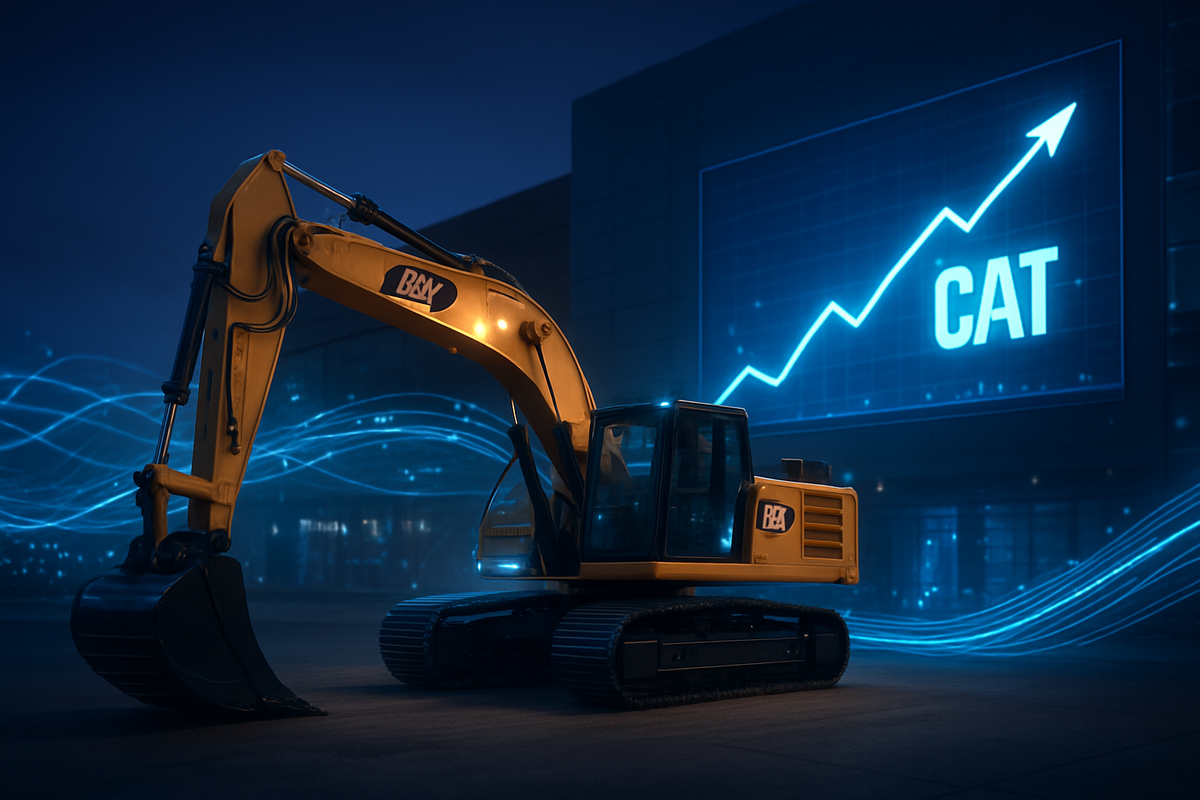
As the markets close the books on 2025, one name stands above the traditional tech giants as the surprise champion of the industrial sector. Caterpillar Inc. (NYSE: CAT) has not only defied the gravity of high interest rates but has successfully rebranded itself in the eyes of Wall Street. No longer viewed as just a cyclical manufacturer of yellow tractors and excavators, Caterpillar has emerged as a critical "AI infrastructure" play, a shift that propelled its stock to a staggering 62% gain in 2025 alone, dwarfing the S&P 500’s respectable 17% climb.
This meteoric rise represents a fundamental "re-rating" of the company. While the broader industrial sector grappled with a slowdown in residential construction and a recession in the agricultural market, Caterpillar found a lucrative second life in the power generation business. By providing the massive natural gas and diesel generators required to keep AI data centers humming, the company has tapped into a secular growth trend that has decoupled its share price from the traditional economic cycle.
A Timeline of Technical Mastery and Record Highs
The journey to Caterpillar’s current valuation was marked by a series of high-conviction technical breakouts that began in late 2024. After reaching a record high of $418.50 in November 2024, many analysts feared the stock had peaked. However, a "Golden Cross" formation—where the 50-day moving average crossed above the 200-day moving average—signaled sustained institutional buying that carried into the new year. The stock maintained this bullish posture for nearly the entirety of 2025, serving as a beacon of stability in a volatile market.
The defining moment of the year occurred on October 29, 2025. Following a third-quarter earnings report that shattered expectations, CAT shares surged 11.6% in a single trading session. This breakout was supported by massive volume, with over 7 million shares changing hands compared to the daily average of 2.7 million. This "AI re-rating" saw the stock blast through previous resistance levels, eventually crossing the psychological $600 barrier on December 11, 2025, and hitting a terminal peak of $627.50 by year-end.
This performance was underpinned by the Energy & Transportation (E&T) segment, which became the company’s primary growth engine. While Construction Industries saw modest 7% growth due to high borrowing costs, the E&T division reported a 17% year-over-year revenue jump by Q3 2025. The insatiable demand for backup power from hyperscale data center operators like Microsoft Corporation (NASDAQ: MSFT) and Amazon.com, Inc. (NASDAQ: AMZN) created a backlog that currently sits at a record-breaking $40 billion.
The Great Industrial Divide: Winners and Losers
Caterpillar’s success in 2025 is even more striking when compared to its peers, who largely failed to catch the "power generation" wave. Deere & Company (NYSE: DE) found itself on the wrong side of a deep agricultural recession. Despite its heavy investment in autonomous "Precision Ag" technology, Deere’s stock managed only a 12.4% gain in 2025, as falling net farm income and high interest rates led North American farmers to slash equipment spending by nearly 30%.
The contrast was even sharper for CNH Industrial (NYSE: CNHI), which emerged as one of the year’s primary "losers." CNHI was hammered by a double-whammy: a decline in residential construction and a massive inventory glut in its agricultural segment. By mid-2025, the company reported a 64% drop in adjusted net income, leading to a stock decline of nearly 20% for the year. Meanwhile, Komatsu Ltd. (OTC: KMTUY) saw a modest 18% rise, supported by steady mining demand but weighed down by its heavy exposure to the stagnant Chinese real estate market.
The market’s message in 2025 was clear: investors rewarded companies that provided solutions to the global power crunch. While competitors were moving earth or planting seeds, Caterpillar was essentially building the "plumbing" for the artificial intelligence revolution. This strategic pivot allowed CAT to maintain premium margins even as global trade frictions and tariffs imposed a $1.6 billion headwind on its manufacturing costs.
Broad Trends and the "AI Infrastructure" Ripple Effect
Caterpillar’s outperformance is a symptom of a much larger shift in the industrial landscape. The ongoing rollout of the Infrastructure Investment and Jobs Act (IIJA) has provided a steady floor for heavy machinery demand in North America, but the real story is the electrification of everything. As the world transitions toward more data-intensive economies, the strain on existing power grids has made on-site power generation a necessity rather than a luxury.
This trend has significant ripple effects across the industry. Caterpillar’s dominance in large-scale reciprocating engines has forced competitors to rethink their product portfolios. We are seeing a historical precedent similar to the mid-20th century build-out of the interstate highway system, where one dominant player captures the lion's share of infrastructure spending. Furthermore, Caterpillar’s status as a "Dividend Aristocrat"—having raised its dividend for 31 consecutive years—has made it a rare hybrid: a high-growth play that offers the safety of a defensive value stock.
However, the path hasn't been entirely smooth. The company has had to navigate complex regulatory environments and the aforementioned tariff impacts. The "Caterpillar Model" of 2025—high-tech power solutions combined with traditional heavy iron—is now being studied by policy makers as a blueprint for how legacy American manufacturers can remain competitive in a landscape increasingly dominated by software and silicon.
The Road Ahead: 2026 and Beyond
As we move into 2026, the primary question for investors is whether Caterpillar can maintain this parabolic trajectory. In the short term, the $40 billion backlog provides a massive cushion against any potential economic softening. If the Federal Reserve begins a cycle of interest rate cuts in early 2026, we could see a "second wind" for the stock as the Construction Industries segment finally recovers from its high-rate slumber.
Strategically, Caterpillar is likely to double down on its Energy & Transportation segment. Expect more acquisitions in the microgrid and battery storage space as the company looks to provide end-to-end power solutions for data centers. The challenge will be managing the supply chain for these complex systems, which are far more sophisticated than the mechanical engines of the past. If Caterpillar can successfully navigate these technical hurdles, the "AI infrastructure" narrative could drive the stock toward the $700 mark by the end of 2026.
Final Assessment: A New Benchmark for Industrials
Caterpillar’s performance over the last 24 months has rewritten the playbook for industrial investing. By outperforming the S&P 500 and even rivaling the gains of tech leaders like NVIDIA Corporation (NASDAQ: NVDA) at various points in 2025, CAT has proved that "Old Economy" companies can thrive in a "New Economy" world. The key takeaways for investors are the company's aggressive capital return program—highlighted by a $20 billion share buyback authorization—and its pivot to high-margin power segments.
Moving forward, the market will be watching the E&T segment's book-to-bill ratio and any signs of cooling in the data center construction boom. For now, Caterpillar remains the undisputed king of the industrial sector, a 100-year-old giant that has managed to become as essential to the digital age as the microchip itself. Investors should keep a close eye on quarterly margin trends, as the company’s ability to pass on tariff costs will be the ultimate test of its pricing power in 2026.
This content is intended for informational purposes only and is not financial advice.