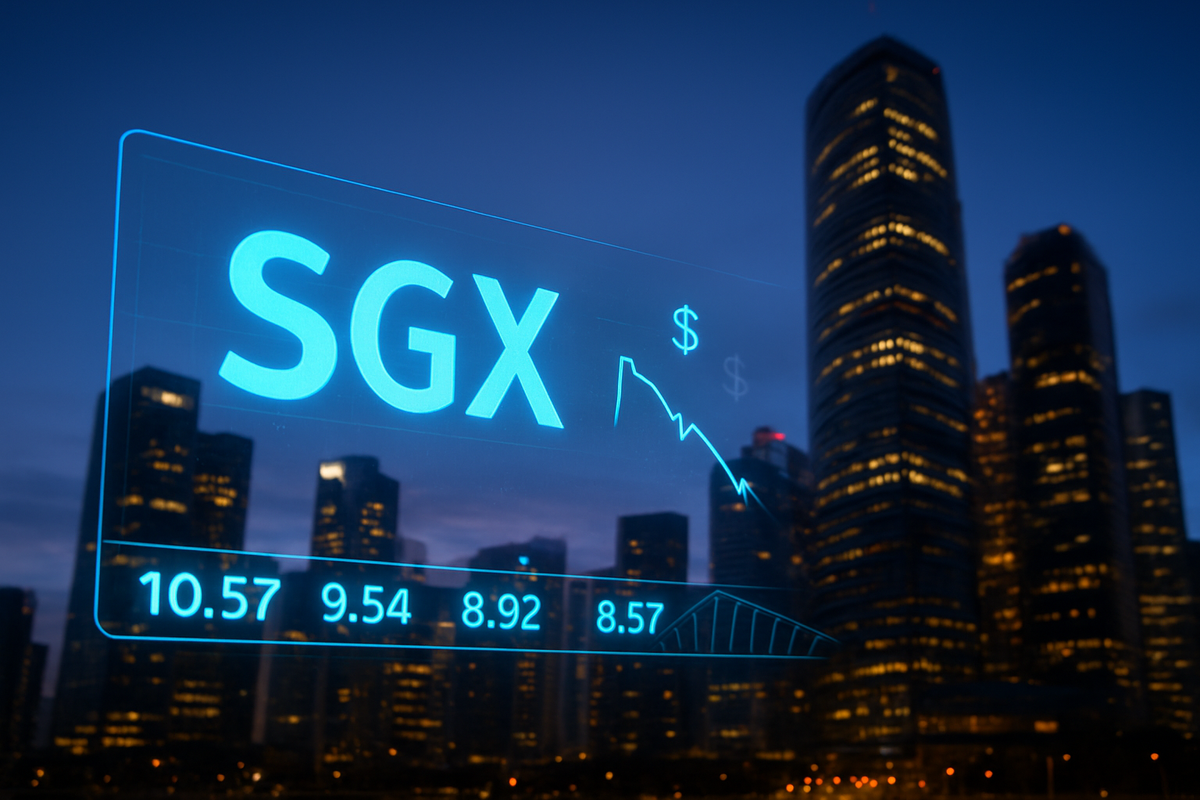
As the final bells rang across global trading floors on December 31, 2025, the Singapore Exchange (SGX:S68) found itself in an uncharacteristically quiet retreat. Despite a landmark year that saw the exchange reach record-breaking revenue and solidify its position as a global derivatives powerhouse, the stock slipped 0.8% on the final day of trading. This year-end dip serves as a poignant reminder that even the most resilient financial hubs are not immune to the shifting winds of global monetary policy and investor sentiment.
The immediate implication of this slip is a recalibration of expectations for 2026. While the "multi-asset" strategy of the SGX Group has successfully diversified its income streams, the exchange now faces a transition from a liquidity-driven rally to a market defined by fundamental growth. As the calendar turns to January 1, 2026, investors are closely watching how the Singapore market will navigate a "higher-for-longer" interest rate environment and a strengthening local currency that threatens to complicate international earnings.
A Year of Records Met with a December Chill
The narrative of 2025 for the Singapore Exchange was largely one of triumph. Following a 25% rally in late 2024—sparked by the formation of a high-level review group by the Monetary Authority of Singapore (MAS) to revitalize the local equities market—SGX entered 2025 with significant momentum. The financial year ending June 2025 was the strongest on record, with adjusted net profits climbing nearly 16% to S$609.5 million. This growth was fueled by a 28% surge in Foreign Exchange (FX) average daily volumes and a commodities segment that saw iron ore derivatives become a global industrial benchmark.
However, the momentum stalled as the year drew to a close. The primary catalyst for the December 31st slip was the release of the U.S. Federal Reserve’s latest meeting minutes. The documents signaled a definitive pause in interest rate cuts, dashing hopes for further liquidity injections in early 2026. For SGX, which had benefited from the initial rate-cut cycle earlier in 2025, this "hawkish pause" triggered a sell-off in high-yield and financial services stocks.
Furthermore, the "sell the news" phenomenon took hold regarding the MAS Equity Market Review. While the government introduced several tax incentives and support measures in early 2025, the market’s reaction was lukewarm. By Q4 2025, the initial euphoria had faded into skepticism, with traders questioning whether the reforms were aggressive enough to reverse the long-standing trend of delistings outnumbering new Initial Public Offerings (IPOs).
Winners and Losers in the Shifting Tide
The primary "loser" of the recent year-end slip is undoubtedly the SGX Group (SGX:S68) itself in the short term, as its valuation reached the upper end of its historical Price-to-Earnings range (roughly 26x), making it vulnerable to any negative macroeconomic news. However, the exchange's commitment to increasing dividends by 0.25 cents per quarter through 2028 provides a floor for long-term investors.
Singapore’s "Big Three" banks—DBS Group Holdings (SGX:D05), OCBC Bank (SGX:O39), and United Overseas Bank (SGX:U11)—stand in a complex position. While the Fed's pause on rate cuts helps maintain their net interest margins (NIMs), a cooling equities market typically reduces their wealth management and brokerage fee income. In the 2025 year-end session, these banking giants saw mixed results, mirroring the broader uncertainty.
On the winning side, regional competitors like Hong Kong Exchanges and Clearing (HKG:0388) have shown signs of resurgence. In 2025, HKEX regained its status as a top global IPO hub, raising over US$24 billion. This puts pressure on SGX to innovate. Conversely, global derivatives giants like CME Group (NASDAQ: CME) and Intercontinental Exchange (NYSE: ICE) continue to view SGX as a formidable partner and rival in the Asian FX space, where SGX now ranks among the top three exchange-backed OTC FX platforms globally.
Global Macroeconomic Significance and the Currency Factor
The performance of SGX is a bellwether for the broader shift in global industry trends. As we enter 2026, the era of "easy money" appears to be transitioning into a period of structural stability. The Fed's decision to maintain rates affects SGX’s treasury income—the interest earned on margin deposits—which fell by 17% in 2025 as rates began their initial descent. A stabilized rate environment in 2026 may help normalize this revenue stream, but it removes the explosive growth seen during the rate-hike cycles of 2023-2024.
Currency rates are another critical factor. Throughout 2025, the Singapore Dollar (SGD) strengthened significantly against the U.S. Dollar (USD), hitting a decade-high of 1.27. For a global exchange like SGX, where a large portion of derivatives and OTC FX business (such as INR/USD and USD/CNH futures) is denominated in USD, this creates a "negative currency translation effect." When these USD earnings are converted back into SGD for financial reporting, the figures appear smaller. While volume growth has so far offset this, a continued surge in SGD strength could become a significant headwind in 2026.
This situation echoes historical precedents, such as the post-2014 period when currency volatility and interest rate uncertainty led to a prolonged sideways movement in Asian financial stocks. The difference today is SGX’s multi-asset diversification, which provides a more robust buffer than it had a decade ago.
The 2026 Outlook: Strategic Pivots and the Nasdaq Bridge
Looking ahead into 2026, the most anticipated catalyst is the launch of the dual-listing bridge between SGX and Nasdaq (NASDAQ: NDAQ), scheduled for mid-year. This strategic pivot is designed to allow high-growth technology and biotech companies to list on both exchanges simultaneously, providing them with access to both Asian and American capital pools. If successful, this could finally break the IPO drought that has plagued the Singapore market for years.
In the short term, SGX will likely focus on its Fixed Income, Currencies, and Commodities (FICC) segment to drive growth while the cash equities market finds its footing. The exchange is also expected to lean heavily into its ESG (Environmental, Social, and Governance) derivatives, positioning itself as the "green hub" of Asia. However, the challenge remains: can these new initiatives outpace the potential drag from a strengthening SGD and a stagnant interest rate environment?
Investors should anticipate a "wait-and-see" approach in Q1 2026. The success of the MAS reforms and the initial participation rates in the Nasdaq bridge will be the primary indicators of whether SGX can break out of its current valuation ceiling.
Summary and Final Thoughts for Investors
The year-end slip of the Singapore Exchange is less a sign of fundamental weakness and more a reflection of the global market's exhaustion after a record-breaking 2025. The exchange remains a highly profitable, well-diversified entity with a clear roadmap for dividend growth and international expansion. However, the "easy gains" driven by 2025's liquidity shifts are now in the rearview mirror.
As we move into 2026, the key takeaways are:
- Monetary Policy: The Fed's pause on rate cuts will challenge treasury income but may stabilize trading volumes.
- Currency Headwinds: A strong SGD remains a risk for translated earnings in the FX and derivatives segments.
- Structural Reform: The success of the Nasdaq partnership and MAS initiatives will determine if the cash equities market can finally catch up to the derivatives side.
For investors, the coming months will require a focus on "quality over quantity." Watching the volume of new listings and the stability of the SGD/USD exchange rate will be crucial for determining if the current slip is a buying opportunity or the start of a longer consolidation period.
This content is intended for informational purposes only and is not financial advice.