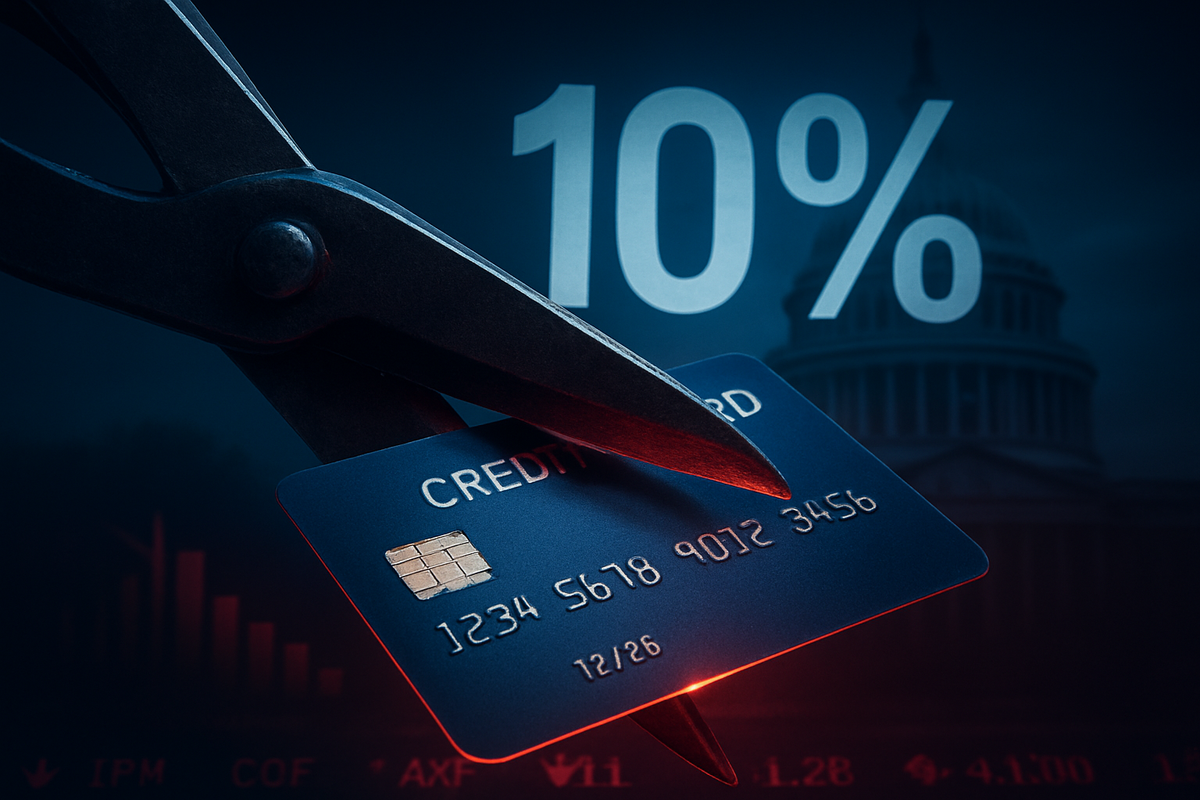
The financial markets were jolted into a state of high volatility on Monday, January 12, 2026, as investors reacted to a renewed and aggressive push from President Donald Trump to implement a federal cap on credit card interest rates. The proposal, which seeks to limit annual percentage rates (APRs) to a maximum of 10%, represents a massive departure from decades of banking deregulation and has sent shockwaves through the consumer finance sector.
The immediate implications are stark: a potential "revenue cliff" for the nation’s largest lenders. As markets opened for the first time since the President’s weekend announcement, shares of major credit card issuers plummeted. Analysts are warning that if enacted, the move could fundamentally alter the availability of credit in the United States, potentially locking millions of sub-prime borrowers out of the traditional financial system while stripping billions in projected earnings from Wall Street’s balance sheets.
A Weekend "Truth" Sparks Market Mayhem
The current firestorm began late Friday night, January 9, 2026, when President Trump took to Truth Social to demand a "one-year temporary cap" on credit card interest rates, effective January 20, 2026—the one-year anniversary of his second inauguration. Labeling the initiative a fight for "AFFORDABILITY!" the President argued that while the Federal Reserve has begun cutting benchmark rates, credit card companies have kept APRs near record highs of 21% to 23%, creating an "unacceptable burden" on the American working class.
This is not a new theme for the President, but the urgency and specific deadline have caught the industry off guard. The proposal first surfaced during a campaign rally in Uniondale, New York, in September 2024. While a bipartisan bill—the Credit Card Interest Rate Cap Act—was introduced by Senators Bernie Sanders and Josh Hawley in early 2025, it had largely remained dormant as the administration focused on other deregulation efforts. The sudden revival of the 10% cap is seen by many political analysts as a strategic populist move ahead of the 2026 midterm elections.
The reaction from the banking industry was swift and unified. By Sunday evening, the American Bankers Association (ABA) and the Bank Policy Institute (BPI) issued a joint statement warning that a 10% cap is "mathematically incompatible" with the risk profile of most unsecured lending. They argued that such a cap would not lower costs for most, but would instead result in the immediate withdrawal of credit for those who need it most.
The Fallout: Capital One, American Express, and JPMorgan Chase
The market's verdict on Monday morning was punishing, though the pain was not distributed equally. Capital One (NYSE: COF) emerged as the primary victim of the sell-off, with shares sliding as much as 11% in early trading. As a "pure-play" card issuer with significant exposure to sub-prime and near-prime borrowers, Capital One’s business model is uniquely sensitive to interest rate caps. Analysts at KBW noted that a 10% ceiling is likely below the cost of capital and loss-provisioning required for Capital One’s riskier portfolios, potentially "wiping out" the firm's earnings for the 2026 fiscal year.
In contrast, American Express (NYSE: AXP) saw a more muted, though still significant, decline of approximately 4.5%. Amex is partially shielded by its "spend-centric" model, where a large portion of revenue is derived from merchant fees and annual cardholder dues rather than just interest income. Furthermore, its affluent customer base typically carries lower default risks, meaning a 10% cap—while still damaging—does not threaten the core viability of its lending in the same way it does for its competitors.
JPMorgan Chase (NYSE: JPM), the nation’s largest bank, saw its shares dip roughly 2.5%. While JPMorgan is a massive player in the credit card space through its Chase brand, its highly diversified revenue streams—including investment banking, asset management, and commercial lending—provided a buffer. However, the bank’s leadership warned that a 10% cap would force a "complete re-evaluation" of their credit card rewards programs, hinting that the popular "Sapphire" line of cards could see significant benefit cuts to offset the loss in interest revenue.
A Seismic Shift in Regulatory Policy
This event marks a significant shift in the broader industry trend. For the past decade, the trend in consumer finance has been toward "risk-based pricing," where interest rates are tailored to the individual’s creditworthiness. A hard 10% cap would effectively end this practice at the federal level, returning the U.S. to a regulatory environment not seen since the late 1970s, before the Supreme Court’s Marquette decision effectively deregulated interstate interest rates.
The potential ripple effects extend far beyond the major banks. Retailers that rely on "private label" credit cards to drive sales—such as department stores and electronics retailers—could see a sharp drop in consumer purchasing power. Partners like Synchrony Financial (NYSE: SYF), which fell nearly 10% on the news, provide the backbone for these retail cards. If these lenders cannot charge more than 10%, they may stop issuing store cards entirely, leading to a secondary impact on the broader retail economy.
Historically, usury caps have led to "credit rationing." When the government sets a price ceiling below the market rate for risk, the supply of that service tends to dry up. Economists point to historical precedents in states that maintained strict usury laws in the 20th century, noting that while those with "gold-plated" credit could still borrow, lower-income individuals were often forced toward unregulated, predatory "shadow" lenders or pawnshops.
The Road Ahead: Legal Battles and Strategic Pivots
Looking forward, the path to a 10% cap is fraught with legal and legislative hurdles. Because the President likely lacks the authority to unilaterally cap interest rates via Executive Order, the battle will move to Congress. Investors should expect a massive lobbying blitz from the financial services sector to block any formal legislation. However, the "populist alignment" between Trump and progressives like Bernie Sanders on this specific issue creates a rare and unpredictable political coalition.
In the short term, banks are already preparing "Plan B" strategies. If a cap appears imminent, expect a wave of credit limit reductions and account closures as banks "de-risk" their balance sheets. We may also see a pivot toward new fee structures. If interest income is capped, banks may introduce "monthly maintenance fees" or "active user fees" for credit cards—essentially turning the credit card into a subscription service to recapture lost revenue.
Navigating the New Financial Landscape
The 10% interest rate cap proposal has fundamentally changed the risk assessment for the banking sector. The key takeaway for investors is that the "regulatory floor" has moved; the assumption that banks have total freedom to price risk is being challenged by a new wave of economic populism that transcends traditional party lines.
Moving forward, the market will be hyper-sensitive to any legislative movement on the Sanders-Hawley bill or any formal Executive Action from the White House. Investors should closely watch the quarterly earnings calls of major lenders in the coming months for guidance on how they plan to navigate a potential "low-cap" environment. While the proposal may ultimately be diluted or blocked in court, the mere fact that it is now a central pillar of administration policy suggests that the era of record-high credit card margins may be coming to an end.
This content is intended for informational purposes only and is not financial advice.