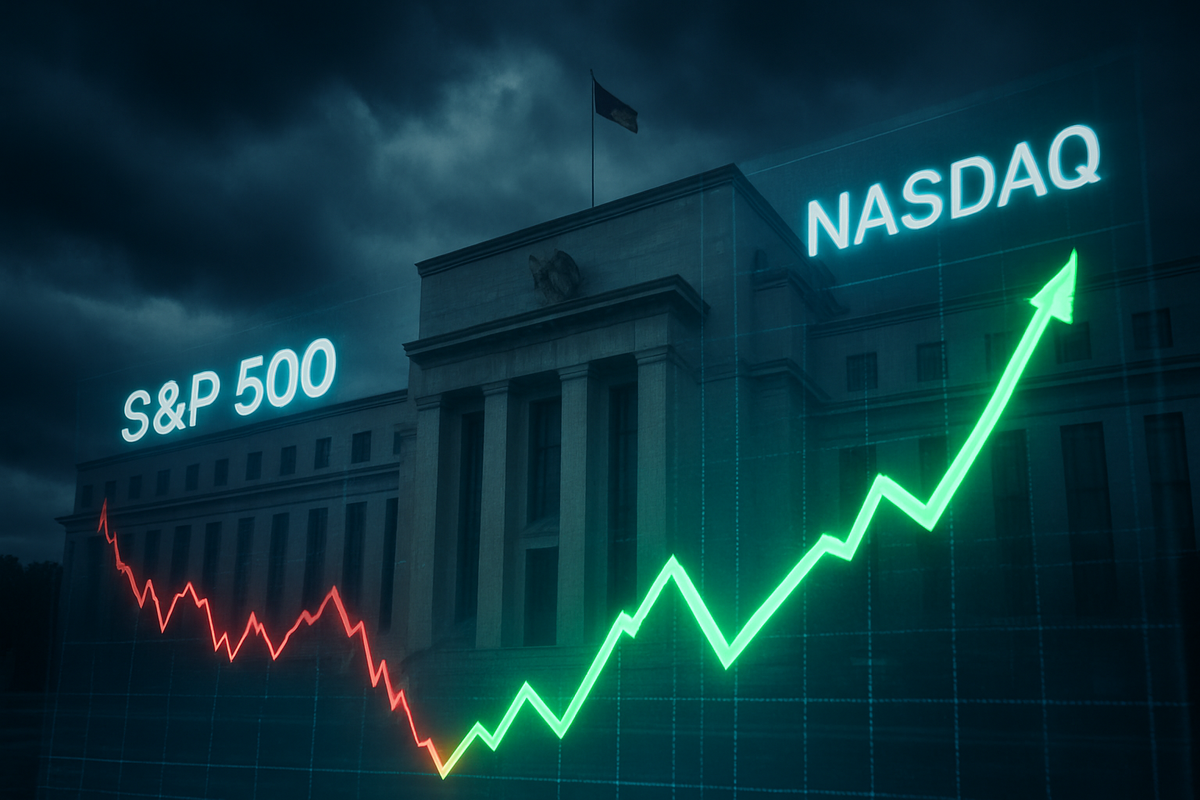
In a stunning display of market resilience, the S&P 500 and Nasdaq Composite erased significant early-morning losses on Monday, January 12, 2026, to finish the trading session in positive territory. The reversal came despite a geopolitical and domestic bombshell: the Department of Justice (DOJ) has officially launched a criminal investigation into Federal Reserve Chair Jerome Powell. The probe, which many analysts view as a direct assault on the independence of the U.S. central bank, initially sent shockwaves through global exchanges before being met by a tidal wave of "buy the dip" retail and institutional demand.
The morning sell-off saw the S&P 500 drop nearly 0.4% within the first hour of trading, while the Dow Jones Industrial Average plummeted over 300 points. However, as the lunch hour approached, the narrative shifted from panic to opportunism. By the closing bell, the S&P 500 had ticked up 0.1% to roughly 6,961, and the Nasdaq Composite climbed 0.4%, signaling that investors are currently more focused on corporate earnings and AI-driven productivity than the unprecedented legal drama unfolding in Washington, D.C.
A Headquarters Renovation Turns Into a Constitutional Crisis
The DOJ probe, authorized by U.S. Attorney for the District of Columbia Jeanine Pirro, centers on allegations that Chair Jerome Powell made false or misleading statements to the Senate Banking Committee in June 2025. The investigation focuses on the $2.5 billion renovation of the Federal Reserve’s Marriner S. Eccles Building. Critics, led by Russell Vought, Chair of the Office of Management and Budget (OMB), have accused Powell of authorizing "ostentatious" luxury upgrades and misrepresenting the total costs of the project to Congress.
The timeline of the escalation moved rapidly over the weekend. On Sunday, January 11, Powell released an extraordinary video statement defending the Fed’s actions and labeling the investigation a "pretext" for political retaliation. This follows months of public pressure from the White House, with President Donald Trump repeatedly demanding aggressive interest rate cuts to fuel economic growth. The issuance of grand jury subpoenas to Fed officials on Monday morning was the catalyst for the initial market plunge, as investors feared a total breakdown in the relationship between the executive branch and the nation's monetary authority.
Key players in this drama include not only Powell and the DOJ but also figures like Kevin Hassett, the Director of the National Economic Council, who is rumored to be the administration’s top choice to replace Powell when his term as Chair expires in May 2026. Senator Thom Tillis (R-NC) has also emerged as a vocal critic of the probe, warning that the move could permanently damage the credibility of the U.S. dollar by signaling the end of central bank independence.
Winners and Losers: Tech Leads the Charge While Banks Brace for Impact
The primary beneficiaries of the "buy the dip" sentiment were the mega-cap technology stocks that dominate the Nasdaq. Companies like Nvidia (NASDAQ: NVDA) and Microsoft (NASDAQ: MSFT) saw significant inflows as investors bet that the political noise would not derail the long-term AI-driven productivity super-cycle. Apple (NASDAQ: AAPL) also saw its shares recover from an early 1% drop to finish slightly higher, as retail investors viewed the morning volatility as a rare entry point into a high-quality asset.
Conversely, the financial sector faced more uncertainty. Shares of JPMorgan Chase (NYSE: JPM) and Goldman Sachs (NYSE: GS) initially struggled as the prospect of a leaderless or politically compromised Federal Reserve raised questions about regulatory stability and future interest rate trajectories. While these stocks eventually stabilized, they lagged behind the broader market recovery. Meanwhile, traditional "safe havens" saw a massive influx of capital; Gold (COMEX:GC) surged to a record high of $4,629, and Bitcoin (BTC) spiked toward $92,000 before settling, as some investors sought refuge from the potential debasement of the dollar.
The Evolution of the 'Buy the Dip' Culture in 2026
The market’s ability to shrug off a criminal probe into the world’s most powerful central banker highlights a profound shift in investor psychology. In 2026, "buy the dip" has transitioned from a speculative meme into a structural market force. According to data from firms like Citadel Securities, retail investors in early 2026 hold cash balances in the 98th percentile historically, providing a massive liquidity buffer that can be deployed the moment a headline causes a price dislocation.
This event fits into a broader trend of "headline desensitization." Over the past two years, markets have navigated numerous political shocks, leading many institutional desks—such as those at Wellington Management—to adopt "resilience" as their primary mantra. The prevailing sentiment is that as long as the "Fed put" exists—or in this case, the expectation that the administration will eventually get the rate cuts it wants—any dip is viewed as a temporary discount rather than a systemic threat. This creates a self-fulfilling prophecy where the market's rapid recovery actually emboldens political actors to take further risks, knowing the "wealth effect" of the stock market remains intact.
The Road to May 2026: What Comes Next?
In the short term, the market will be hyper-focused on whether Jerome Powell chooses to resign or fight the DOJ subpoenas in court. A resignation could trigger a second, more severe round of volatility, especially if a more partisan successor is fast-tracked through the appointment process. However, if Powell remains in his seat and continues to hold the line on interest rates, a prolonged legal battle could create a "new normal" of high-frequency political friction that the market may eventually learn to ignore entirely.
Strategically, the Federal Reserve may be forced to pivot its communications. To maintain its independence, the Fed might lean into even more transparent data-dependency to prove that its decisions are not being swayed by the DOJ's pressure. For investors, the challenge will be distinguishing between "noise" and "signal." If the probe begins to affect the actual mechanics of the Treasury market or the Fed's ability to conduct open-market operations, the "buy the dip" strategy will face its greatest test since the 2020 pandemic.
A Market Built on Iron-Clad Conviction
The events of January 12, 2026, will likely be remembered as the day the "buy the dip" era was tested by a constitutional crisis—and won. The fact that the S&P 500 and Nasdaq ended the day in the green suggests that the current market is powered by a level of retail and institutional conviction that is almost entirely decoupled from the political stability of Washington.
Moving forward, investors should watch for the results of the grand jury proceedings and any potential retaliatory moves from the Fed, such as an unexpected "hawkish" hold on rates to assert independence. While the resilience of the market is impressive, the erosion of institutional norms carries long-term risks that may not be reflected in today's stock prices. For now, the "melt-up" continues, but the shadow of the DOJ over the Eccles Building ensures that the months leading up to the May 2026 Chair transition will be some of the most volatile in financial history.
This content is intended for informational purposes only and is not financial advice.