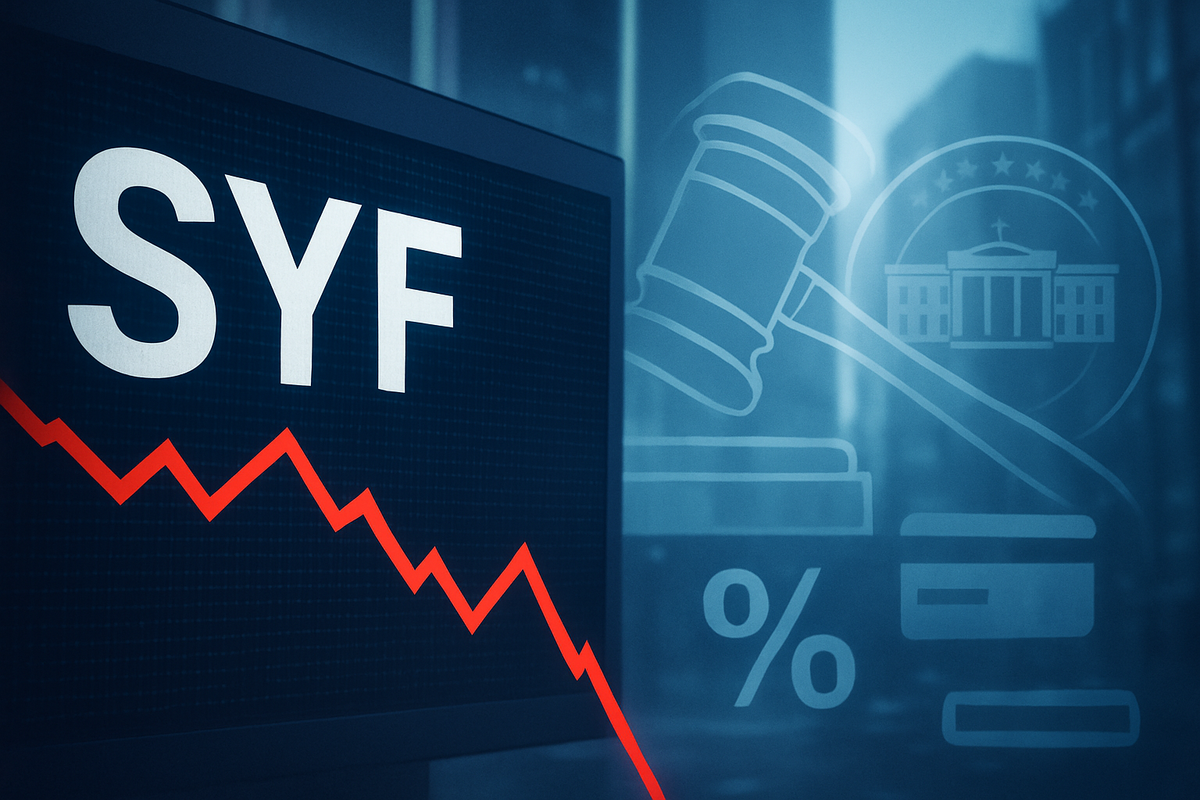
NEW YORK — Shares of Synchrony Financial (NYSE: SYF) plummeted more than 8% on Monday as investors reacted with alarm to a weekend proposal from President-elect Donald Trump to institute a temporary 10% cap on credit card interest rates. The announcement, which sent shockwaves through the consumer finance sector, has ignited a fierce debate over the future of credit accessibility and the profitability of the nation’s largest lenders.
The sell-off reflects growing concerns that a federally mandated rate ceiling would fundamentally dismantle the business models of specialized lenders who rely on high-yield interest to offset the risks of lending to subprime and near-prime consumers. While framed by the incoming administration as a populist measure to provide relief to debt-burdened Americans, market analysts warn that the move could inadvertently trigger a massive contraction in available credit, leaving millions of borrowers without access to traditional financial services.
A Weekend "Truth" and a Monday Morning Rout
The turmoil began late Friday night, January 9, 2026, when President-elect Trump took to Truth Social to outline a centerpiece of his administration's first-year economic agenda. In the post, Trump proposed a "temporary" one-year cap on all credit card interest rates at 10%, arguing that current rates—which often range between 20% and 30%—are "ripping off" the American public. The proposal is slated to coincide with the one-year anniversary of his second administration on January 20, 2026.
By the time markets opened on Monday, January 12, the reaction was swift and decisive. Synchrony Financial, the largest issuer of private-label credit cards in the United States, saw its stock price drop by 8.7% in early trading. Synchrony is particularly exposed to such a policy because its portfolio is heavily weighted toward retail partnerships and consumers who often carry balances at higher interest rates. The 10% cap is significantly lower than the cost of risk and capital for much of Synchrony’s core customer base, leading analysts to suggest that a large portion of the company's current portfolio could become overnight loss-leaders.
The banking industry, represented by the American Bankers Association (ABA) and the Bank Policy Institute (BPI), issued a rare joint statement on Sunday evening, calling the proposal "economically devastating." The groups argued that the cap would force banks to tighten lending standards so severely that subprime borrowers would be effectively locked out of the credit market, potentially driving them toward unregulated and predatory "loan sharks."
Winners and Losers: A Sector Divided
The fallout was not limited to Synchrony. Other major card issuers with significant subprime exposure faced similar pressure. Capital One Financial Corp. (NYSE: COF) saw its shares slide 7.2%, while Discover Financial Services (NYSE: DFS) dropped 8.1%. Bread Financial Holdings, Inc. (NYSE: BFH), which specializes in store-branded cards for middle-market retailers, was the hardest hit among the mid-caps, with shares tumbling nearly 12.5%. Even diversified giants like Citigroup Inc. (NYSE: C) and JPMorgan Chase & Co. (NYSE: JPM) saw their shares dip 4.1% and 2.5%, respectively, as investors weighed the impact on their massive credit card divisions.
However, the news created an unexpected rally for the "Buy Now, Pay Later" (BNPL) sector. Shares of Affirm Holdings, Inc. (NASDAQ: AFRM) and Block, Inc. (NYSE: SQ) rose by 4.5% and 3.2%, respectively. Analysts suggest that if traditional credit cards are restricted by a 10% cap, banks will likely cancel millions of high-risk accounts. This would create a vacuum that BNPL providers—which often operate under different regulatory frameworks and offer installment-based "interest-free" or fixed-fee models—are perfectly positioned to fill. For these fintech companies, a crackdown on traditional revolving credit represents a massive opportunity for user acquisition.
Historical Precedents and the "Credit Crunch" Warning
The proposal marks the most aggressive attempt to regulate interest rates since the 1978 Supreme Court ruling in Marquette National Bank v. First of Omaha, which allowed national banks to "export" the interest rates of their home states across the country. This ruling effectively ended state-level usury caps and paved the way for the modern, risk-based pricing model of the credit card industry.
While the Credit CARD Act of 2009 introduced significant protections against hidden fees and retroactive rate hikes, it stopped short of a hard interest rate cap. The only existing federal precedent for such a move is the Military Lending Act, which caps APRs at 36% for active-duty service members. Trump’s 10% proposal is nearly four times more restrictive than the military cap and sits well below the historical average for even the most prime borrowers.
Industry veterans are drawing parallels to the 1991 Senate vote that briefly approved a 14% cap, only to see the bill die in the House after bank stocks cratered and the industry warned of a "credit crunch." The concern today is that a 10% cap would not just reduce bank profits, but would eliminate the "rewards" ecosystem entirely. Cash-back programs and travel points are largely funded by the interchange and interest revenue that this cap would decimate.
The Road Ahead: Legal Hurdles and Strategic Pivots
Despite the market's visceral reaction, many legal experts remain skeptical that such a cap could be implemented through executive action alone. Most analysts believe a national interest rate cap would require an act of Congress, where it would likely face stiff opposition from both moderate Republicans and banking-aligned Democrats. "This is likely a 'shot across the bow' intended to pressure banks to lower rates voluntarily," said one senior analyst at Wolfe Research. "However, the mere threat of such a policy increases the 'regulatory risk premium' for the entire sector."
In the short term, companies like Synchrony Financial may be forced to pivot their strategy toward more fee-based income or stricter credit tiering. If the proposal gains legislative traction, we could see a massive "de-risking" event where banks proactively close accounts for any borrower with a credit score below 700. This would likely lead to a sharp decline in consumer spending, particularly in the retail and e-commerce sectors that rely on private-label credit to drive high-ticket sales.
A Defining Moment for Consumer Finance
The plunge in Synchrony Financial’s stock serves as a stark reminder of the industry's sensitivity to populist regulatory shifts. While the 10% cap remains a proposal for now, the political climate has clearly shifted toward more direct intervention in the financial lives of Americans. For investors, the coming months will be defined by "headline risk" as the Trump administration moves from social media posts to formal policy drafting.
The key takeaway for the market is that the era of uncontested, high-yield revolving credit may be nearing a crossroads. Whether through a hard cap or increased political pressure, the margins for credit card issuers are under siege. Investors should keep a close eye on the upcoming confirmation hearings for Treasury and CFPB appointments, as these officials will be the ones tasked with turning Trump's 10% vision into a regulatory reality. In the meantime, the flight to quality—and the migration toward fintech alternatives—appears to be the dominant trend in a volatile consumer finance landscape.
This content is intended for informational purposes only and is not financial advice.