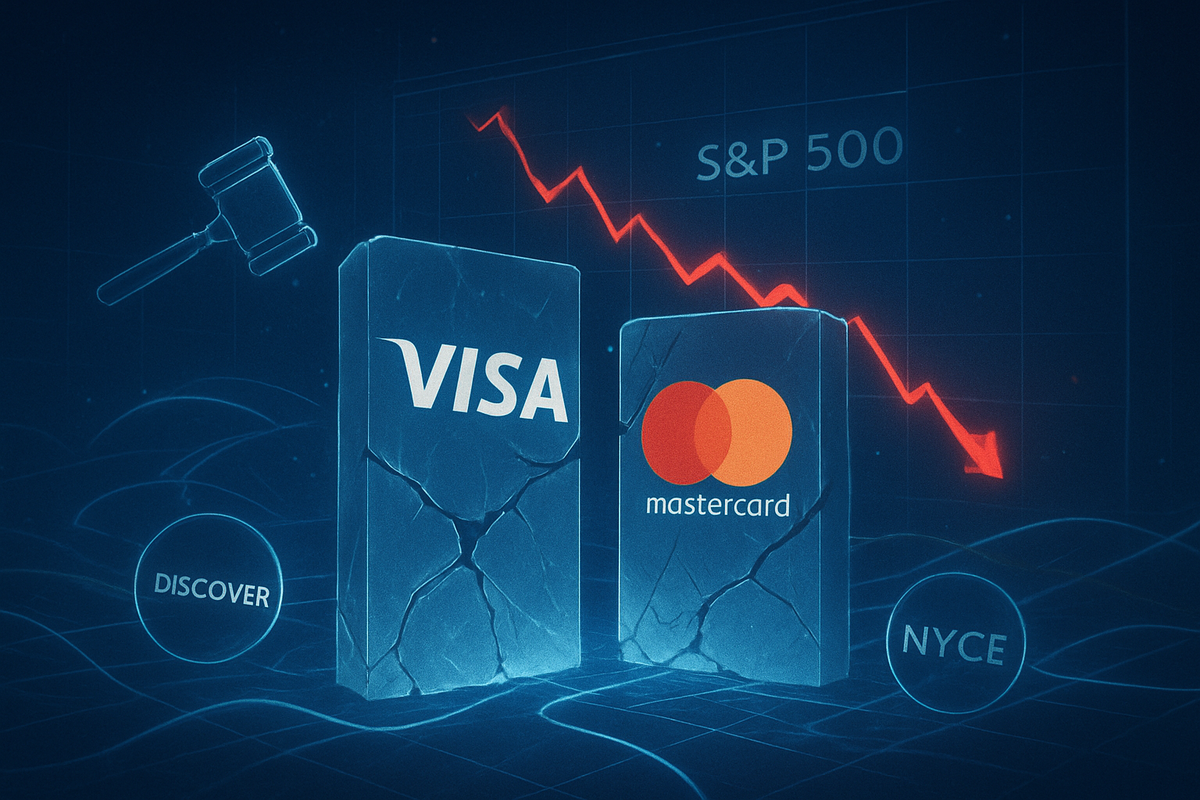
The global payments landscape was sent into a tailspin this week as a series of aggressive regulatory maneuvers and political shifts converged on the industry's dominant players. Visa (NYSE: V) saw its stock price crater by over 7% since the opening bell on Monday, marking one of its most volatile periods in recent memory. Its primary rival, Mastercard (NYSE: MA), fared little better, shedding approximately 5% of its market value as investors braced for what analysts are calling a "perfect storm" of legislative and judicial challenges that could fundamentally dismantle the industry's long-standing fee structures.
The immediate catalyst for the sell-off was a dual-pronged attack from the highest levels of the U.S. government. In a move that surprised both Wall Street and Washington, a new push for the Credit Card Competition Act (CCCA) received a high-profile endorsement on January 13, 2026, coinciding with a separate proposal to implement a 10% nationwide cap on credit card interest rates. With the S&P 500 (INDEXSP: .INX) feeling the drag from these financial heavyweights—which together command nearly $1 trillion in combined market capitalization—the broader market is now grappling with the potential end of the payment duopoly's era of unchecked dominance.
A Week of Unprecedented Regulatory Escalation
The volatility began in earnest on Friday, January 9, 2026, when a proposal was floated to cap credit card interest rates at 10%. While Visa and Mastercard act as payment networks rather than direct lenders, the market immediately priced in a "contraction effect." Investors fear that such a cap would force issuing banks to tighten credit standards, leading to a sharp decline in transaction volumes—the lifeblood of network fee revenue. The pressure intensified on January 13, when President Trump officially endorsed the Credit Card Competition Act on social media, labeling current interchange fees as an "out of control ripoff." This endorsement transformed the bill from a long-stalled legislative effort into a high-priority mandate.
The CCCA, reintroduced by Senators Dick Durbin (D-IL) and Roger Marshall (R-KS), aims to break the "Visa-Mastercard duopoly" by requiring U.S. banks with over $100 billion in assets to offer at least two unaffiliated networks for credit card routing. Critically, one of these networks must be a provider other than Visa or Mastercard. This would effectively allow merchants to bypass the two giants in favor of cheaper alternatives like the newly integrated Discover network or independent rails like NYCE or Star.
Compounding these domestic woes, the UK High Court ruled on January 15, 2026, that the Payment Systems Regulator (PSR) has the legal authority to cap cross-border interchange fees between the UK and the EU. This ruling permits the PSR to proceed with plans to slash fees that had risen fivefold following Brexit. Simultaneously, the Department of Justice (DOJ) continues to tighten the noose on Visa’s debit business, with a major discovery update scheduled for January 16 regarding its ongoing antitrust lawsuit alleging an illegal monopoly in the U.S. debit market.
Winners and Losers: A Shifting Power Dynamic
The primary victors in this regulatory upheaval are the world’s largest retailers. For giants like Walmart (NYSE: WMT), Amazon (NASDAQ: AMZN), and Target (NYSE: TGT), the ability to "least-cost route" transactions is a multibillion-dollar windfall. By choosing cheaper processing rails mandated by the CCCA, these retailers can significantly expand their profit margins, which have long been compressed by the 2% to 3% "swipe fees" that fund the current ecosystem.
In the financial sector, the clear winner is Capital One (NYSE: COF), which completed its landmark $52 billion acquisition of Discover in May 2025. By owning the Discover network, Capital One has positioned itself as the "third rail" of the American payments industry. As the largest credit card issuer in the U.S. by outstanding balances, Capital One is now migrating its vast portfolio onto its own proprietary network, effectively bypassing Visa and Mastercard entirely. Furthermore, other major banks may soon turn to Capital One’s Discover network to satisfy the CCCA's requirement for an alternative routing option, turning a former competitor into a vital utility.
Conversely, the "losers" list extends beyond the networks themselves. Large card-issuing banks like JPMorgan Chase (NYSE: JPM) and Citigroup (NYSE: C) are facing a "double jeopardy" scenario: the loss of interchange revenue used to fund reward programs and the potential for capped interest income. This shift likely signals the end of the "golden age" of credit card rewards. As interchange revenue dries up, analysts predict that popular travel points and cash-back programs will be significantly scaled back or replaced by higher annual fees, much like the disappearance of debit card rewards following the 2010 Durbin Amendment.
Broader Market Implications and Historical Context
The current crisis mirrors the 2010 fight over debit card "swipe fees," often referred to as Durbin 1.0. However, the stakes in 2026 are significantly higher because they involve the much more lucrative credit card market. Historically, Visa and Mastercard have maintained a "price-fixed" model where they set uniform interchange rates for all banks on their networks. The CCCA seeks to dismantle this model by introducing price competition at the network level, a move that could lead to a permanent "re-rating" of payment processor stocks.
The ripple effects are also being felt internationally. The European Union’s push for a "Digital Euro" is gaining technical momentum in 2026, explicitly aimed at reducing Europe's "strategic dependence" on U.S. payment rails. Between the UK’s cross-border fee caps and the EU’s implementation of the Payment Services Directive 3 (PSD3), the global regulatory environment is becoming increasingly hostile to the high-margin, toll-bridge business model that has made Visa and Mastercard two of the most profitable companies in history.
The Road Ahead: Strategic Pivots and Scenarios
In the short term, the market will be laser-focused on the legislative progress of the CCCA and the upcoming DOJ court dates. If the bill passes in its current form, Visa and Mastercard may be forced to radically alter their business models, perhaps by acquiring smaller, independent networks themselves or by lowering fees to predatory levels to stifle the very competition the law seeks to create.
Long-term, the industry may see a "balkanization" of payments. We are likely moving toward a world where transactions are routed through a patchwork of regional and proprietary networks rather than a global duopoly. For Visa and Mastercard, the strategic pivot must involve moving "beyond the card." This includes further investment in "Value-Added Services" (VAS) like fraud detection, data analytics, and cross-border B2B payments—areas that are less susceptible to the current wave of consumer-facing retail regulation.
Conclusion: A New Era for Payments
The events of early January 2026 mark a definitive turning point for the financial sector. The 7% drop in Visa’s stock is more than just a weekly fluctuation; it is a signal that the political and regulatory immunity long enjoyed by the payment giants has finally eroded. The convergence of a populist political climate, aggressive antitrust enforcement, and the rise of "vertically integrated" competitors like the post-merger Capital One has created a landscape where the status quo is no longer tenable.
For investors, the coming months will be a period of intense scrutiny. The primary metrics to watch will be the "routing migration" of large banks and the potential degradation of credit card reward value. While Visa and Mastercard remain formidable engines of global commerce, the "duopoly discount" is now being priced in. The market is moving toward a more fragmented, competitive, and regulated future—one where the "swipe" may never be as profitable as it once was.
This content is intended for informational purposes only and is not financial advice.