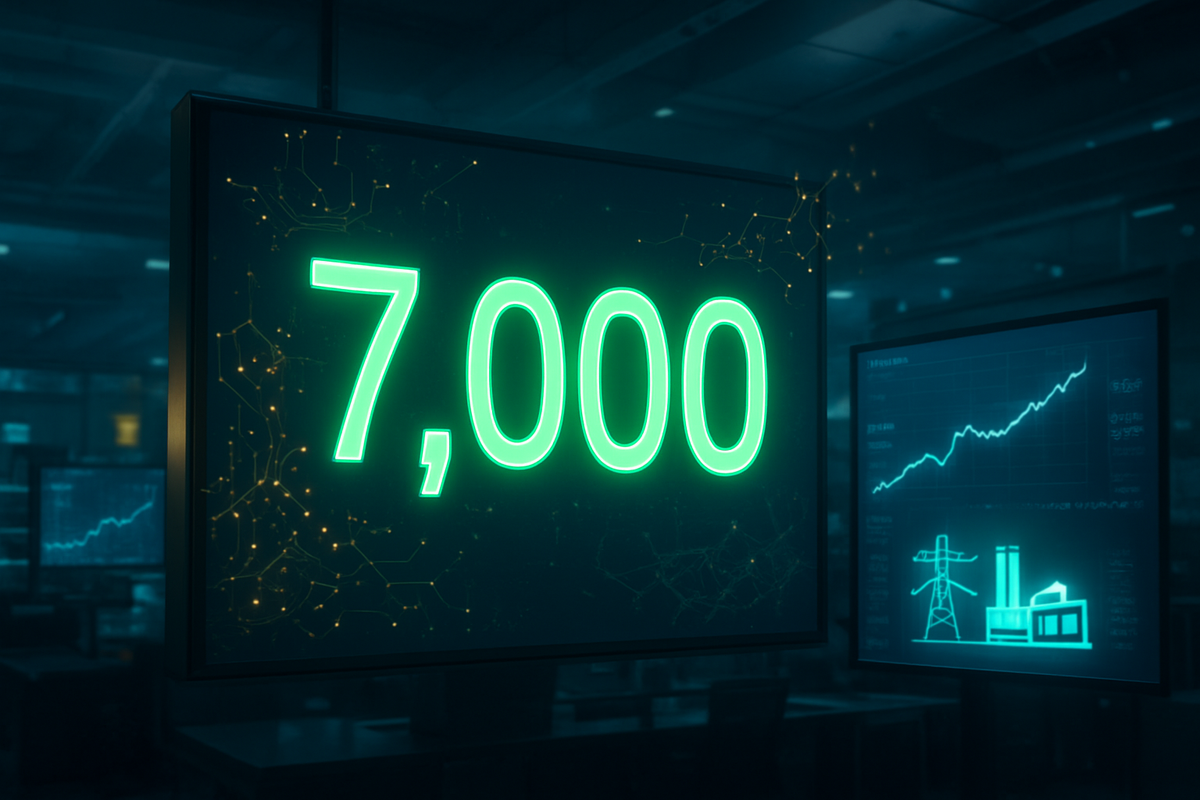
Wall Street etched a new chapter in financial history this week as the S&P 500 index briefly surged past the 7,000-point threshold for the first time, marking a breathtaking ascent that has redefined investor expectations for the decade. On January 28, 2026, the benchmark index touched an intraday high of 7,002.28, a psychological victory that underscores the resilience of the American economy and the transformative power of the artificial intelligence "Capex Super-Cycle."
The breach of the 7,000 level comes just fourteen months after the index first crossed 6,000 in November 2024, representing one of the fastest 1,000-point gains in the history of the market. While the index has slightly retreated to 6,969.01 as of today, January 30, 2026, the momentum generated by a combination of corporate tax incentives and a massive infrastructure build-out has set a bullish tone for the remainder of the year.
The Path to 7,000: A Timeline of Acceleration
The journey to this historic milestone was catalyzed by a "perfect storm" of fiscal policy and technological innovation that began in mid-2025. The definitive turning point arrived in July 2025 with the passage of the "One Big Beautiful Bill Act," a sweeping legislative package that introduced retroactive tax cuts and enhanced deductions for business investment. This policy shift acted as a massive liquidity injection, encouraging corporations to deploy capital at a record pace.
Leading up to the January 28 breakout, the market was propelled by a relentless rally in the "Magnificent Seven" and an expanding roster of semiconductor giants. Throughout 2025, the Federal Reserve managed a delicate "soft landing," gradually easing interest rates to 4.25% before pausing to assess the inflationary impact of new trade tariffs. This stability allowed growth-oriented sectors to flourish. The final push to 7,000 was sparked by a series of stellar Q4 earnings reports from the tech sector, which confirmed that AI productivity gains were finally beginning to manifest in bottom-line margins across the broader S&P 500.
Winners and Losers in the Race to the Top
The primary architects of the 7,000-point rally have been the hyperscale technology providers and the energy firms that power them. Microsoft Corp (NASDAQ: MSFT) and Alphabet Inc (NASDAQ: GOOGL) have seen their valuations soar as they successfully monetized AI integrated into enterprise software. Meanwhile, the semiconductor sector has transitioned from a cyclical industry to a permanent utility. Micron Technology, Inc. (NASDAQ: MU) and Western Digital Corp (NASDAQ: WDC) have emerged as top performers, with Western Digital gaining significant ground due to the insatiable demand for high-capacity storage in AI data centers.
The energy sector has also undergone a radical revaluation. No longer viewed simply as a hedge against inflation, companies like Exxon Mobil Corp (NYSE: XOM) and SLB (NYSE: SLB)—formerly Schlumberger—have pivoted to support the massive electricity needs of the digital revolution. SLB, in particular, has gained over 31% year-to-date as it provides the infrastructure necessary for the "Powering AI" initiative. Conversely, the transition has been less kind to traditional renewable energy firms, which have faced headwinds from a pro-fossil fuel regulatory environment and the high cost of grid integration, leading to a widening performance gap between "Old Energy" and "Green Tech."
Psychological Milestones and Broader Implications
The 7,000 level is more than just a number; it represents a profound psychological shift for institutional and retail investors alike. Historical precedents, such as the 1,000-point breach in 1998 or the 2,000-point milestone in 2014, show that such round numbers often act as a magnet for capital before serving as a new floor for support. The speed of this 1,000-point climb—taking just over a year—compared to the nearly five years it took to move from 2,000 to 3,000, signals a period of "hyper-growth" driven by automated efficiency.
However, this milestone also brings regulatory and policy implications to the forefront. The sheer concentration of the market in AI-related stocks has drawn the attention of antitrust regulators. Furthermore, the "Roaring 2020s" narrative championed by analysts like Ed Yardeni—who now projects an S&P 500 target of 7,700 by year-end—is being balanced against the risks of a potential "AI bubble." The broader market's reliance on a handful of tech titans remains a point of contention among skeptics who fear a repeat of the 2000 dot-com collapse.
The Road to 8,000: What Lies Ahead
Looking forward, the market faces a transition period as it digests the gains of early 2026. The short-term focus has already shifted to the Federal Reserve following the nomination of Kevin Warsh as the next Fed Chair. Known for a more hawkish stance on inflation, Warsh's potential leadership has introduced a layer of caution, contributing to the slight pullback seen in the last 48 hours. Investors are now watching to see if the central bank will maintain its accommodative stance or if the 7,000 level will trigger a period of consolidation.
Strategic pivots are also expected in the energy sector, where the "nuclear renaissance" is gaining steam. As data centers demand 24/7 carbon-free baseline power, partnerships between tech firms and nuclear providers are likely to emerge as the next major investment theme. The ability of the "other 493" companies in the S&P 500 to maintain their earnings growth will be the ultimate test of whether the index can sustain its trajectory toward 8,000.
Summary and Market Outlook
The S&P 500’s ascent to 7,000 is a testament to the compounding effects of technological breakthroughs and favorable fiscal policy. While the tech and energy sectors have been the undeniable engines of this growth, the milestone reflects a broader optimism about the U.S. economy's ability to innovate out of inflationary pressures. Key takeaways for investors include the critical importance of the AI infrastructure chain and the renewed relevance of traditional energy services in a digital-first world.
Moving forward, the market is expected to remain volatile as it navigates a changing of the guard at the Federal Reserve and the implementation of new trade policies. Investors should closely monitor Q1 2026 earnings for any signs of slowing capital expenditure in the tech sector. While the 7,000 level has been breached, the journey to 8,000 will likely require a broader participation from value sectors and a continued "soft landing" for interest rates.
This content is intended for informational purposes only and is not financial advice.