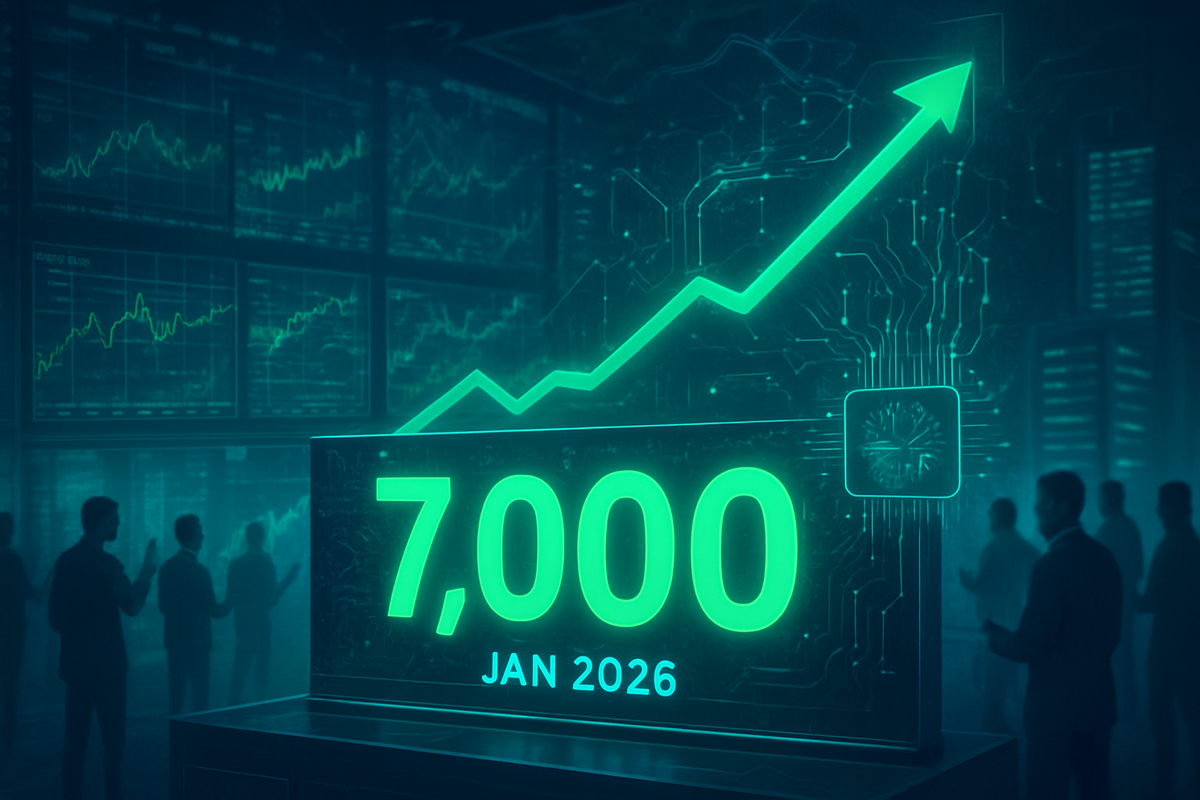
In a historic display of market resilience and technological optimism, the S&P 500 index officially crossed the 7,000-point threshold on January 28, 2026. This monumental achievement marks a new era for Wall Street, coming just fourteen months after the index first touched 6,000 in late 2024. The ascent to 7,000 has been propelled by a unique "perfect storm" of maturing artificial intelligence (AI) infrastructure, a pivot toward pro-business fiscal policy, and a Federal Reserve that has successfully navigated a "soft landing" for the U.S. economy.
The immediate implications of the 7,000-point breakout are profound, signaling an aggressive shift in market momentum. While the milestone is psychologically significant, it also reflects a tangible explosion in corporate profitability. Analysts note that the rally has been underpinned by a massive "Capex Super-Cycle," with the world’s largest technology firms funneling hundreds of billions into AI data centers, which is now beginning to translate into bottom-line growth across the broader economy.
The 14-Month Sprint: From 6,000 to 7,000
The journey to 7,000 was characterized by a rapid acceleration that caught many institutional bears by surprise. After hitting 6,000 in November 2024, the market navigated a volatile 2025 before being turbocharged by the "Santa Claus rally" of December 2025, which saw an 18% annual return. By the first weeks of January 2026, the S&P 500 was consistently testing record highs, recording its fourth record close of the year on the very day it shattered the 7,000 barrier. This 1,000-point gain in just over a year is significantly faster than the nearly three-year journey required to move from 4,000 to 5,000.
Key players in this ascent have been the "Big Four" AI spenders, whose combined capital expenditures are projected to hit $505 billion in 2026. This massive investment served as a liquidity engine for the entire semiconductor and energy sectors. Furthermore, the Federal Reserve played a critical role; after three consecutive 25-basis-point rate cuts in late 2025, the central bank held rates steady in January 2026 within the 3.0% to 3.75% range. This "steady easing" cycle provided the necessary confidence for equities to surge, even as geopolitical tensions periodically threatened to derail the momentum.
The final push over the 7,000 mark was also heavily influenced by the implementation of the "One Big Beautiful Bill Act" (OBBBA), which went into effect on January 1, 2026. The act made 100% bonus depreciation for business equipment permanent, providing a massive fiscal tailwind for capital-intensive firms. As the index crossed the mark on January 28, market participants pointed to a "gamma breakout" in the options market, where heavy bullish positioning finally forced market makers to hedge, accelerating the upward move in the final hours of trading.
The Two-Speed Market: Winners and Losers of the 7,000 Era
The rally to 7,000 has not been a "rising tide" for all boats. Instead, it has created a starkly bifurcated market. On the winning side, Nvidia (NASDAQ: NVDA) remains the ultimate AI bellwether, having surpassed a staggering $5 trillion market capitalization in late 2025. Other hyperscalers like Microsoft (NASDAQ: MSFT) and Meta (NASDAQ: META) have seen their valuations soar as AI investments began to significantly improve ad monetization and enterprise productivity. Semiconductor giants Broadcom (NASDAQ: AVGO) and Micron (NASDAQ: MU) have also thrived, riding the wave of secondary infrastructure demand.
Conversely, the march to 7,000 has left several legacy sectors in the dust. The healthcare industry has faced a "haircut" due to sweeping policy changes and earnings misses; Humana (NYSE: HUM) and UnitedHealth Group (NYSE: UNH) saw their stocks plummet by 21.1% and 19.6%, respectively, in the weeks leading up to the milestone. Traditional software companies are also facing an existential crisis as AI "agents" begin to cannibalize traditional enterprise budgets. Legacy firms like SAP (NYSE: SAP), Salesforce (NYSE: CRM), and Adobe (NASDAQ: ADBE) have struggled, with SAP plunging 15% after a cautious cloud outlook suggested that their traditional seats-based model is being disrupted.
Furthermore, specific policy shifts within the OBBBA and the current administration's trade stance have created "sectoral losers." Traditional retail and luxury brands like Lululemon Athletica (NASDAQ: LULU) and LVMH (OTC: LVMUY) have seen declines of over 50% year-over-year as consumer spending rotates. Meanwhile, Intel (NASDAQ: INTC) faced a devastating 17% drop in January 2026 alone, as it failed to pivot its foundry business quickly enough to compete with the specialized AI silicon being produced by its rivals.
Geopolitical Friction and the Policy Landscape
The significance of the 7,000 milestone is heightened by the fact that it occurred against a backdrop of intense geopolitical uncertainty, most notably the "Greenland Crisis." In early January 2026, tensions peaked between the U.S. and NATO over demands for U.S. "ownership" or sovereignty over Greenland. The market briefly wobbled when threats of a 25% import tax on European goods were issued. However, the "Davos Framework" announced on January 21—following a meeting between U.S. leadership and NATO Secretary-General Mark Rutte—staved off a full-scale trade war, allowing the rally to resume.
Policy-wise, the OBBBA is the primary engine of the 2026 economy. By providing tax-free status for tips and overtime pay, and increasing the Child Tax Credit, the bill is expected to inject $160 billion into consumer hands in 2026. This fiscal stimulus, combined with permanent R&D expensing, has fundamentally altered the valuation models for S&P 500 companies. However, the bill also introduced a 1% remittance excise tax on foreign fund transfers, which has pressured global money-transfer providers but bolstered domestic liquidity.
Historically, reaching 7,000 puts the S&P 500 at a valuation multiple (P/E ratio) not seen since the peak of the 2021 post-pandemic bubble. While bulls argue that "this time is different" due to the transformative nature of AI-driven productivity, skeptics point to the historical precedent of milestones often being followed by a period of "digestion" or consolidation. The speed of the move—gaining 1,000 points in just 14 months—has raised concerns about market overheating and "sentiment fatigue."
Looking Ahead: The Road to 8,000 or a Mid-Year Correction?
As the market enters February 2026, the question on every investor's mind is whether the 7,000 level will act as a floor or a ceiling. Wall Street analysts remain divided. Oppenheimer (NYSE: OPY) has set a bold target of 8,100 for the year's end, citing continued dominance by the tech sector. Conversely, Fundstrat has forecasted a target of 7,300 but warns of a potential 15-20% mid-year pullback as the market "cleanses" the excessive leverage that typically accompanies such rapid milestones.
The next strategic pivot for investors will likely involve moving away from "AI infrastructure" and toward "AI applications"—the companies that are successfully using these tools to expand margins. Additionally, the market will need to monitor potential regulatory challenges for the defense sector. Lockheed Martin (NYSE: LMT) and Northrop Grumman (NYSE: NOC) recently faced pressure after the White House threatened to ban dividends and buybacks for firms until production bottlenecks are resolved, a move that could shift capital flows into more deregulated sectors.
Summary of the Market's Historic Achievement
The S&P 500’s arrival at 7,000 is a testament to the transformative power of the AI revolution and a highly accommodative fiscal environment. The key takeaways for investors are clear: we are in a "two-speed" economy where technological innovators are being rewarded with unprecedented valuations, while legacy industries face significant disruption and policy-driven headwinds. The maturation of AI from a speculative theme to a core driver of earnings growth has redefined the market's trajectory.
Moving forward, the sustainability of this rally will depend on corporate earnings continuing to meet the high bar set by 2026 projections. Investors should keep a close eye on inflation data, as any resurgence could force the Federal Reserve to abandon its "steady easing" stance. Furthermore, the fallout from the "Greenland Crisis" and the continued implementation of the OBBBA will remain the dominant themes for the remainder of the year. While 7,000 is a historic win, the coming months will test whether the market’s momentum is a structural shift or a temporary peak.
This content is intended for informational purposes only and is not financial advice.