As the calendar turns to 2026, the financial world remains transfixed by Nvidia Corp. (NASDAQ: NVDA), the semiconductor titan that redefined the limits of corporate growth over the last three years. Following a 2025 that saw the company become the first in history to breach a $5 trillion market capitalization, investors are now grappling with whether the "AI supercycle" has more room to run or if the law of large numbers will finally catch up to the world's most valuable chipmaker.
The immediate implications are profound: Nvidia’s stock performance has become the de facto pulse of the global economy. With a consensus "Strong Buy" rating and a median price target of $264.11, Wall Street is betting that the transition from the "Blackwell" architecture to the newly unveiled "Rubin" platform will catalyze another year of double-digit growth. However, as the company enters 2026, it faces a more complex landscape characterized by intensifying competition from traditional rivals and a shift in demand from massive model training to widespread AI inference.
The 2025 Foundation and the Rubin Reveal
Nvidia entered 2026 on the heels of a blockbuster 2025, during which its stock surged approximately 40%, significantly outperforming the broader S&P 500. The year was defined by the massive rollout of the Blackwell architecture, specifically the GB200 "Superchip," which became the backbone of global data centers. By the third fiscal quarter of 2026 (reported in late 2025), Nvidia’s Data Center revenue had skyrocketed to a record $51.2 billion—a 66% year-over-year increase that silenced skeptics who predicted a "spending cliff."
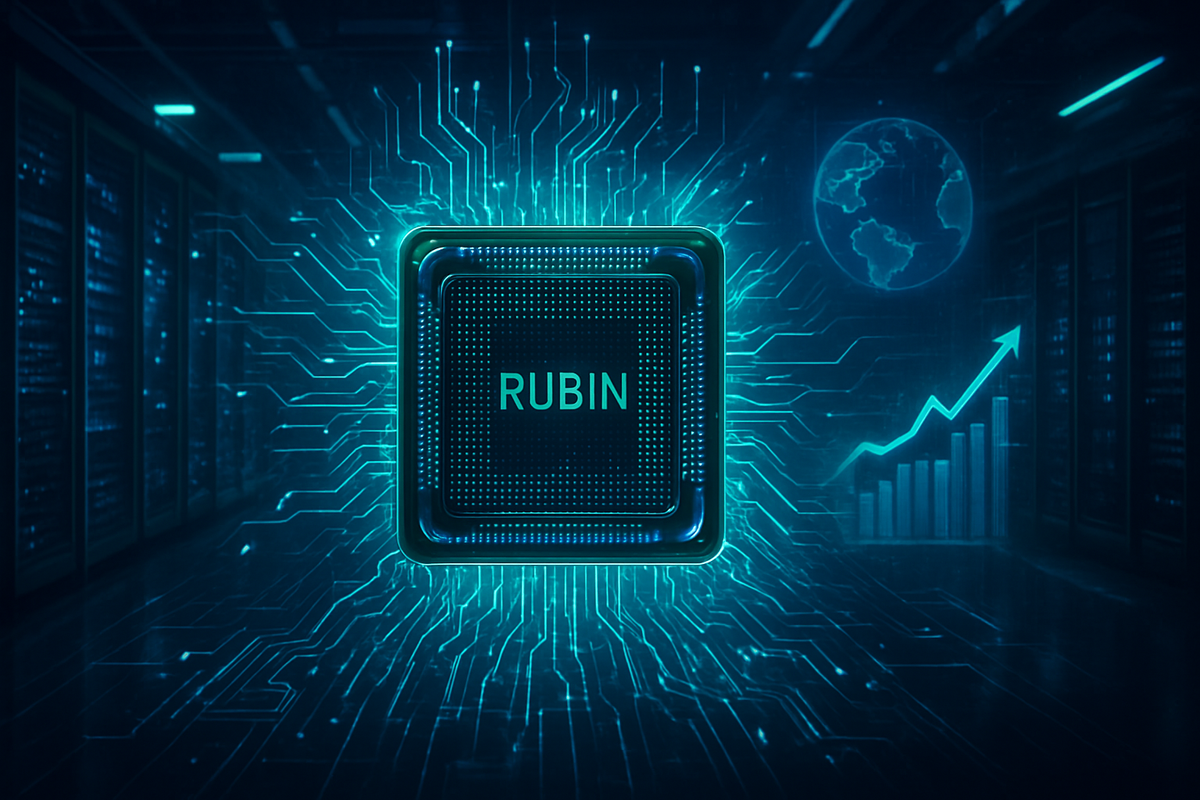
The momentum reached a fever pitch yesterday, January 5, 2026, at the Consumer Electronics Show (CES), where CEO Jensen Huang officially launched the "Rubin" platform. Positioned as the successor to Blackwell, Rubin is confirmed to be in full production, with commercial availability slated for the second half of 2026. The platform introduces the "Vera" CPU, a custom ARM-based processor that doubles the data processing performance of its predecessor, and the Rubin GPU, which utilizes cutting-edge 3nm process technology and HBM4 (High Bandwidth Memory). According to Nvidia, Rubin delivers five times the inference performance of Blackwell, a critical metric as the industry shifts toward "agentic AI"—autonomous software agents that require constant, low-latency compute.
This technological leap is not just a matter of pride; it is a strategic necessity. The timeline of the last 24 months shows Nvidia accelerating its product cadence from a two-year cycle to an annual one. This "treadmill of innovation" has forced competitors to chase a moving target, but it has also placed immense pressure on Nvidia’s primary manufacturer, Taiwan Semiconductor Manufacturing Co. (NYSE: TSM), which is currently operating at 100% capacity for its 3nm nodes to meet Nvidia’s voracious demand.
Winners and Losers in the $600 Billion Arms Race
The primary beneficiaries of Nvidia’s continued dominance are the "Hyperscalers"—Microsoft (NASDAQ: MSFT), Alphabet (NASDAQ: GOOGL), Amazon (NASDAQ: AMZN), and Meta (NASDAQ: META). These four giants are projected to spend a staggering $600 billion in capital expenditures in 2026, with 75% of that earmarked for AI infrastructure. While they are Nvidia’s largest customers, they are also increasingly its most formidable competitors. Amazon and Google are aggressively scaling their own custom silicon, such as Trainium2 and TPU v7, to reduce their reliance on Nvidia’s high-margin chips.
In the merchant silicon market, Advanced Micro Devices (NASDAQ: AMD) has emerged as the most credible challenger. AMD’s Instinct MI400 series, set for a mid-2026 launch, boasts 432 GB of HBM4 memory—roughly 1.5 times the capacity of Nvidia’s Rubin. This makes AMD a winner for enterprises running the largest "Mixture-of-Experts" (MoE) models, where memory capacity is the primary bottleneck. Conversely, Intel (NASDAQ: INTC) has pivoted away from its standalone Gaudi line to focus on "Crescent Island," an inference-optimized system. While Intel may lose the "training" war, it is positioning itself as a cost-effective alternative for the high-volume inference market.
The "hidden" winners of the 2026 outlook are the memory manufacturers. SK Hynix and Samsung (OTC: SSNLF) are in a race to supply the HBM4 modules required for the Rubin GPU. With Nvidia demanding 16-Hi HBM4 stacks—the densest ever produced—by the end of the year, these firms are seeing record margins, though they face significant technical hurdles in thinning silicon wafers to the required 30-micrometer thickness.
The Rise of Sovereign AI and Geopolitical Shifts
Beyond corporate competition, Nvidia’s 2026 outlook is being shaped by the macro trend of "Sovereign AI." Nations are no longer content to outsource their intelligence to Silicon Valley; they are building domestic compute clusters as a matter of national security. Saudi Arabia’s "HUMAIN" project and the UAE’s "Stargate Abu Dhabi" are multi-billion-dollar initiatives aimed at creating Arabic-native AI ecosystems powered almost exclusively by Nvidia hardware.
This trend fits into a broader industry shift toward "geopatriation," where data residency and local model control are prioritized. In Europe, France and the UK have launched sovereign infrastructure plans worth over €100 billion combined, utilizing Nvidia’s Grace Blackwell superchips to provide domestic alternatives to US-based clouds. For Nvidia, this represents a massive new revenue stream that is less sensitive to the capital expenditure cycles of US tech giants.
However, this global expansion brings regulatory risks. As Nvidia’s chips become "strategic assets," they are increasingly subject to export controls and national security reviews. The company’s success has made it a central figure in the technological "Cold War" between the US and China, with Nvidia constantly redesigning products to meet evolving Department of Commerce guidelines. This regulatory tightrope remains the single largest "known unknown" for investors in 2026.
The Road Ahead: From Training to Inference
As we look toward the remainder of 2026, the key challenge for Nvidia will be navigating the transition from the training of Large Language Models (LLMs) to the "inference" phase—where those models are actually put to work. While training requires massive clusters of GPUs, inference can often be handled by less powerful, more energy-efficient chips. If the industry moves toward smaller, specialized models, Nvidia’s high-end Rubin GPUs may face a "saturation point" in traditional data centers.
To counter this, Nvidia is pivoting toward "Agentic AI" and robotics. The 2026 roadmap includes significant investments in the "Omniverse" platform and the "Thor" chip for autonomous machines. These strategic pivots suggest that Nvidia is no longer just a chip company, but a full-stack AI foundry. The short-term opportunity lies in the "Rubin" ramp-up in the second half of the year, while the long-term challenge will be maintaining its 80% market share as the "Magnificent 5" hyperscalers become more self-sufficient.
Investor Takeaway: A High-Stakes Balancing Act
Nvidia enters 2026 in a position of unprecedented strength, but the stakes have never been higher. The company is currently trading at a premium that assumes flawless execution of the Rubin rollout and continued triple-digit growth in its data center segment. Investors should watch closely for any signs of "digestion"—a period where hyperscalers pause their buying to integrate the massive amounts of Blackwell hardware purchased in 2025.
The key metrics for the coming months will be TSMC’s 3nm yields and the adoption rate of HBM4 memory. If supply chain bottlenecks persist, Nvidia may struggle to hit its bullish $264 median price target. However, if the "Sovereign AI" wave continues to build and "Agentic AI" becomes the next killer app, Nvidia’s $5 trillion valuation may only be the beginning. For now, the semiconductor giant remains the indispensable engine of the fourth industrial revolution, but in 2026, the world will be watching to see if that engine can maintain its record-breaking RPMs.
This content is intended for informational purposes only and is not financial advice. Moving forward, investors should consult with a qualified financial advisor before making any investment decisions regarding Nvidia or the semiconductor sector.