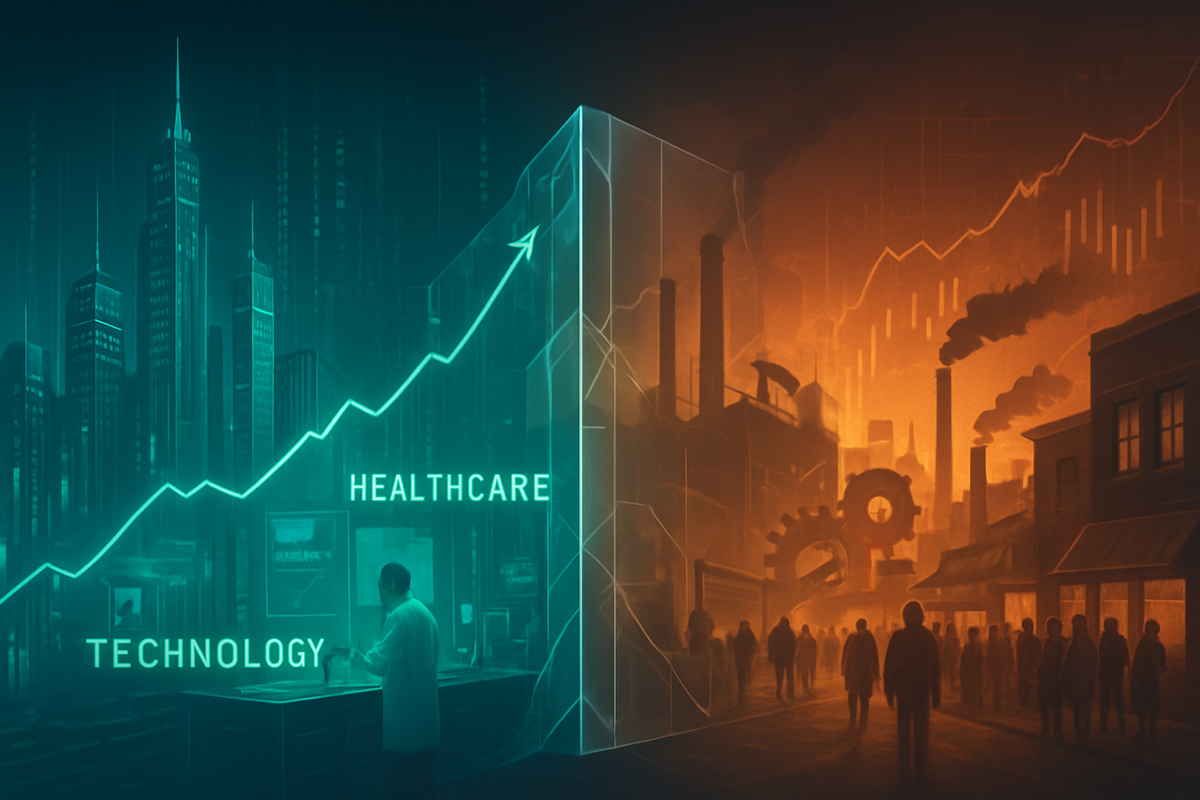
As the first week of 2026 comes to a close, the financial markets are undergoing a significant structural shift. The broad-based "rising tide" that lifted almost all sectors throughout 2025 has begun to fragment, giving way to a more discerning "Internal Repair" phase. Investors are increasingly rotating capital out of economically sensitive cyclical stocks and small-cap names, instead funneling it into the high-conviction strongholds of Technology and Healthcare. This pivot suggests that the market’s appetite for general risk is waning, replaced by a focused demand for companies with fortress balance sheets and clear secular growth drivers.
The immediate implications are stark: while the S&P 500 (NYSE Arca: SPY) remains near record highs around the 6,858 level, the underlying participation is narrowing. The Nasdaq Composite (NASDAQ: QQQ), currently consolidating near 23,235, is once again outperforming its peers as the "Second Wave of AI" takes hold. Meanwhile, the Russell 2000 (NYSE Arca: IWM), representing smaller companies, has already dipped 1.5% in the opening days of the year, signaling that the broader risk rally may be stalling under the weight of persistent inflation and a "refinancing wall" for debt-heavy firms.
A Tale of Two Markets: The January Rotation
The current market environment is the culmination of a transition that began in the final quarter of 2025. After a year where Industrials (NYSE Arca: XLI) and Small Caps enjoyed a "catch-up" rally, the reality of "higher-for-longer" interest rates—currently floor-set at 3.5%—has dampened enthusiasm for cyclical plays. Investors are now facing a reality where inflation remains sticky at 3%, making the debt servicing costs for smaller, less profitable companies a primary concern. This has led to a sharp rotation into the Technology Select Sector SPDR Fund (NYSE Arca: XLK) and the Health Care Select Sector SPDR Fund (NYSE Arca: XLV), which are increasingly viewed as "quality havens."
In the technology sector, the narrative has evolved from the speculative "AI gold rush" of 2024 and 2025 into a phase of industrialization and monetization. Stakeholders are no longer satisfied with promises of future utility; they are rewarding companies that provide the essential infrastructure for the digital age. Key players like Nvidia (NASDAQ: NVDA) continue to lead the charge, with the market already pricing in the highly anticipated release of its "Vera Rubin" chip architecture later this year. The timeline of this rotation was accelerated by early January reports showing that AI software revenue is finally beginning to scale, justifying the massive capital expenditures seen over the past 24 months.
Simultaneously, the healthcare sector is experiencing a renaissance fueled by clinical breakthroughs and a surge in mergers and acquisitions. The sector, which had been a laggard for much of the previous year, found a major catalyst on January 5, 2026, when the first oral GLP-1 pill for obesity was officially launched in the U.S. market. This event has re-energized the entire biotech landscape, drawing capital away from defensive value plays like Consumer Staples (NYSE Arca: XLP) and into high-growth therapeutic innovators.
Winners and Losers in the New Regime
The primary beneficiaries of this rotation are the "Hyperscalers" and "Bio-Titans." Eli Lilly (NYSE: LLY) and Novo Nordisk (NYSE: NVO) have solidified their dominance in the metabolic health space, with Eli Lilly’s pipeline of oral weight-loss candidates like orforglipron drawing massive institutional interest. In the mid-cap space, Viking Therapeutics (NASDAQ: VKTX) has emerged as a standout winner, with its oral candidate VK2735 making the company a prime buyout target for larger pharmaceutical firms looking to bolster their metabolic portfolios.
In the tech space, the "Nervous System" providers are outperforming. Broadcom (NASDAQ: AVGO) and Arista Networks (NYSE: ANET) are seeing gains as they dominate the transition to 1.6T Ethernet networking, a requirement for the massive 100,000-GPU clusters being built by OpenAI and Meta. Microsoft (NASDAQ: MSFT) also remains a winner, as its "Inference Inflection Point" demonstrates that its Copilot AI tools are driving meaningful bottom-line growth. Intuitive Surgical (NASDAQ: ISRG) is another notable gainer, successfully bridging the gap between tech and healthcare by integrating AI-driven insights into its next-generation robotic surgery platforms.
Conversely, the "losers" of this rotation are concentrated in sectors sensitive to consumer spending and high debt. United Parcel Service (NYSE: UPS) has struggled as consumer-facing demand remains sluggish, leading to double-digit stock losses. Intel (NASDAQ: INTC) continues to underperform relative to its peers as it retreats from high-end AI chip competition to focus on its long-term foundry business. Furthermore, the Real Estate (NYSE Arca: XLRE) sector is stalling as the hope for aggressive rate cuts in 2026 has evaporated, leaving property owners to grapple with high financing costs and stagnant valuations.
Wider Significance and Historical Precedents
This shift into "Quality Growth" mirrors historical precedents such as the post-2001 recovery and the 2011 "flight to safety," where investors abandoned speculative small-cap names in favor of companies with durable earnings. The broader industry trend is now one of "Bifurcation"—a market where the gap between the winners (those who can monetize AI and medical innovation) and the losers (those burdened by debt and legacy models) is wider than ever. This trend has significant ripple effects on competitors; as leaders like Nvidia and Eli Lilly pull ahead, their competitors are forced into defensive mergers or risky strategic pivots to maintain relevance.
From a policy perspective, the Federal Reserve's stance has created a "floor" for the market. With rates unlikely to drop below 3.5% in the near term, the "zombie companies" within the Russell 2000 are facing an existential threat. This has regulatory implications as well, as the surge in Biotech M&A is likely to draw increased scrutiny from antitrust regulators concerned about the concentration of power in the metabolic drug market. Historically, such rotations often precede a period of heightened volatility, as the market adjusts to a narrower group of leaders.
The Road Ahead: What Comes Next?
In the short term, the upcoming earnings season will be the ultimate litmus test for this rotation. Investors will be looking for concrete evidence that the premium valuations currently afforded to Tech and Healthcare are justified by accelerated earnings-per-share growth. If companies like Microsoft or Broadcom fail to show continued AI monetization, the current rotation could quickly turn into a broader market correction. However, if they deliver, the "quality" trade could become the dominant theme for the remainder of 2026.
Strategic pivots will be required for those currently on the losing side of the rotation. Industrials and small-cap firms must find ways to integrate AI-driven efficiencies to offset high labor and borrowing costs. Market opportunities may emerge in "distressed quality"—strong companies currently being sold off alongside the broader small-cap index—but this requires a high degree of selectivity. The most likely scenario is a continued "Stock Picker's Market," where index-level gains are modest, but individual sector leaders continue to reach new heights.
Summary and Investor Outlook
The market rotation of early 2026 marks a definitive end to the "rising tide" era. The shift into Technology and Healthcare represents a flight to quality and a bet on the two most transformative secular trends of the decade: the industrialization of AI and the revolution in metabolic medicine. While the broader risk rally in small caps and industrials shows signs of exhaustion, the strength in names like Nvidia, Eli Lilly, and Broadcom suggests that there is still significant liquidity available for high-conviction growth.
Moving forward, investors should watch for the "Refinancing Wall" impact on small-cap earnings and any potential shifts in inflation data that could alter the Fed's rate path. The key takeaway is clear: in 2026, diversification alone is not a strategy. Success will depend on identifying the specific companies that possess the technological edge and balance sheet strength to thrive in a high-rate, high-innovation environment.
This content is intended for informational purposes only and is not financial advice.