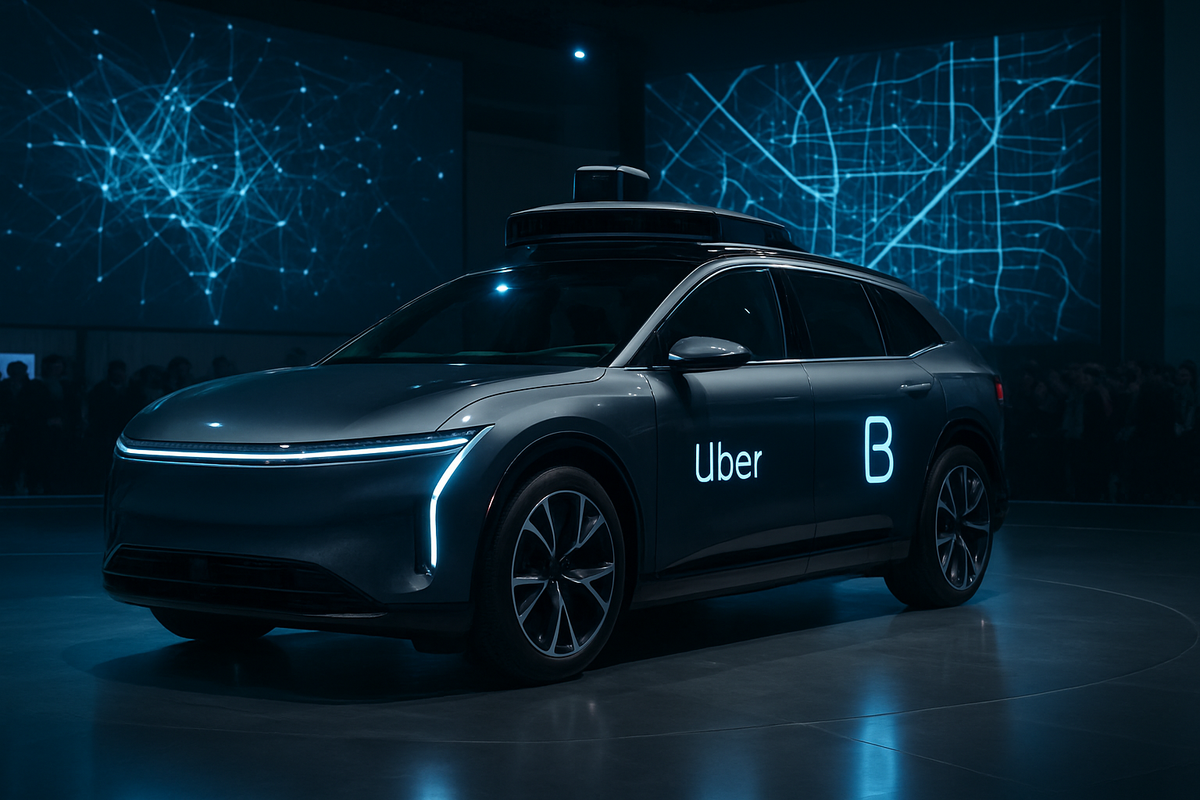
LAS VEGAS — In a move that signals a bold return to the hardware-integrated autonomous vehicle (AV) space, Uber Technologies Inc. (NYSE: UBER) took center stage at the 2026 Consumer Electronics Show (CES) to debut its first custom-built robotaxi. Developed in a high-stakes partnership with luxury EV maker Lucid Group Inc. (NASDAQ: LCID) and autonomous delivery pioneer Nuro, the vehicle represents Uber’s strategic pivot from a pure software aggregator to a deeply integrated player in the driverless economy.
The unveiling, held during the NVIDIA Corp. (NASDAQ: NVDA) showcase, comes at a critical juncture for the ride-hailing giant. As competitors like Waymo, owned by Alphabet Inc. (NASDAQ: GOOGL), and Tesla Inc. (NASDAQ: TSLA) accelerate their own autonomous deployments, Uber’s new alliance seeks to bridge the gap between premium passenger experience and cutting-edge self-driving technology. The immediate market reaction has been optimistic, particularly for Lucid, as investors weigh the implications of a massive new fleet demand against the high capital costs of autonomous scaling.
The "Halo" Debut: A High-Tech Marriage of Luxury and Logic
The star of the show was a modified Lucid Gravity SUV, outfitted with a proprietary "Halo" roof module that houses a sophisticated suite of solid-state LiDAR, high-resolution cameras, and radar. This isn't just a standard vehicle with sensors bolted on; the integration is seamless, powered by Nuro’s Level 4 "Driver" stack and running on the high-performance NVIDIA DRIVE AGX Thor platform. The choice of the Lucid Gravity provides Uber with a luxury edge, offering expansive interior space that Uber executives claim will redefine the "passenger-as-guest" experience.
The timeline leading to this moment has been swift. Following a $300 million strategic investment by Uber into Lucid in September 2025, the two companies, along with Nuro, began secretive supervised testing in the San Francisco Bay Area in December 2025. The CES 2026 debut marks the transition from testing to "production-intent," with Uber announcing plans to integrate at least 20,000 of these custom robotaxis into its global platform over the next six years. Initial commercial operations are slated to begin in San Francisco by late 2026.
Initial market reactions on January 5 and 6 have been telling. Lucid Group’s stock surged as much as 5.5%, as the deal provides the EV maker with a guaranteed high-volume customer and a powerful validation of its vehicle platform. Uber’s stock saw a more measured gain of approximately 1.8%, as some Wall Street analysts expressed caution regarding the long-term margin pressure of managing a physical fleet, even through partners.
The Winners and Losers: A Shifting Power Dynamic
Lucid Group stands out as a primary winner in this arrangement. For a company that has faced scrutiny over its cash burn and production scales, the Uber partnership provides a reliable "fleet-as-a-service" revenue stream. By leveraging the Gravity SUV for robotaxi duties, Lucid effectively diversifies its business model beyond direct-to-consumer sales, positioning itself as a key infrastructure provider for the autonomous era.
Uber also gains a strategic "third way." By partnering with Nuro for the autonomous stack and Lucid for the hardware, Uber avoids the astronomical R&D costs that sank its previous in-house "Advanced Technologies Group" years ago. However, the company now faces the challenge of managing a complex tripartite relationship while competing against vertically integrated giants.
On the losing side, traditional automakers who have been slow to pivot toward autonomous-ready platforms may find themselves locked out of the lucrative ride-hailing market. Furthermore, Tesla Inc. (NASDAQ: TSLA) faces a new, formidable competitor. While Elon Musk’s "Cybercab" aims for a lower price point, the Uber-Lucid-Nuro alliance offers a premium, existing vehicle platform that may appeal more to the high-end urban demographic that currently drives much of Uber’s "Black" and "Comfort" revenue.
A New Regulatory Wind and the "Universal Aggregator" Strategy
The debut of the Uber robotaxi fits into a broader industry trend toward "platform agnosticism." Uber is no longer trying to win the AV race alone; instead, it is positioning its app as the "universal aggregator" for autonomous miles. By early 2026, the Uber app already hosts Waymo and Baidu’s Apollo Go in select markets. Adding a proprietary-partnered vehicle allows Uber to control the user experience from end-to-end without the burden of full vertical integration.
This shift is being accelerated by a significant change in the regulatory landscape. Under the current federal AV framework established in late 2025, the National Highway Traffic Safety Administration (NHTSA) has streamlined exemptions for vehicles without traditional steering wheels or pedals. This "national safety standard" has cleared the path for the custom-designed cabins seen in the Lucid-Uber prototype, which features interactive passenger screens for climate control and a "perception display" that shows riders exactly what the AI is seeing to build trust.
Historically, this moment draws comparisons to the early days of the smartphone wars, where Uber is attempting to be the "iOS" of mobility—an ecosystem that hosts various hardware and software "apps" (AV stacks) while maintaining the direct relationship with the consumer.
The Road Ahead: From Prototype to Profit
In the short term, the challenge for the Uber-Lucid-Nuro trio will be the transition from the CES stage to the streets of San Francisco. Scaling Level 4 autonomy remains a "neighborhood-by-neighborhood" battle. Uber must navigate the technical hurdles of Nuro’s AI foundation model in complex urban environments while ensuring the Lucid Gravity’s hardware can withstand the high-utilization demands of a ride-hailing fleet.
Longer-term, the strategic pivot required will be one of operational excellence. Uber will need to prove it can manage the logistics of charging, cleaning, and maintaining a specialized fleet of 20,000 luxury EVs. If successful, this model could be licensed to other automakers, turning Uber’s "Autonomous Operations" into a high-margin software and logistics business. However, if Tesla achieves its sub-$30,000 Cybercab production goals by mid-2026, Uber may face a bruising price war that tests the limits of its "premium" strategy.
Final Takeaways for the Market
The Uber robotaxi debut at CES 2026 is a watershed moment that confirms the autonomous ride-hailing market is moving out of the "experimental" phase and into "commercial maturity." For investors, the key takeaway is Uber’s resilience; the company has successfully reinvented its autonomous strategy to leverage the strengths of specialized partners rather than going it alone.
As we move through 2026, the market will be watching for three things: the progress of the San Francisco pilot, any further federal regulatory shifts that could favor or hinder fleet deployments, and the quarterly delivery numbers from Lucid to see if the "Uber effect" translates into tangible balance sheet improvements. While the road to full autonomy still has its bumps, the Uber-Lucid-Nuro alliance has officially fired a loud opening shot in the battle for the future of the city street.
This content is intended for informational purposes only and is not financial advice.