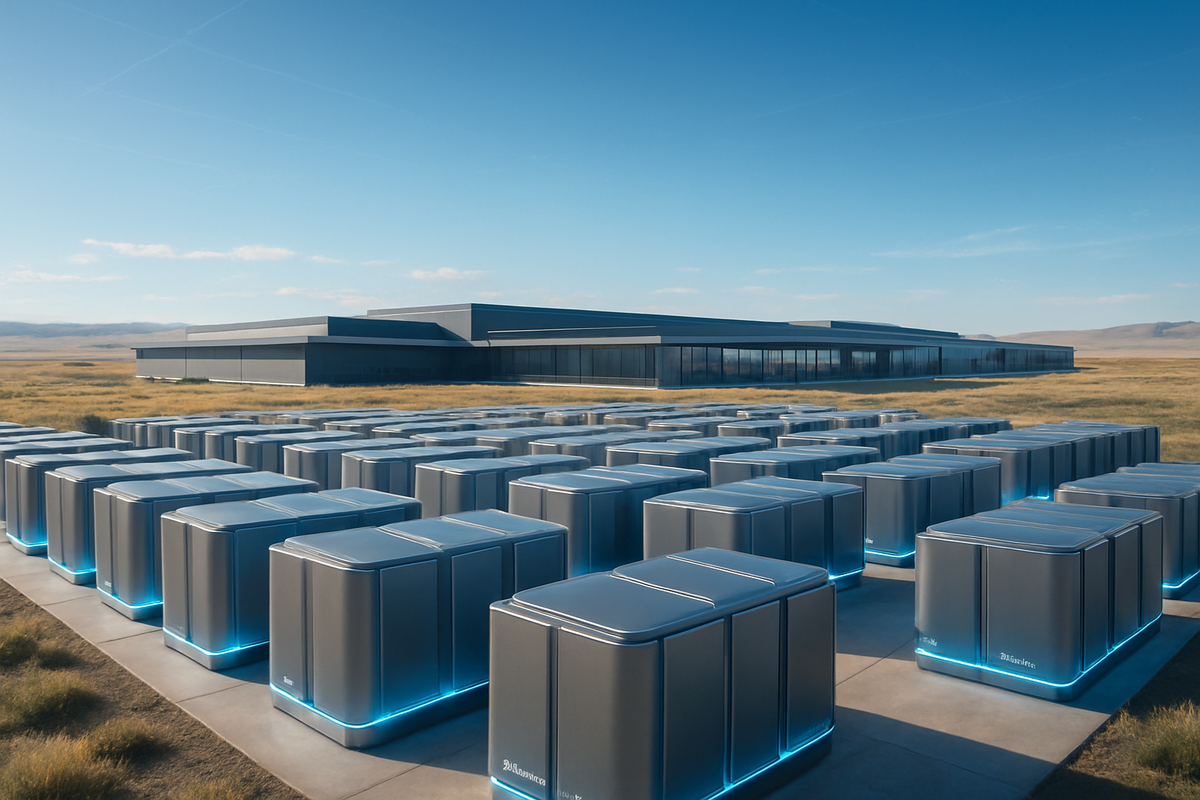
In a landmark decision that bridges the gap between massive AI compute demands and sustainable energy solutions, Bloom Energy (NYSE: BE) shares skyrocketed by more than 18% in early trading on January 8, 2026. The surge follows the final regulatory approval for a colossal 1.8-gigawatt (GW) AI data center campus in Cheyenne, Wyoming, often referred to as the "Cheyenne AI Factory." This project represents one of the largest private power generation initiatives in history and solidifies Bloom Energy’s position as a critical infrastructure provider for the generative AI era.
The approval, granted by the Wyoming Industrial Siting Council, marks a pivotal shift in how data centers are powered. By utilizing Bloom’s proprietary solid-oxide fuel cell (SOFC) technology, the project bypasses the traditional, often years-long wait for utility grid connections. This "behind-the-meter" strategy allows the facility to generate its own reliable, base-load power on-site, providing a blueprint for the future of high-density computing at a time when the national power grid is increasingly strained by the rapid expansion of artificial intelligence.
The Cheyenne AI Factory: A New Paradigm in Infrastructure
The journey to this approval began in late 2025, when BFC Power LLC—a subsidiary of the energy logistics giant Tallgrass, which is owned by Blackstone (NYSE: BX)—filed an application to develop a massive high-density compute campus. The project is a cornerstone of Wyoming Governor Mark Gordon’s "Winning the AI Race" initiative, a strategic push to transform the state from a traditional coal and gas hub into a leader in digital sovereignty and AI infrastructure. Bloom Energy was selected to provide 900 megawatts (MW) of fuel cell capacity for the first phase of the project, a deal that was cemented with today's definitive agreement.
The timeline leading to this moment has been marked by intense collaboration between state regulators and private enterprise. Following the initial filing in September 2025, the Wyoming Department of Environmental Quality (DEQ) fast-tracked the environmental review, focusing on the project's unique integration of carbon capture technology. The fuel cells will initially run on natural gas but are designed to be "hydrogen-ready." Furthermore, the site will leverage the nearby Trailblazer pipeline for carbon sequestration, ensuring that the massive energy consumption required by AI training does not come at the cost of the state's environmental goals.
Market reaction was immediate and overwhelmingly positive. Analysts had been watching the Cheyenne project closely as a "proof of concept" for grid-independent data centers. When the final approval was announced this morning, Bloom Energy's stock broke through previous resistance levels, reaching heights not seen since the initial AI infrastructure boom of 2024. The deal is backed by a 20-year offtake agreement with American Electric Power (NASDAQ: AEP), which had previously secured an option for 1,000 MW of Bloom’s technology to support its growing data center client base.
Strategic Winners and the Shifting Competitive Landscape
Bloom Energy is the most visible winner in this development, but the ripple effects extend across the technology and energy sectors. Blackstone, through its ownership of Tallgrass and its massive investments in data center developers like QTS, is positioning itself as the landlord of the AI age. By solving the "time-to-power" problem—the primary bottleneck for AI expansion—Blackstone and its partners are able to bring capacity online years faster than competitors relying on traditional utility upgrades. Oracle (NYSE: ORCL) is also expected to be a primary beneficiary, as it has been linked as a strategic partner for the high-density compute clusters that will inhabit the Cheyenne campus.
On the other side of the ledger, traditional regulated utilities that have been slow to adapt to the "behind-the-meter" trend may find themselves sidelined. While American Electric Power has successfully integrated into this project, other utilities may lose out on lucrative industrial contracts as large-scale energy users opt for self-generation. Furthermore, traditional backup generator manufacturers like Caterpillar (NYSE: CAT) and Cummins (NYSE: CMI) are facing a direct threat; Bloom’s fuel cells provide "always-on" power that eliminates the need for the diesel generators that have long been the industry standard for data center redundancy.
In the fuel cell space, the Wyoming project creates a significant gap between Bloom Energy and its peers. While FuelCell Energy (NASDAQ: FCEL) and Plug Power (NASDAQ: PLUG) continue to pursue hydrogen-centric strategies, Bloom’s ability to run on natural gas today while transitioning to hydrogen tomorrow has proven more attractive to data center developers who need immediate, reliable power. This project sets a high bar for scale and regulatory integration that competitors may struggle to match in the near term.
The Intersection of Energy Scarcity and AI Ambition
The significance of the Cheyenne AI Factory extends far beyond a single contract. It highlights a critical trend in the global economy: the "energy-compute bottleneck." As AI models grow in complexity, requiring hundreds of thousands of GPUs from manufacturers like NVIDIA (NASDAQ: NVDA), the demand for electricity has outpaced the ability of the aging U.S. power grid to deliver it. This project proves that the solution may lie in decentralized, modular power generation.
Historically, data centers were built where power was cheap and the grid was robust. Today, they are being built where power can be deployed the fastest. Bloom’s fuel cells offer a "plug-and-play" power plant model that can be scaled alongside the data center’s growth. This shift mirrors the transition from centralized mainframe computing to distributed cloud computing, but for the physical energy layer. Moreover, the project’s use of carbon capture and hydrogen-ready infrastructure provides a regulatory template for other states to follow, balancing the economic windfall of AI with net-zero commitments.
Looking Ahead: The Future of Distributed Power
In the short term, the success of the Wyoming project is likely to trigger a wave of similar "behind-the-meter" filings across the "Mountain West" and other regions with favorable regulatory environments. Investors should watch for Bloom Energy to announce further partnerships with major cloud providers who are desperate for power capacity. The primary challenge moving forward will be the supply chain; producing 900 MW of fuel cells is a massive manufacturing undertaking that will test Bloom’s operational efficiency and its ability to maintain margins.
Long-term, the Wyoming project may serve as the bridge to a true hydrogen economy. As green hydrogen production scales, these fuel cells can be transitioned away from natural gas, potentially making the Cheyenne AI Factory one of the first truly carbon-neutral massive compute sites in the world. However, the emergence of Small Modular Reactors (SMRs) remains a potential long-term competitor. While SMRs are still years away from commercial deployment, companies like Oklo (NYSE: OKLO) are targeting the same data center market, promising even higher power densities.
A New Chapter for Infrastructure Investors
The approval of the Cheyenne project is a watershed moment for Bloom Energy and the broader AI infrastructure sector. It confirms that "time-to-power" is now the most valuable currency in the tech industry. For Bloom Energy, this is no longer about niche green energy applications; it is about providing the literal lifeblood for the most important technological shift of the decade. The 18% jump in stock price reflects a market that is finally pricing in the massive total addressable market for on-site power generation.
Moving forward, investors should monitor the execution of the Cheyenne build-out and the progress of the carbon capture integration via the Trailblazer pipeline. The ability of Bloom and its partners to meet their aggressive timelines will determine if this model becomes the global standard. As AI continues to reshape the economy, the companies that can solve the energy equation will likely remain the market’s top performers.
This content is intended for informational purposes only and is not financial advice.