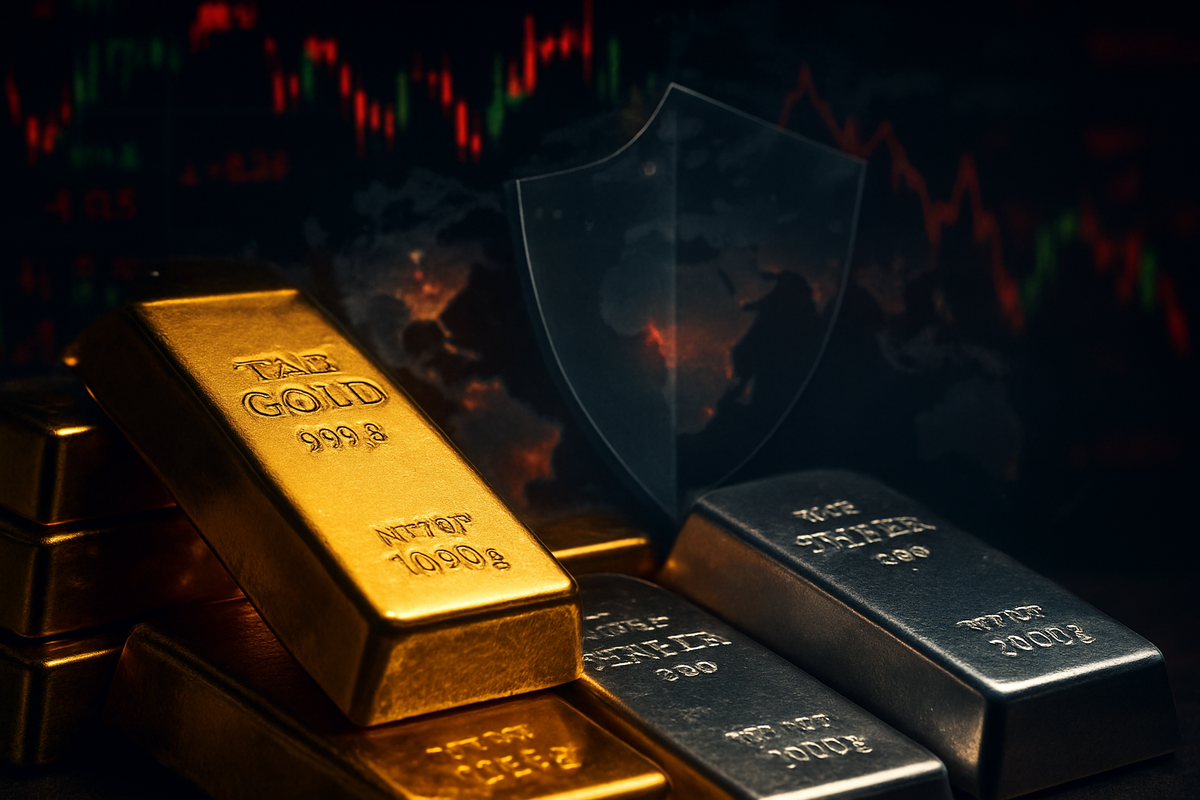
As of January 9, 2026, the global financial markets are witnessing a dramatic resurgence in precious metals, with gold and silver reclaiming their roles as the ultimate hedges against a world increasingly defined by volatility. Following a brief but sharp correction during the first week of the year, gold prices have surged back toward the $4,500 per ounce mark, while silver has rallied to approximately $78 per ounce. This rebound is being fueled by a "perfect storm" of geopolitical shocks in South America and the Middle East, coupled with mounting domestic anxiety over the legal and economic future of the 2025 "Liberation Day" tariffs.
The immediate implications of this price action are reverberating across Wall Street and Main Street alike. For investors, the flight to quality suggests a waning confidence in traditional equity markets, which have struggled to digest the inflationary impact of a trade-war-heavy economy. As the U.S. Supreme Court prepares to deliver a landmark ruling today on the executive branch's tariff-imposing authority, the demand for "hard assets" has reached a fever pitch, signaling that the commodity super-cycle of the mid-2020s is far from over.
The Perfect Storm: Geopolitics and the Tariff Tinderbox
The rebound in precious metals did not occur in a vacuum; it is the result of a rapid-fire series of events that began in late 2025. After gold achieved a record-breaking 70% gain last year, the market saw a "violent" profit-taking correction in the final days of December and the first 48 hours of 2026. However, the narrative shifted abruptly on January 4, 2026, when U.S. military forces conducted a high-stakes operation in Venezuela to capture President Nicolás Maduro on drug-trafficking charges. This move sent shockwaves through global energy and metal markets, as traders feared a protracted regional conflict and potential disruptions to South American supply chains.
Simultaneously, tensions in the Middle East escalated following a series of aggressive diplomatic maneuvers and social media warnings from the U.S. administration, suggesting a potential intervention in Iranian civil unrest. These "flashpoints" created an immediate spike in the geopolitical risk premium, driving institutional capital out of riskier assets and into the safety of bullion. By the morning of January 5, gold had already recovered $100 in a single trading session, setting the stage for the sustained rally observed throughout this week.
Adding to the fire is the domestic economic uncertainty surrounding the "Liberation Day" tariffs—a sweeping set of 10% to 25% duties on China, Canada, and Mexico enacted in 2025. While many companies successfully "front-loaded" inventory last year to avoid these costs, those stockpiles have now officially run dry. As of early January 2026, businesses are being forced to restock at tariff-inflated prices, leading to a visible spike in retail costs and a "sticky" inflation rate that remains stubbornly above the Federal Reserve’s target.
The market’s eyes are now fixed on the U.S. Supreme Court, which is expected to rule today, January 9, on whether these tariffs were legally implemented under the International Emergency Economic Powers Act. A ruling against the government could trigger a massive fiscal shock, requiring the refund of nearly $150 billion to importers. The prospect of such a large-scale fiscal disruption has weakened the U.S. dollar and further incentivized the move into gold and silver as a hedge against currency instability.
Winners and Losers: Mining Giants and Industrial Squeeze
The primary beneficiaries of this price surge are the major mining conglomerates, which are seeing their profit margins expand at an unprecedented rate. Newmont Corporation (NYSE: NEM), the world’s largest gold miner, has seen its stock price climb as the higher spot price of gold directly bolsters its bottom line. Similarly, Barrick Gold Corporation (NYSE: GOLD) is reaping the rewards of its diversified portfolio, with analysts noting that the company’s "all-in sustaining costs" (AISC) have remained relatively stable even as the selling price of their primary product nears $4,500.
In the silver space, the impact is even more pronounced due to a structural supply deficit exacerbated by new Chinese export restrictions. Wheaton Precious Metals Corp. (NYSE: WPM), a leading streaming company, is uniquely positioned to benefit from the silver rally without the direct operational risks of mining. Meanwhile, pure-play silver miners like Pan American Silver Corp. (NYSE: PAAS) and First Majestic Silver (NYSE: AG) have become favorites for retail and institutional investors looking for high-beta exposure to the metal, which many analysts believe could reach $100 per ounce before the end of 2026.
However, the news is not universally positive. Industrial consumers of these metals are facing a severe margin squeeze. The solar energy sector, which relies heavily on silver for photovoltaic cells, is seeing project costs skyrocket, potentially slowing the pace of the green energy transition. Manufacturers of high-end electronics and semiconductors are also feeling the pinch, as the rising cost of "critical minerals"—now being used as geopolitical leverage by nations like China—threatens to disrupt production schedules and force further price hikes on consumers.
Exchange-traded funds (ETFs) have also seen massive inflows this week. The SPDR Gold Shares (NYSE: GLD) and the iShares Silver Trust (NYSE: SLV) have recorded some of their highest daily volumes since the pandemic era. For these funds, the challenge is no longer attracting capital, but managing the logistical complexities of physical metal acquisition in a market where physical supply is becoming increasingly tight due to central bank hoarding and industrial demand.
Stagflation Fears and the Weaponization of Critical Minerals
This event fits into a broader global trend of "deglobalization" and the weaponization of trade. The early 2026 rebound in metals is a direct reflection of the market’s realization that tariffs are not merely temporary negotiating tools, but permanent fixtures of the new economic order. This has led to a "stagflationary" environment—one where economic growth is hampered by trade barriers while inflation is driven higher by supply shocks. Historically, gold has been the premier asset during such periods, outperforming both stocks and bonds.
The ripple effects are extending to America's trading partners and competitors. China’s decision, effective January 1, 2026, to restrict the export of silver and other critical minerals like tungsten and indium is a clear retaliatory strike against U.S. trade policies. By tightening the global supply of metals essential for high-tech manufacturing, Beijing is effectively exporting inflation back to the West. This move has fundamentally altered the silver market, transforming it from a mere industrial commodity into a strategic geopolitical asset.
Furthermore, the current situation draws striking parallels to the 1970s, a decade marked by oil shocks, geopolitical instability, and a massive bull run in precious metals. Much like the 1970s, the Federal Reserve now finds itself in a "hawkish pause," unable to cut rates to stimulate growth because of tariff-driven inflation, yet hesitant to raise rates further for fear of triggering a deep recession. This policy paralysis is a primary driver of the current safe-haven demand, as investors lose faith in the ability of central banks to manage the "soft landing" they once promised.
The Road Ahead: Supreme Court Rulings and the Fed’s Dilemma
In the short term, the market's direction hinges almost entirely on the Supreme Court’s ruling regarding the "Liberation Day" tariffs. If the court upholds the tariffs, the market will likely price in "inflation for longer," potentially pushing gold past the $4,600 resistance level. Conversely, a ruling that strikes down the tariffs could lead to a temporary "relief sell-off" in metals as the dollar strengthens, though any such dip would likely be bought aggressively by those fearing the resulting fiscal chaos of $150 billion in government refunds.
Looking toward the mid-to-late months of 2026, the strategic pivot for many companies will involve securing physical supply chains. We may see more industrial giants following the lead of the EV industry by taking direct equity stakes in mining projects to ensure they have access to the silver and gold necessary for their products. This "vertical integration of the periodic table" will likely be a major theme for the remainder of the year, creating new opportunities for junior miners and exploration firms.
The ultimate scenario for 2026 is a "dual-track" market: one where traditional financial assets struggle under the weight of trade wars and high interest rates, while hard assets thrive. If the geopolitical situation in Venezuela or the Middle East deteriorates further, the "fear trade" could drive gold toward the $5,000 milestone much sooner than analysts previously anticipated. Investors must be prepared for extreme volatility, as the liquidity of these markets will be tested by the sheer volume of capital looking for a safe harbor.
Investor Takeaways: Navigating the New Gold Standard
The key takeaway for the start of 2026 is that the era of "low-volatility growth" has officially ended, replaced by a regime of geopolitical risk and trade-driven inflation. The rebound in gold and silver is not just a technical bounce; it is a fundamental revaluation of what constitutes a "safe" asset in a fragmented global economy. Investors should watch for the Federal Reserve's reaction to the upcoming CPI data, as any hint of a "pivot" toward rate cuts in the face of rising inflation would be like throwing gasoline on the fire for precious metals.
As the market moves forward, the focus will shift from "if" prices will rise to "how high" they can go. The combination of central bank buying—which reached record levels in 2025—and the return of the retail investor to the silver market suggests that the current rally has deep roots. Moving into the spring of 2026, the primary indicators to watch will be the status of Chinese mineral exports, the stability of the U.S. dollar in the wake of the Supreme Court's decision, and any further escalations in South American geopolitics.
In summary, the events of early January 2026 have reaffirmed the timeless value of gold and silver. While the path ahead will undoubtedly be volatile, the underlying drivers—tariff fears, global instability, and a weakening trust in fiat currency—remain firmly in place. For the modern investor, precious metals are no longer just a "fringe" insurance policy; they have become the cornerstone of a defensive portfolio in an increasingly uncertain world.
This content is intended for informational purposes only and is not financial advice.