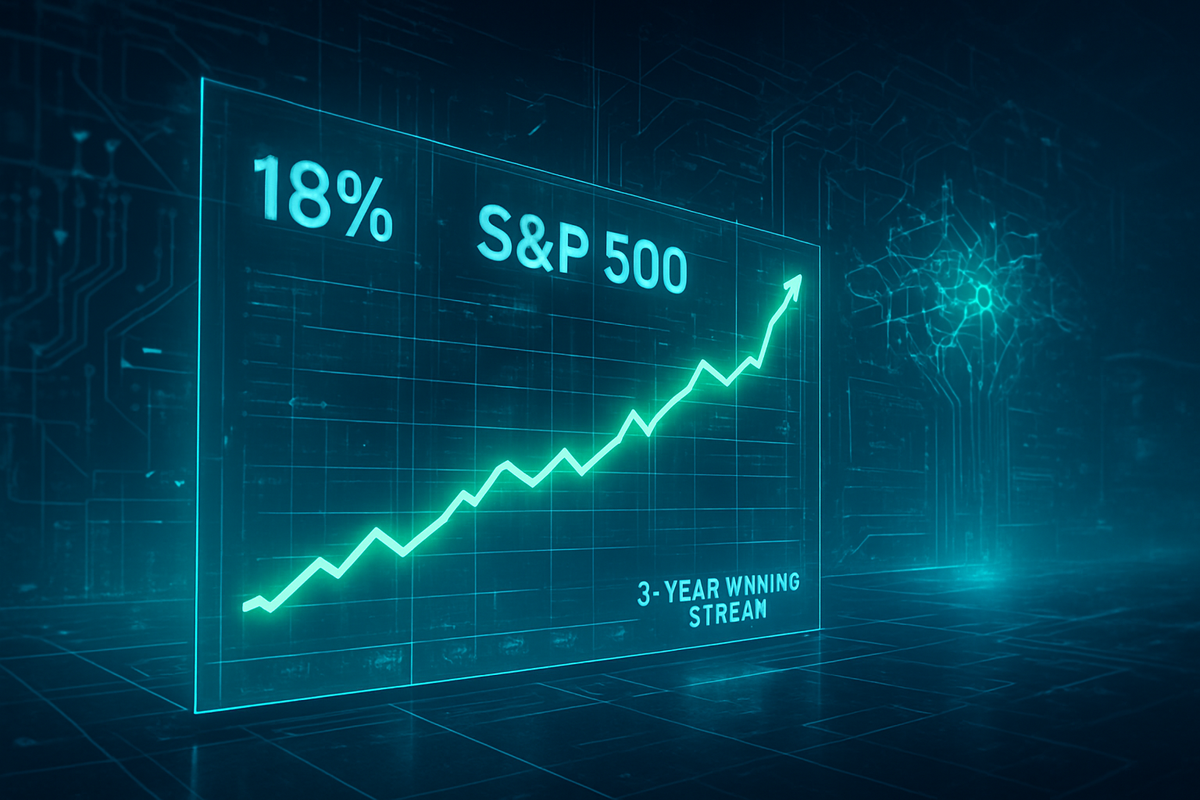
The S&P 500 index closed out 2025 with a robust 18% total return, marking its third consecutive year of double-digit gains and cementing one of the most resilient bull markets in recent history. As of January 9, 2026, the market sits at a critical juncture, having defied mid-year recession fears and "tariff shocks" to reach new all-time highs fueled by a late-year pivot from the Federal Reserve and a massive acceleration in artificial intelligence infrastructure spending.
This extended winning streak has pushed the benchmark index into uncharted territory, leaving investors to weigh the benefits of continued momentum against the risks of historically high valuations. While the "soft landing" narrative dominated the 2025 headlines, the dawn of 2026 brings a more complex set of challenges, including "sticky" inflation and a shifting fiscal landscape that could test the endurance of even the most bullish portfolios.
The Path to 18%: A Year of Resilience and Stimulus
The story of 2025 was defined by a transition from speculative AI hype to a tangible "deployment phase." Throughout the first half of the year, the market grappled with persistent core inflation, leading many to believe the Federal Reserve would keep interest rates "higher for longer." However, the economic narrative shifted dramatically in the third quarter of 2025, supported by the implementation of the "One Big Beautiful Bill Act" (OBBBA). This fiscal stimulus package provided significant tax refunds and investment incentives, propelling real GDP growth to a surprising 4.3% in Q3 and providing the liquidity necessary to sustain the rally.
By the second half of 2025, the Federal Reserve executed a decisive "risk management" pivot. As the unemployment rate ticked up to 4.6%, the FOMC delivered three consecutive 25-basis-point interest rate cuts in September, October, and December. These moves brought the federal funds rate down to a range of 3.50%–3.75%, easing borrowing costs for corporations and providing a powerful valuation tailwind for growth-oriented sectors. This monetary easing, combined with robust corporate earnings growth of 12.3%, allowed the S&P 500 to shrug off geopolitical volatility and finish the year near its peak.
The timeline of the 2025 rally was not without its hurdles. Mid-year trade tensions and renewed volatility in Red Sea maritime routes briefly threatened global supply chains, causing a temporary pullback in late Q2. However, the market’s ability to "climb the wall of worry" was bolstered by a massive capital expenditure boom among technology "hyperscalers." Companies like Microsoft (NASDAQ: MSFT) and Alphabet (NASDAQ: GOOGL) reportedly spent upwards of $400 billion on AI infrastructure in 2025 alone, ensuring that the demand for high-end semiconductors and data center capacity remained insatiable.
The Corporate Vanguard: Winners and Losers in the AI-Driven Market
The 2025 rally was led by a familiar cast of technology titans, but the year also saw a significant broadening of participation. NVIDIA (NASDAQ: NVDA) remained a primary engine of growth, surging 39% as it prepared for the 2026 launch of its "Vera Rubin" AI platform. Similarly, Broadcom (NASDAQ: AVGO) capitalized on its dominance in custom AI chips and networking, posting a 50% gain for the year. The Communication Services sector was the standout performer, with Alphabet (NASDAQ: GOOGL) climbing 66% as it successfully integrated Gemini AI into its search and advertising ecosystems, inching closer to a historic $4 trillion market capitalization.
Beyond the tech sector, GE Aerospace (NYSE: GE) emerged as a massive winner, gaining 86% on the back of a $175 billion backlog and a surge in both defense and commercial aviation demand. The industrial sector more broadly benefited from the AI boom, as companies like Caterpillar (NYSE: CAT) saw increased demand for power generation and construction equipment required for new data center projects. This "catch-up" trade in the so-called "S&P 493" helped diversify the market's gains, moving away from the extreme concentration seen in 2023 and 2024.
However, the year was not kind to all sectors. Consumer Discretionary and Real Estate faced significant headwinds. Despite the Fed's late-year rate cuts, the office real estate sector continued to struggle with high vacancy rates and debt refinancing challenges. Retailers also faced "pockets of consumer stress" as the cumulative effect of years of inflation began to weigh on middle-income households. While the broader index soared, companies with high debt loads or those sensitive to discretionary spending saw their margins squeezed, highlighting a growing divide between the AI-enabled "haves" and the traditional "have-nots."
Historical Context and the Looming Valuation Shadow
The three-year winning streak of 2023–2025 draws inevitable comparisons to the late 1990s dot-com era and the post-pandemic recovery of 2020–2021. However, the current market environment is unique due to the sheer scale of the Shiller CAPE ratio, which ended 2025 at approximately 40. This is the second-highest level in 150 years, trailing only the peak of the 1999 tech bubble. While corporate earnings have largely supported these valuations thus far, the S&P 500's forward P/E of 22.5x leaves very little room for error as we enter 2026.
This period of growth also reflects a broader industry trend toward "AI-driven productivity." Unlike previous cycles driven by pure speculation, the 2025 rally was backed by a 7.0% increase in corporate revenue and a clear shift in how companies utilize technology to optimize operations. This structural change has led some analysts to argue that higher valuations may be the "new normal," though historical precedents suggest that such periods of expansion are often followed by a phase of consolidation or "mean reversion" when fiscal and monetary stimulus begins to fade.
Regulatory and policy implications also loom large. The success of the OBBBA stimulus in 2025 provided a temporary cushion, but as those tax incentives are set to expire or diminish in mid-2026, the market may face a "fiscal drag." Additionally, increased scrutiny of Big Tech’s market dominance and potential AI regulations in the EU and the US could create volatility. Historically, third-year rallies are often the hardest to maintain, and the market’s reliance on a handful of mega-cap stocks remains a systemic risk that competitors and partners must navigate carefully.
The 2026 Horizon: Navigating Sticky Inflation and Geopolitical Headwinds
Looking ahead into 2026, the consensus among Wall Street analysts is one of "cautious optimism." Goldman Sachs (NYSE: GS) has set a target of 8,100 for the S&P 500, implying a 12% return driven by continued AI-led productivity gains. Conversely, JPMorgan Chase (NYSE: JPM) has issued a more conservative outlook, warning that much of the potential upside is already priced in. The primary challenge for the new year will be the "stickiness" of inflation; with Core PCE expected to remain between 2.4% and 2.7%, the Federal Reserve may be forced to pause its rate-cut cycle sooner than the market currently anticipates.
In the short term, investors should watch for a potential "softening" of GDP growth to the 1.5%–1.8% range as the post-OBBBA stimulus effects wear off. This could lead to a strategic pivot toward defensive sectors or "quality" stocks with strong balance sheets and reliable cash flows. The emergence of "Maximum Pressure 2.0" sanctions on Iran and escalating trade clashes between the EU and China also present geopolitical wildcards that could disrupt global energy markets and supply chains, potentially reigniting inflationary pressures.
Despite these risks, opportunities remain in sectors that are still in the early stages of AI integration. Healthcare and Small Caps are viewed by some, including analysts at Oppenheimer, as the next frontier for the "broadening rally." If these sectors can successfully adopt AI tools to lower costs and improve margins, they could provide the necessary fuel to extend the bull market into a fourth year. However, the margin for error is razor-thin, and any significant earnings miss from the "Magnificent Seven" could trigger a sharp market correction.
Conclusion: A Cautious Path Forward
The S&P 500’s 18% gain in 2025 was a testament to the power of technological innovation and a flexible monetary policy. The three-year winning streak has rewarded patient investors and validated the massive investments made in the AI ecosystem. However, as we move further into 2026, the "easy money" phase of the recovery appears to be behind us. The market is now entering a high-stakes environment where valuation discipline and macroeconomic stability will be paramount.
Investors should remain vigilant, keeping a close eye on inflation data and the Fed’s subsequent commentary in the coming months. While the momentum of 2025 provides a strong tailwind, the looming fiscal drag and geopolitical uncertainties suggest that 2026 will be a year defined by volatility and sector rotation. Success in the new year will likely require a shift from broad index exposure to a more selective approach, focusing on companies that can deliver genuine earnings growth in a moderating economic environment.
This content is intended for informational purposes only and is not financial advice.