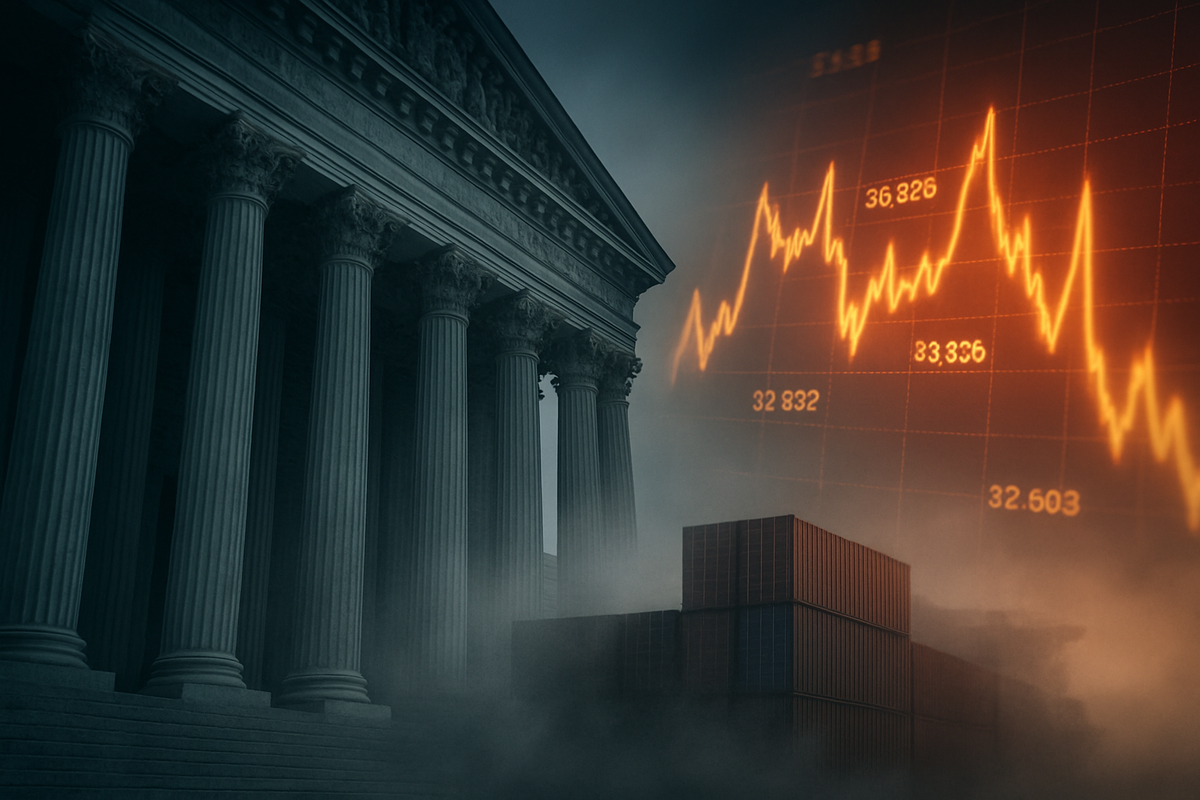
The U.S. financial markets closed on Friday, January 9, 2026, in a state of high-strung anticipation as the Supreme Court of the United States (SCOTUS) deferred its long-awaited ruling on the legality of President Donald Trump’s sweeping global tariff regime. Despite expectations that the Court would deliver a definitive opinion on the administration’s use of emergency powers to bypass Congress, the session ended without a verdict, leaving investors and multinational corporations in a state of "cautious paralysis."
The postponement has immediate and profound implications for the global economy, extending a period of trade uncertainty that has defined the early months of 2026. With the next potential opinion day scheduled for Monday, January 12, the options market is already pricing in significant volatility. Analysts warn that the eventual ruling will be a "binary event" for the S&P 500, with the potential to either trigger a massive relief rally or cement a permanent shift toward protectionism that could redefine corporate earnings for the next decade.
The Legal Deadlock: IEEPA Authority Under Fire
The current legal battle centers on two consolidated cases, Learning Resources, Inc. v. Trump and Trump v. V.O.S. Selections, Inc., which challenge the President’s use of the International Emergency Economic Powers Act (IEEPA) of 1977. The Trump administration has utilized this act to impose "reciprocal" tariffs on a wide array of goods, arguing that trade imbalances constitute a national emergency. Lower courts previously ruled that the executive branch overstepped its constitutional authority, leading to the current Supreme Court showdown.
The timeline leading to this moment has been a rollercoaster for the markets. Since the reimposition of aggressive trade barriers in early 2025, importers have paid an estimated $150 billion to $200 billion in duties. Stakeholders, ranging from small-scale importers to massive conglomerates, have been lobbying for clarity, as the lack of a ruling prevents companies from making long-term capital allocation decisions. Friday’s delay was met with a mix of frustration and anxiety on Wall Street, as traders had hoped to clear the "tariff overhang" before the weekend.
Initial market reactions on Friday were muted but tense. While the major indexes saw slight gains due to strong labor data, the "volatility surface" for tariff-sensitive sectors spiked in the final hour of trading. Institutional investors are reportedly moving into defensive positions, with cash reserves reaching multi-month highs as the market prepares for the possibility of a surprise announcement early next week.
Winners and Losers: A Tale of Two Portfolios
The delay in the ruling has created a bifurcated outlook for public companies. Retail giants like Target Corporation (NYSE: TGT) and Nike, Inc. (NYSE: NKE) are among the most exposed to the ongoing uncertainty. These companies have seen their margins compressed by high input costs and have been unable to fully pass these costs to consumers. A ruling that strikes down the tariffs would likely lead to a massive surge in their stock prices as they seek to recoup billions in paid duties. Conversely, a delay keeps them in a state of limbo, unable to finalize pricing strategies for the upcoming spring season.
The technology sector is equally vulnerable, particularly firms with complex global supply chains like Apple Inc. (NASDAQ: AAPL) and Nvidia Corporation (NASDAQ: NVDA). For Broadcom Inc. (NASDAQ: AVGO) and other semiconductor leaders, the threat of retaliatory tariffs from trading partners remains a primary concern. The tech sector has historically thrived on globalized trade; thus, a Supreme Court decision upholding the tariffs could lead to a permanent "reset" in valuation multiples as analysts account for higher structural costs and supply chain fragmentation.
The automotive industry is perhaps the most sensitive to the SCOTUS decision. Ford Motor Company (NYSE: F) and General Motors Company (NYSE: GM) rely heavily on integrated North American supply chains, particularly parts moving across the Mexican and Canadian borders. Even Tesla, Inc. (NASDAQ: TSLA), which has a more vertically integrated model, faces headwinds from tariffs on raw materials and specialized components. For these companies, the delay is a double-edged sword: it prevents immediate disaster but prolongs a period where strategic planning is virtually impossible.
Wider Significance: A Precedent for Global Trade
This event fits into a broader trend of "deglobalization" that has accelerated over the past several years. The Supreme Court's decision will not just affect U.S. companies; it will set a precedent for how international trade law is interpreted in the 21st century. If the Court grants the President broad authority under the IEEPA, it effectively shifts the power to regulate commerce from Congress to the White House, a move that could have ripple effects across all sectors of the economy for decades.
Historically, this situation draws comparisons to the 1970s trade disputes, but the scale of the current tariffs is unprecedented. Partners like India and Canada are watching the U.S. judiciary with bated breath. In India, the Sensex and Nifty indexes are bracing for extreme volatility on Monday, as the country currently faces a 50% "reciprocal" tariff on many of its key exports. A ruling against the administration would be seen as a victory for global trade stability, whereas a delay or an uphold would likely trigger a new wave of retaliatory measures.
Furthermore, the White House has already signaled that it will not go down without a fight. National Economic Council Director Kevin Hassett stated on Friday that the administration has "alternative legal tools" ready to reimpose tariffs almost immediately if the Supreme Court rules against the current IEEPA framework. This suggests that even a "win" for the markets in court might only be a temporary reprieve, creating a complex regulatory environment where policy shocks can occur at any moment.
The Road Ahead: What to Expect in the Next Session
In the short term, all eyes are on Monday morning. Options traders have priced in an expected swing of 0.9% to 1.2% for the S&P 500, reflecting the high stakes of the impending decision. If the Court issues a ruling before the opening bell on January 12, we could see one of the most significant single-day moves in recent history. Investors should be prepared for a "gap up" or "gap down" scenario, where the market opens significantly higher or lower than Friday's close.
Longer term, companies will need to adapt to a "new normal" of trade volatility. Strategic pivots may include "near-shoring" production to domestic facilities or diversifying supply chains away from countries targeted by reciprocal tariffs. While these moves provide a hedge against policy shifts, they often come at the cost of efficiency and higher consumer prices. The market may begin to reward companies with "policy-agnostic" business models—those that can maintain profitability regardless of the tariff environment.
Closing Thoughts for Investors
The Supreme Court’s delay has turned a legal question into a major market catalyst. The key takeaway for investors is that the "tariff era" is far from over, regardless of the specific outcome of Learning Resources, Inc. v. Trump. The administration’s willingness to use alternative tools means that trade policy will remain a primary driver of market sentiment throughout 2026.
Moving forward, the market will likely remain sensitive to any headlines regarding trade negotiations or executive orders. Investors should watch for the Court's next opinion release and pay close attention to management commentary during the upcoming Q1 earnings season. Companies that have successfully navigated the current uncertainty will likely emerge as leaders, while those caught flat-footed by sudden policy shifts may face significant downward pressure. For now, the watchword on Wall Street is "patience," but the fuse is remarkably short.
This content is intended for informational purposes only and is not financial advice.