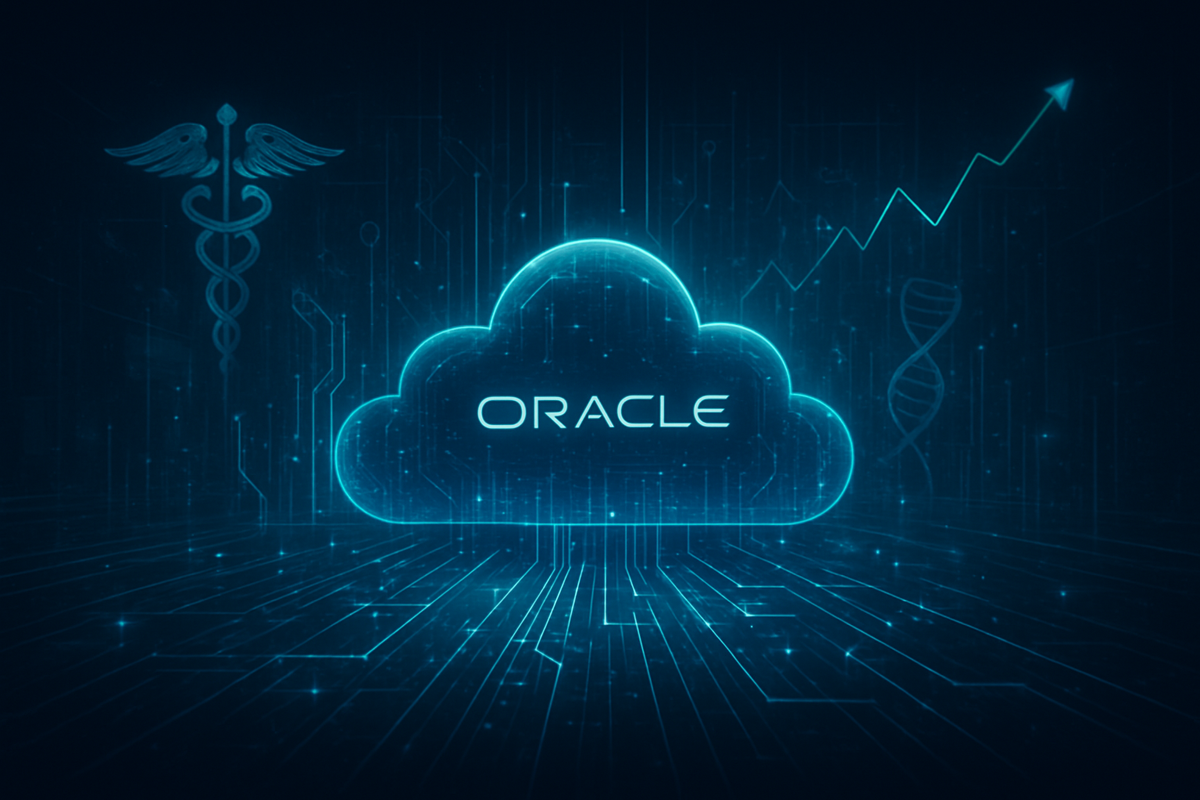
AUSTIN, Texas — Shares of Oracle Corporation (NYSE: ORCL) surged 9.6% this week, marking one of the tech giant's strongest trading sessions of the year. The rally was ignited by a high-profile analyst upgrade and sustained by the official announcement that the Centers for Medicare and Medicaid Services (CMS) has selected Oracle Cloud Infrastructure (OCI) to lead a massive modernization of the nation’s healthcare data systems. The deal represents a pivotal win for Oracle, transforming it from a legacy database provider into a frontline contender for the federal government’s most sensitive and complex cloud workloads.
This multi-year initiative, aimed at migrating mission-critical claims and eligibility systems to the cloud, is expected to provide a substantial boost to Oracle's recurring revenue. By securing a foothold in the heart of the U.S. healthcare infrastructure, Oracle has effectively validated its $28 billion acquisition of Cerner and signaled to the market that its cloud platform, OCI, is now capable of competing head-to-head with industry titans for high-stakes public sector contracts.
The Landmark CMS Modernization: A Timeline of the Surge
The momentum began on Monday, February 9, 2026, when D.A. Davidson analyst Gil Luria upgraded Oracle (NYSE: ORCL) from "Neutral" to "Buy," raising the price target to $180. Luria cited growing confidence in Oracle’s burgeoning AI partnerships—most notably its collaboration with OpenAI—and the untapped value of its stake in the restructured TikTok USA. This upgrade triggered an initial 9.6% price jump, catching the attention of institutional investors who had been waiting for a clear signal of Oracle’s upward trajectory in the AI era.
The rally found its second wind on February 11, 2026, when Oracle officially confirmed its selection by the CMS. Under the terms of the agreement, Oracle will migrate systems that manage data for over 150 million Americans. This includes the highly sensitive "claims adjudication" and "eligibility verification" engines that form the backbone of the U.S. healthcare safety net. These systems have long resided on aging, on-premise mainframes that struggled with the data demands of a modernizing healthcare landscape.
A key figure behind this strategic victory is Seema Verma, the former CMS Administrator who joined Oracle as an Executive Vice President in 2024. Industry insiders suggest that Verma’s deep understanding of federal healthcare requirements was instrumental in tailoring Oracle’s bid to meet the rigorous security and interoperability standards required by the CMS. The market reaction has been overwhelmingly positive, with trading volume for ORCL hitting 1.5 times its 30-day average as investors price in the long-term stability of federal recurring revenue.
Winners and Losers in the Cloud Arms Race
Oracle (NYSE: ORCL) is the undisputed winner of this development, not only because of the immediate stock appreciation but because of the "halo effect" this contract provides for its cloud business. By proving it can handle the scale and security demands of the CMS, Oracle is now a "tier-one" cloud provider in the eyes of federal procurement officers. This victory likely secures Oracle’s place in the upcoming rounds of federal cloud spending, potentially at the expense of its larger rivals.
Conversely, the "Big Three" cloud providers—Amazon (NASDAQ: AMZN), Microsoft (NASDAQ: MSFT), and Google (NASDAQ: GOOGL)—face a narrowing moat in the public sector. While Amazon Web Services (AWS) has historically dominated federal contracts, Oracle’s recent wins suggest that the government is moving toward a multi-cloud strategy to avoid vendor lock-in and leverage Oracle’s specific expertise in database management and healthcare data. Microsoft, while still a dominant force, may find its Azure platform under increased pressure to demonstrate superior healthcare-specific AI capabilities to keep pace with Oracle’s integrated Cerner-OCI offering.
Other potential winners include Nvidia (NASDAQ: NVDA), whose H200 and Blackwell chips power the high-performance computing clusters within OCI that make such massive data migrations possible. On the losing side, legacy infrastructure providers who maintained the CMS’s aging mainframes are seeing their sunset accelerated, as the federal government fully commits to a cloud-native future.
Analyzing the Significance: Healthcare as the New Cloud Battleground
The CMS deal is more than just a single contract; it is a bellwether for the broader industry trend of "sovereign cloud" and specialized vertical clouds. As healthcare data becomes increasingly digitized and integrated with AI, the demand for cloud environments that offer both massive scale and extreme privacy has skyrocketed. Oracle has positioned OCI as the premier destination for these specialized needs, leveraging its historical dominance in database security to win over skeptical government regulators.
This event also highlights the ripple effects of the "AI Gold Rush" on public sector policy. The CMS modernization is expected to incorporate Oracle’s generative AI tools to help automate claims processing and detect fraudulent activity more efficiently. This sets a precedent for how federal agencies can adopt AI: not as a standalone tool, but as an integrated component of their core cloud infrastructure.
Historically, this shift is reminiscent of the "JEDI" contract era, where the Pentagon sought a single cloud provider, only to eventually pivot to a multi-cloud approach. Oracle’s emergence as a viable third or fourth option alongside AWS and Microsoft fundamentally changes the competitive landscape, potentially leading to more aggressive pricing and faster innovation cycles across the entire cloud sector.
The Road Ahead: Scaling the Federal Cloud
In the short term, Oracle must execute the CMS migration without the technical glitches that have historically plagued large-scale government IT projects. Any significant downtime or data breaches during the transition could tarnish the hard-won reputation of OCI. However, if the migration proceeds smoothly, the long-term possibilities are immense. Analysts expect Oracle to leverage this success to bid for even larger contracts within the Department of Veterans Affairs (VA) and the Department of Defense (DoD).
Strategic pivots are already underway, with Oracle expected to further integrate its Cerner electronic health record (EHR) systems with OCI to create a seamless "healthcare-to-cloud" pipeline. This could eventually lead to a "National Health Cloud," a concept that has long been discussed by policymakers but lacked the technical infrastructure to become a reality.
Market participants should also watch for potential regulatory challenges. As Oracle’s influence over federal healthcare data grows, it may face increased scrutiny from antitrust regulators and privacy advocates concerned about the concentration of sensitive data within a single private entity.
Wrap-Up and Investor Outlook
The 9.6% surge in Oracle’s stock is a clear signal that the market finally views the company as a top-tier cloud and AI powerhouse. The CMS contract provides the fundamental "proof of concept" that Oracle Cloud Infrastructure can handle the world's most demanding workloads, while the recurring revenue from such a massive deal provides a defensive buffer against broader economic volatility.
Moving forward, investors should keep a close eye on Oracle’s Remaining Performance Obligations (RPO), which are expected to hit record highs in the coming quarters. The key metrics to watch will be the speed of the CMS migration and any new announcements regarding AI integrations within the OCI healthcare suite.
Oracle has successfully transitioned from a legacy software firm to a cloud leader, and with the federal government now firmly in its corner, the company’s trajectory appears increasingly robust. While the "Big Three" still hold the majority of market share, the CMS deal proves that in the era of specialized cloud services, Oracle is no longer just an underdog—it is a formidable architect of the digital state.
This content is intended for informational purposes only and is not financial advice.