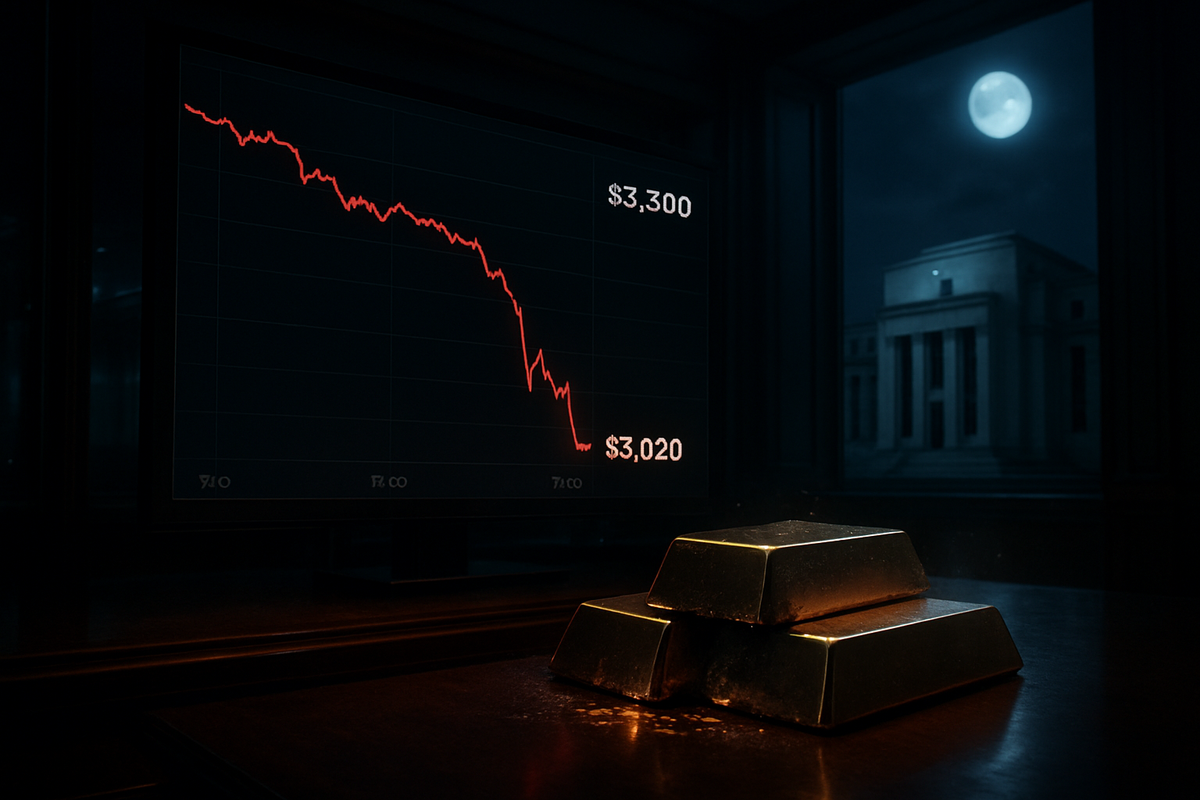
The global financial landscape was fundamentally reshaped on January 30, 2026, by what is now being called the "Warsh Shock." The nomination of Kevin Warsh as the next Chair of the Federal Reserve sent shockwaves through the commodities market, ending a multi-year parabolic rally in precious metals. Gold, which had climbed to an atmospheric record of $5,608 per ounce just days prior, suffered its most violent single-day reversal in over forty years, plunging toward a psychological support level of $5,020.10 by early February.
This dramatic correction represents a total pivot in market sentiment. For months, investors had been positioned for a "debasement trade," betting that a "dovish" appointment would signal the end of Federal Reserve autonomy and the start of aggressive rate cuts to monetize sovereign debt. Instead, the selection of Warsh—a known monetary hawk—has signaled a return to "Sound Money" principles and the re-establishment of the Fed’s independence from political pressure.
The Timeline of a Historic Reversal
The seeds of the current market turmoil were sown in late 2025, as speculative fervor drove gold prices to unprecedented heights. By mid-January 2026, spot gold was trading near $5,600 as the market anticipated a "loyalist" candidate for the Fed Chair position who would facilitate rapid monetary expansion. However, the announcement of Kevin Warsh on January 30 shattered these expectations. Within hours of the news, gold suffered an intraday drop of approximately 11%, falling with a velocity not seen since the historic crash of February 28, 1983.
The "Warsh Shock" was not a one-day event but a multi-week deleveraging cycle. After the initial flash crash, which saw gold futures tumble toward $4,400, the market entered a period of extreme volatility. By February 9, 2026, the price had attempted to stabilize, opening at exactly $5,020.10. This level has become a critical battleground for bulls and bears, marking a nearly $600-per-ounce loss from the January highs. Silver, often the more volatile sibling of gold, saw an even more catastrophic "capitulation event," crashing nearly 39% from its peak of $120 to hover around the $80 mark.
Winners and Losers in the Great Liquidity Reset
The sudden shift in the interest rate outlook has created a stark divide in the equity markets. The primary casualties have been the major gold mining companies, which saw billions in market capitalization evaporate. Newmont (NYSE: NEM) and Barrick Gold (NYSE: GOLD) both witnessed double-digit percentage drops in the wake of the nomination, with Newmont sliding from $126 to nearly $110 in a single week. High-leverage producers like Agnico Eagle (NYSE: AEM) and silver-focused Pan American Silver (NASDAQ: PAAS) were hit even harder as institutional funds rotated out of inflation hedges.
Conversely, the banking sector has emerged as the primary beneficiary of the "Warsh Shock." Shares of JPMorgan Chase (NYSE: JPM) and Goldman Sachs (NYSE: GS) rallied as investors bet on a steepening yield curve and a stronger U.S. dollar. The nomination is seen as a boon for traditional financial institutions, as Warsh’s "Sound Money" reputation suggests a more predictable, disciplined monetary environment. Meanwhile, the SPDR Gold Shares (NYSE: GLD) and the VanEck Gold Miners ETF (NYSE: GDX) have experienced record-breaking outflows, as the "independence risk premium" that had been baked into gold prices since 2024 was suddenly removed.
A Return to Monetary Dominance
The wider significance of Warsh’s nomination cannot be overstated. Since the early 2020s, many economists feared a move toward "fiscal dominance," where the Federal Reserve would be forced to subordinate its inflation-fighting goals to accommodate massive government spending. Warsh, who famously resigned from the Fed Board in 2011 in protest of Quantitative Easing (QE2), represents the antithesis of this trend. His appointment is being interpreted as a restoration of the "Volcker Era" mentality, where price stability is the paramount objective.
This event mirrors the 1983 crash, when the end of the 1970s inflation era led to a 12.1% single-day drop in gold prices. Historically, such "regime shifts" occur when the market realizes that a central bank is willing to endure short-term economic pain to preserve the long-term value of the currency. By choosing Warsh, the administration has signaled to the world that the U.S. dollar's status as a reserve currency will be defended, even at the expense of the "everything bubble" that had lifted gold to $5,600.
What Comes Next for the Markets
In the short term, gold is expected to remain highly sensitive to any rhetoric from the incoming Chair regarding the pace of balance sheet reduction. Analysts suggest that while the initial "shock" has been absorbed, a prolonged period of consolidation is likely as the market recalibrates for a higher-for-longer interest rate environment. The $5,000 level is now viewed as a crucial technical and psychological floor; a break below this could trigger another wave of algorithmic selling.
Long-term, the "Warsh Shock" may mark the beginning of a strategic pivot for institutional investors. The "inflation trade" that dominated the first half of the decade is being replaced by a focus on "real yields" and quality earnings. Companies with high debt loads may find the coming years difficult as the era of cheap, easy money definitively ends. For the gold market, the path to recovery will likely depend on whether global geopolitical tensions can offset the headwind of a resurgent, hawkish Federal Reserve.
Final Assessment: The End of an Era
The events of the past few weeks mark a definitive end to the speculative mania that drove gold to the brink of $6,000. The nomination of Kevin Warsh has reasserted the primacy of Federal Reserve independence, effectively removing the "political risk premium" that had fueled much of gold’s recent rise. While the $5,020.10 stabilization point offers some relief to beleaguered precious metal investors, the broader market remains in a state of adjustment.
Investors should watch closely for Warsh's confirmation hearings in the coming months. Any deviation from his hawkish reputation could spark a relief rally, but for now, the "Warsh Shock" has served as a potent reminder that the Federal Reserve remains the most powerful force in global finance. As the "Great 2026 Liquidity Reset" continues to unfold, the shift from a regime of fiscal accommodation to one of monetary discipline will be the defining story of the year.
This content is intended for informational purposes only and is not financial advice.