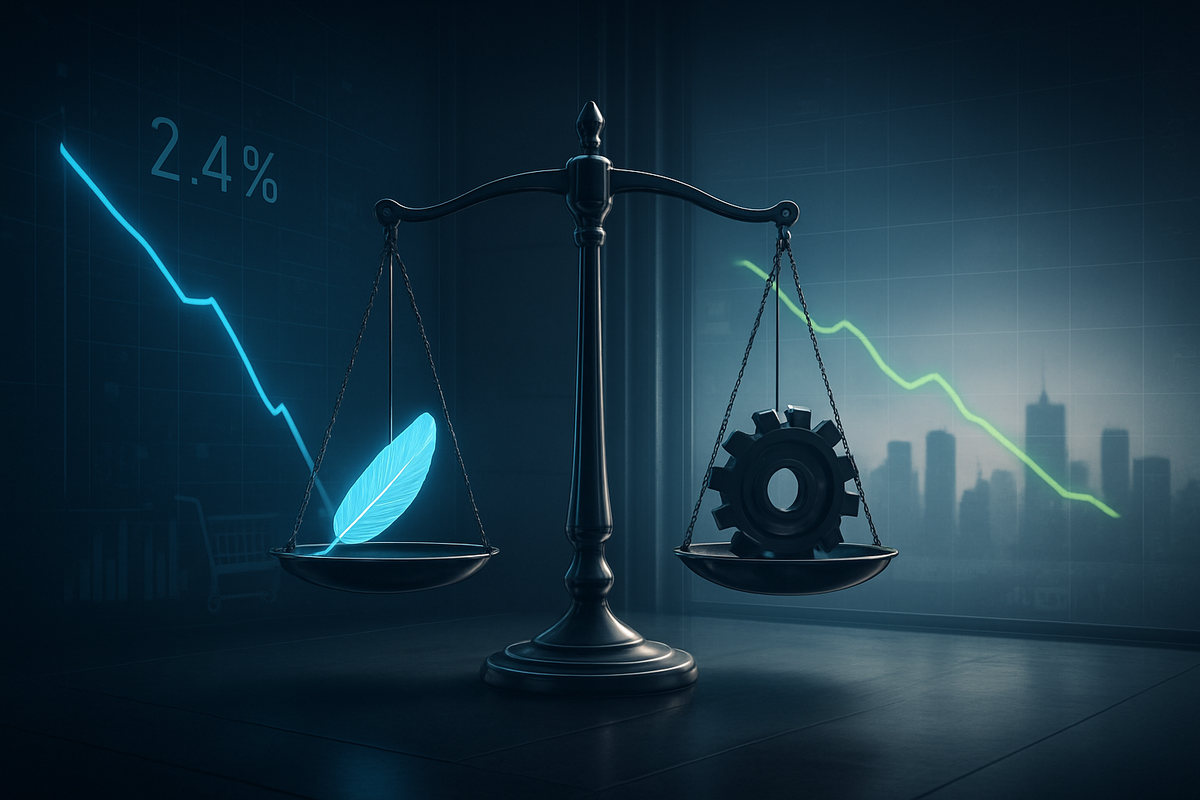
The U.S. labor and consumer markets received a pivotal update this week as the Bureau of Labor Statistics released the January 2026 Consumer Price Index (CPI) report. Headline inflation cooled to a 2.4% annual rate, marking the lowest level of price growth since mid-2021 and coming in slightly below the 2.5% consensus expectation. On a month-over-month basis, prices rose a modest 0.2%, down from December’s 0.3% pace, signaling that the aggressive monetary tightening of the past two years is finally anchoring price stability near the Federal Reserve’s long-term target.
However, the celebratory mood in the markets was tempered by a "cooling growth pulse" that has economists and policymakers on edge. While the 2.4% print offers the Federal Reserve room to breathe, it arrives amidst a backdrop of softening retail sales, a 43-day partial government shutdown that disrupted federal spending in late 2025, and a projected sharp deceleration in GDP growth for the first quarter of 2026. The central bank now faces a high-stakes balancing act: maintaining its "data-dependent" approach without allowing a cooling economy to slide into a broader contraction.
A Decisive Shift in the Disinflationary Path
The January 2026 CPI report represents a significant milestone in the post-pandemic economic recovery. The 2.4% annual rate is a notable step down from the 2.7% levels maintained throughout the final quarter of 2025. Core CPI, which strips out the volatile categories of food and energy, also hit a multi-year low of 2.5%. The primary engine of this disinflationary trend was a sharp decline in energy costs, with gasoline prices plummeting 7.5% year-over-year. While shelter costs remained somewhat "sticky" at a 3.0% annual increase, the overall trajectory suggests that the "last mile" of the inflation fight is being won through a combination of resolved supply chains and dampened consumer demand.
This data follows a period of significant uncertainty characterized by a "data blackout" during the record-breaking 43-day government shutdown that ended in early January. Investors and Fed officials spent much of the winter flying blind, relying on high-frequency private data until official government reporting resumed. The January 28 meeting of the Federal Open Market Committee (FOMC) saw the Fed hold the federal funds rate steady at a target range of 3.50% to 3.75%. Chair Jerome Powell described this as a "neutral" stance, pausing after three consecutive rate cuts in late 2025. The new CPI data validates that pause but intensifies the internal debate within the Fed, where two dissenting members have already pushed for deeper cuts to protect a softening labor market.
Market reaction was immediate and fragmented. Bond yields retreated, with the 10-year Treasury yield sliding to 4.05% as traders began pricing in a higher probability of a rate cut by June. Equity markets, however, saw a violent rotation. While interest-rate-sensitive sectors like small-caps and real estate rallied, "Big Tech" giants faced a wave of profit-taking as investors shifted focus from growth potential to immediate cash-flow stability.
Winners and Losers in a Cooling Economy
The January data created a clear divide between companies resilient to "inflation fatigue" and those overextended on future growth projections. Walmart (NYSE: WMT) emerged as a dominant winner, with its stock hitting an all-time high and pushing the company to a historic $1 trillion market capitalization in early February. Analysts credit Walmart’s success to a "high-income trade-down" effect, where households earning over $100,000 have increasingly pivoted to the retailer for groceries and essentials to offset core costs. Similarly, McDonald’s (NYSE: MCD) saw its shares surge following a strong Q4 earnings report that highlighted the success of its "McValue" platform, capturing market share from more expensive fast-casual competitors.
In contrast, Amazon (NASDAQ: AMZN) faced a challenging period, recording its longest losing streak in nearly two decades. Despite strong holiday revenue, investors were spooked by a massive $200 billion capital expenditure plan for 2026 focused on AI and satellite infrastructure. In a cooling growth environment, the market has become less tolerant of "exploding" capex, preferring the immediate dividends of value stocks. This "AI exhaustion" also weighed on Nvidia (NASDAQ: NVDA) and Apple (NASDAQ: AAPL), both of which saw their stock prices dip by over 2% in the week following the CPI release as the market rotated toward more defensive staples like Costco (NASDAQ: COST) and Coca-Cola (NYSE: KO).
The energy sector also felt the sting of the cooling CPI. While ExxonMobil (NYSE: XOM) has maintained record-high production levels in the Permian Basin, the 7.5% drop in gasoline prices and general "weak crude realizations" cited in its recent earnings have begun to weigh on its stock performance. Meanwhile, logistics giant UPS (NYSE: UPS) reported a 3.2% revenue decline, explicitly citing a "softening" in shipping volumes as consumers shift their spending from physical goods to services and travel, a trend further evidenced by positive guidance from hospitality leaders like Hilton (NYSE: HLT).
Macro Trends and Historical Precedents
The current economic landscape is drawing frequent comparisons to the "soft landing" of the mid-1990s, where the Fed successfully throttled inflation without triggering a recession. However, the "cooling growth pulse" of early 2026 adds a layer of complexity not seen in previous cycles. The sharp drop in projected GDP growth—from a robust 3.2% in Q4 2025 to an estimated 0.91% in Q1 2026—suggests that the economy is decelerating faster than many anticipated. This "shutdown stumble" has left the consumer in a precarious position; while real wage growth has finally turned positive at 3.7%, the "excess savings" that fueled the post-2022 recovery have largely vanished.
Furthermore, the "SaaSpocalypse" rotation—where investors are fleeing high-valuation Software-as-a-Service and tech names—indicates a structural shift in market leadership. For the first time in several years, the Russell 2000 small-cap index is outperforming the Nasdaq-100 on a relative basis following inflation prints. This suggests that the market is finally believing the Fed’s "higher for longer" era is ending, but it is simultaneously fearful of the growth slowdown that is making those rate cuts necessary. Historically, when inflation falls below 2.5% while growth dips below 1%, the Fed has been forced to move quickly to avoid a "hard landing."
What Comes Next: Pivots and Scenarios
In the short term, all eyes will be on the "One Big Beautiful Bill Act," a major fiscal package expected to take full effect by mid-2026. Proponents argue this will provide the necessary stimulus to prevent a recession, while critics fear it could reignite the very inflation the Fed has just brought under control. If growth continues to stagnate below 1%, the Federal Reserve may be forced to abandon its "neutral" stance as early as the May or June meeting, potentially initiating a series of 25-basis-point cuts to stimulate the labor market, which has slowed to a "low-hire, low-fire" regime of just 11,000 to 30,000 new jobs per month.
Strategic adaptations are already underway in corporate America. We should expect to see more "Value Wars" similar to the strategies deployed by McDonald's and Walmart, as companies compete for a shrinking pool of discretionary consumer dollars. Tech giants like Microsoft (NASDAQ: MSFT) have already signaled consumer-facing weakness in segments like gaming and Windows, suggesting a pivot toward enterprise-grade AI applications where budgets are more resilient. The primary challenge for the remainder of 2026 will be navigating this "bifurcated economy"—where inflation is no longer the primary enemy, but stagnant growth has taken its place.
Summary and Investor Outlook
The January CPI report of 2.4% is a clear victory for price stability, yet it brings the Federal Reserve to a critical crossroads. The era of rampant inflation appears to be over, but the cost of that victory is a cooling growth pulse that has left the U.S. economy on the edge of a significant slowdown. The data-dependent Fed must now weigh the risk of persistent service-sector inflation against a rapidly softening GDP and a fragile labor market.
For investors, the coming months will require a shift in perspective. The "growth at any cost" mentality that propelled the AI rally in 2025 is being replaced by a focus on "quality and value." Monitoring real wage growth and retail sales volume will be just as important as watching the CPI in the months ahead. If the Fed manages to cut rates just as fiscal stimulus kicks in, the "soft landing" may yet be achieved. However, if the cooling growth pulse turns into a freeze, the market could be in for a volatile spring. Watch for the Fed's rhetoric in March for clues on whether the "wait-and-see" mode is shifting toward an active rescue of the growth cycle.
This content is intended for informational purposes only and is not financial advice.