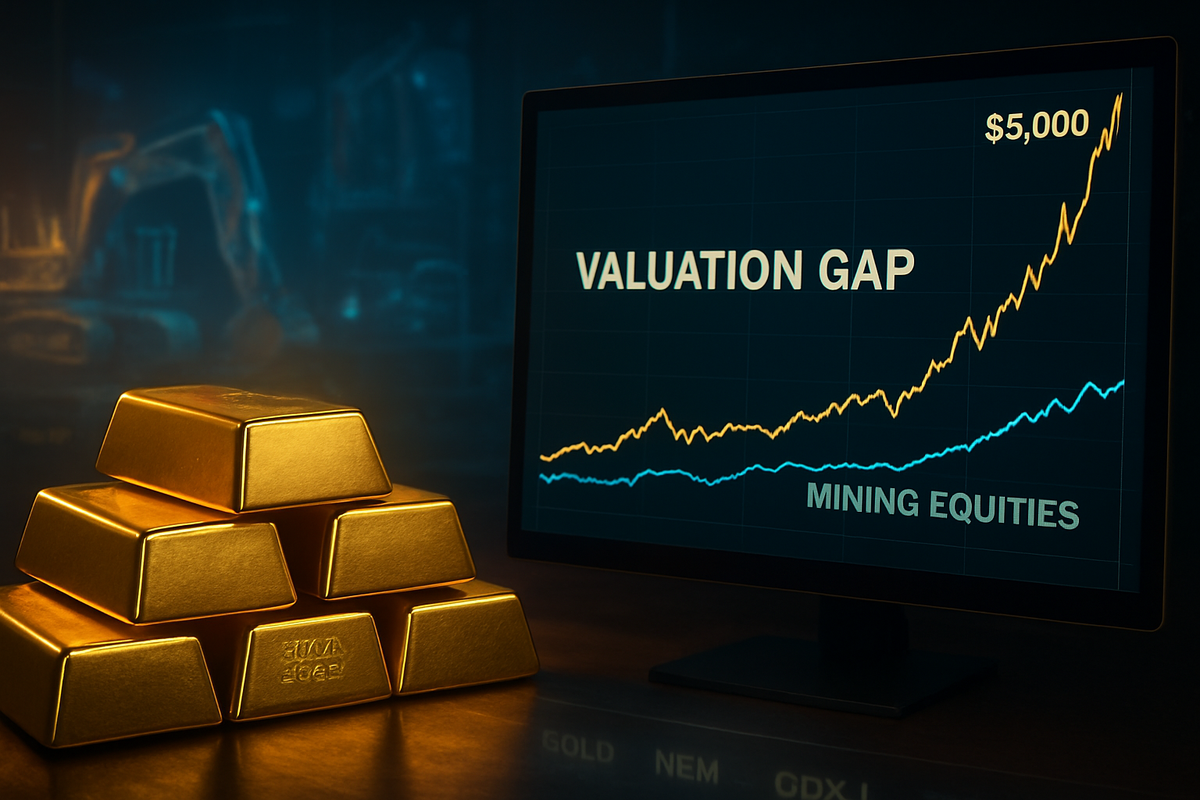
As of February 17, 2026, the global financial landscape is witnessing a paradox that has left even seasoned commodities traders scratching their heads. While physical gold has shattered all previous glass ceilings to trade above $5,000 per ounce, and silver has undergone a historic "melt-up" toward the $110 mark, the companies pulled these metals from the earth are only just beginning to find their footing. This massive valuation gap—where mining equities trade at a 15% to 17% discount to the underlying bullion—has created what many analysts are calling the most significant "deep value" opportunity in the precious metals sector in decades.
The immediate implication for the market is a looming "catch-up" trade of epic proportions. For much of 2025, investors favored physical ETFs and vaulted bullion as a hedge against persistent global de-dollarization and geopolitical volatility. However, with major mining companies now reporting record-breaking free cash flow (FCF) and doubling their dividend payouts, the institutional "wall of money" is finally starting to rotate from the metal itself into the producers, signaled by a sudden 200% trailing twelve-month surge in junior mining benchmarks.
The Road to $5,000 Gold and the Mining Lag
The timeline leading to this current market state began in late 2024, when a combination of aggressive central bank buying—led by the BRICS+ nations—and a shift in Federal Reserve policy created a floor for gold near $2,700. By mid-2025, a systemic supply deficit in silver, driven by the massive expansion of solar and green energy infrastructure, caused the metal to detach from traditional trading ranges. As spot prices soared, mining stocks initially lagged due to "investor disbelief" and a hangover from the inflationary period of 2022-2023, which saw All-In Sustaining Costs (AISC) balloon to nearly $1,600 per ounce.
Throughout 2025, the narrative shifted. While inflation stabilized, gold continued its vertical climb, allowing margins to expand at a rate never before seen in the industry. By early 2026, the average AISC for senior producers has leveled off at approximately $1,800 per ounce, while gold trades at nearly triple that cost. Key stakeholders, including institutional heavyweights like BlackRock and Vanguard, have spent the last six months reassessing the sector. The initial market reaction was cautious, but the Q4 2025 earnings season, which saw miners like Barrick Gold Corp (NYSE: GOLD) and Newmont Corporation (NYSE: NEM) report multi-billion dollar FCF prints, has ignited a fierce re-rating process.
Winners, Losers, and the ETF Revolution
In this high-priced environment, the clear winners are the diversified seniors and the high-beta juniors. Newmont Corporation (NYSE: NEM) has emerged as a powerhouse, delivering a staggering 212% total return over the past year. Despite this, it still trades at a P/E ratio of approximately 19x, which many consider a bargain compared to the broader tech-heavy S&P 500. Similarly, Agnico Eagle Mines Limited (NYSE: AEM) remains a favorite for investors seeking "tier-one" jurisdictional safety, though its premium valuation (24x P/E) makes it a more "defensive" play in the mining space.
On the exchange-traded fund front, the VanEck Junior Gold Miners ETF (NYSEArca: GDXJ) has become the vehicle of choice for speculators, returning over 203% in the last 12 months. Perhaps more interesting is the rise of the Sprott Active Gold & Silver Miners ETF (NYSEArca: GBUG). Launched in early 2025, GBUG has capitalized on the silver "melt-up" by actively managing a portfolio of miners that are specifically positioned to benefit from the $100+ silver price. With a 160% gain since its inception, GBUG highlights the advantage of active management in a sector where "reserve crises" and geopolitical risks make passive indexing more dangerous. The "losers" in this environment are primarily those companies that failed to replace their reserves during the 2020-2024 period, now finding themselves targets of aggressive M&A as larger firms scramble to add "ounces in the ground" to sustain their production profiles.
A Structural Shift in Global Portfolios
The wider significance of this valuation gap cannot be overstated. Historically, gold and mining stocks have accounted for a significant portion of institutional portfolios during periods of high inflation or currency instability. As of February 2026, however, these assets still only make up about 1% to 2% of global allocations. This suggests that the current rally is not the result of a retail "bubble," but rather a slow-motion fundamental shift in how the world perceives value.
This trend is forcing a wave of consolidation. Recent moves, such as Equinox Gold Corp (TSX: EQX) acquiring mid-tier producers to bolster its pipeline, suggest that the industry is entering a "buy vs. build" phase. It is cheaper for a major to buy a junior with a proven discovery than it is to explore and permit a new mine in an increasingly regulated environment. Furthermore, the regulatory landscape has tightened, with ESG (Environmental, Social, and Governance) mandates making it harder to bring new supply online, which paradoxically supports higher prices for the foreseeable future.
The Path Forward: Closing the 17% Gap
Looking ahead, the short-term outlook remains bullish for the miners as they continue to close the 15-17% valuation gap relative to bullion. We expect a "dividend war" to emerge among the senior miners as they attempt to lure back generalist investors who have been absent from the sector for a decade. Strategic pivots toward "green gold"—mining operations that use renewable energy to lower their carbon footprint—will likely become a requirement for attracting the next wave of institutional capital.
The long-term challenge, however, remains the "reserve crisis." With zero major discoveries over 2 million ounces reported in the last two years, the industry is essentially eating its own tail. This will likely lead to even higher M&A premiums and a scramble for projects in "frontier" jurisdictions. Investors should watch for potential scenarios where silver outpaces gold even further, which would disproportionately benefit silver-heavy miners and specialized funds like GBUG.
Summary for the Strategic Investor
The precious metals mining sector in early 2026 is a study in extreme undervaluation amidst record-breaking prosperity. While the spot prices of gold ($5,000) and silver ($110) have captured the headlines, the real story for investors lies in the massive free cash flow generation and the "catch-up" potential of mining equities. The key takeaways are clear: the margins have never been fatter, the dividends have never been higher, and yet the stocks remain historically cheap relative to the metal they produce.
Moving forward, the market will likely move from an "awareness phase" into an "acceleration phase." Investors should keep a close eye on AISC stability and reserve replacement ratios. While the easy money in physical bullion may have been made, the "mining moonshot" appears to be just getting started. As institutional allocations shift from 1% toward a more historical 5%, the pressure on mining share prices will likely remain heavily skewed to the upside.
This content is intended for informational purposes only and is not financial advice.