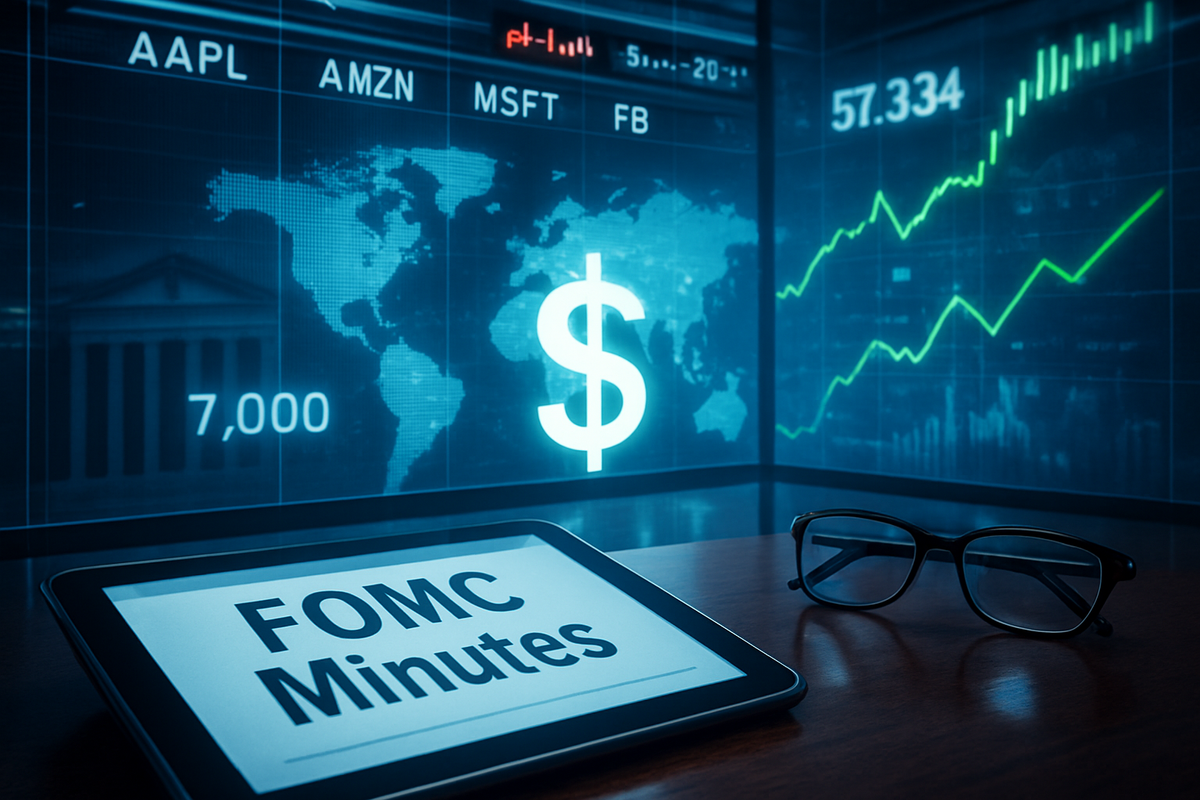
The global financial community is at a standstill today, February 18, 2026, as the Federal Reserve prepares to release the minutes from its January FOMC meeting at 2:00 PM ET. Investors are scouring the upcoming report for any indication of when the central bank might resume its rate-cutting cycle, which saw three consecutive 25-basis-point reductions in late 2025 before a "hawkish pause" in January. With the federal funds rate currently sitting at a range of 3.50% to 3.75%, the primary question remains whether the Fed will pivot toward easing in the spring or maintain its restrictive stance until the summer.
The anticipation of a more cautious Fed has already sent ripples through the currency and equity markets. The U.S. Dollar Index (DXY) has stabilized around the 97.20 mark, holding firm above its psychological floor as traders bet on a "higher-for-longer" narrative. Meanwhile, global indices have shown remarkable resilience; the Nikkei 225 has recently touched record highs near 57,334, and the S&P 500 continues to hover just below the historic 7,000 milestone. This "compression" phase suggests that while growth remains solid, the market is highly sensitive to any shift in the Fed's internal consensus regarding inflation and the labor market.
Internal Rifts and the Path to the January Pause
The minutes are expected to shed light on a significant shift in FOMC dynamics: the 10-2 split vote that occurred during the January 27–28 session. While the majority of the committee voted to hold rates steady, Governors Stephen Miran and Christopher Waller were notable dissenters, advocating for an immediate 25-basis-point cut. Their argument—that the Fed risks being "reactive" rather than "proactive" as the labor market stabilizes—has become a focal point for institutional investors. Market participants are eager to see if this internal friction has grown or if the "solid" growth narrative championed by Chair Jerome Powell continues to dominate the discourse.
Leading up to this moment, the economic backdrop has been a mix of cooling inflation and surprising economic vigor. Core PCE has moderated to approximately 2.5%, still above the Fed’s 2% target but significantly down from the peaks of previous years. This progress allowed for the easing cycle in late 2025, but a recent uptick in services inflation has given the more hawkish members of the committee reason to pause. The January meeting was a strategic timeout, intended to allow the committee to assess the cumulative impact of previous cuts before committing to further easing.
Key stakeholders, including major brokerage houses like Goldman Sachs and Morgan Stanley, have already begun adjusting their forecasts in response to this uncertainty. Most major firms have pushed their expectations for the next rate cut to June 2026, though a vocal minority, including Citigroup (NYSE: C), suggests a move could come as early as April if employment data begins to soften. The minutes will be the first official look at how many committee members share the concerns of the dissenters, potentially shifting the probability of a spring cut.
Winners and Losers in a High-Rate Environment
The delay in rate cuts has created a complex landscape for public companies, particularly in the banking and technology sectors. JPMorgan Chase & Co. (NYSE: JPM) and Citigroup (NYSE: C) are navigating a period of compressed net interest margins as the benefit of high rates is increasingly offset by rising deposit costs. However, a "hawkish pause" can be a double-edged sword for these giants; while it maintains lending profitability, it also increases the risk of credit defaults in more sensitive sectors. Conversely, Lloyds Banking Group (NYSE: LYG) is under intense scrutiny following its most recent earnings release, as international banks grapple with the divergence between U.S. and European monetary policies.
In the technology sector, the focus remains on "discount rates" and their impact on future earnings valuations. Growth powerhouses like Nvidia Corp. (NASDAQ: NVDA) and Meta Platforms Inc. (NASDAQ: META) have led the market higher on the back of AI-driven demand, but their high valuations make them particularly sensitive to the Fed's "neutral rate" discussions. Analog Devices Inc. (NASDAQ: ADI), which also reported earnings today, serves as a bellwether for industrial tech; any hawkish surprise in the Fed minutes could lead to a swift re-rating of these high-growth stocks as the cost of capital remains elevated for longer than anticipated.
The real estate and financial services sectors are perhaps the most vulnerable to a delayed pivot. Prologis Inc. (NYSE: PLD) and American Tower Corp. (NYSE: AMT) rely heavily on corporate debt markets to fund expansion and manage high leverage. A continuation of the current rate plateau could stifle new development and force a more conservative strategic pivot. Meanwhile, Moody's Corp. (NYSE: MCO) is closely watching issuance volumes, as corporate borrowers often wait for a "pivot" signal before tapping the bond markets, potentially delaying the revenue growth expected for the first half of 2026.
Broader Significance and the "Warsh" Factor
The release of these minutes takes on added significance given the looming leadership transition at the Federal Reserve. With Chair Jerome Powell’s term set to expire in May 2026, the political and economic landscape is shifting. The potential nomination of Kevin Warsh as a successor has introduced a new layer of uncertainty. Warsh is often viewed by the market as a "policy hawk," and his potential influence—or even the anticipation of his appointment—could be encouraging the current committee to take a more conservative path to ensure a stable transition.
Historically, the Fed has sought to avoid major policy shifts during leadership changes to prevent market volatility. This "transition friction" is a trend that global markets are watching closely, as it might explain the Fed's hesitation to continue the easing cycle despite inflation nearing its target. This situation draws parallels to the transition periods of the past, where the central bank prioritized continuity over aggressive action, often resulting in a "wait-and-see" approach that can frustrate investors looking for immediate stimulus.
Furthermore, the strength of the U.S. Dollar and the performance of global indices like the FTSE 100 (which is trading near 10,473) suggest that the "U.S. exceptionalism" trade is still very much alive. As other central banks potentially cut rates faster than the Fed, the resulting interest rate differential keeps the dollar strong, which in turn pressures international markets and affects the earnings of U.S. multinationals. The minutes will be parsed for any mention of global financial stability and how much the Fed is considering these international ripple effects.
The Road to June: Scenarios and Strategic Pivots
Looking ahead, the market is pricing in between 50 and 64 basis points of total easing for the remainder of 2026. If today's minutes reveal a consensus that is more worried about the labor market than inflation, we could see a rapid shift in sentiment, with the "April cut" scenario gaining traction. This would likely lead to a cooling of the U.S. Dollar and a fresh leg up for the S&P 500 as it aims for the 7,000 level. Conversely, if the minutes emphasize "stubborn services inflation" and a "solid" economic outlook, the market may have to accept that June is the earliest possible window for relief.
For companies, the short-term priority will be balance sheet management and cost control. We may see more firms like Booking Holdings Inc. (NASDAQ: BKNG) optimizing their discretionary spending to weather a prolonged high-rate environment. Strategic pivots toward more capital-efficient growth models will likely become the norm if the "higher-for-longer" narrative is reinforced today. The ability to navigate this period without the tailwind of cheap capital will separate the market leaders from the laggards in the coming months.
Final Assessment: What to Watch For
In summary, the February 18 Fed minutes are far more than a retrospective look at a January meeting; they are a roadmap for the first half of 2026. The key takeaways will be the depth of the dissent among committee members, the specific language used to describe the "neutral rate," and any hints regarding the upcoming leadership transition. These factors will determine whether the current market optimism is sustainable or if a period of consolidation and re-valuation is on the horizon.
Moving forward, investors should keep a close eye on upcoming labor market reports and the February PCE inflation data. These will be the primary catalysts that either validate the Fed's "solid growth" stance or force a more dovish hand. As the market navigates this "hawkish pause," the focus remains on resilience—both in the economy and in the corporate earnings that sustain the global indices at their current heights.
This content is intended for informational purposes only and is not financial advice.