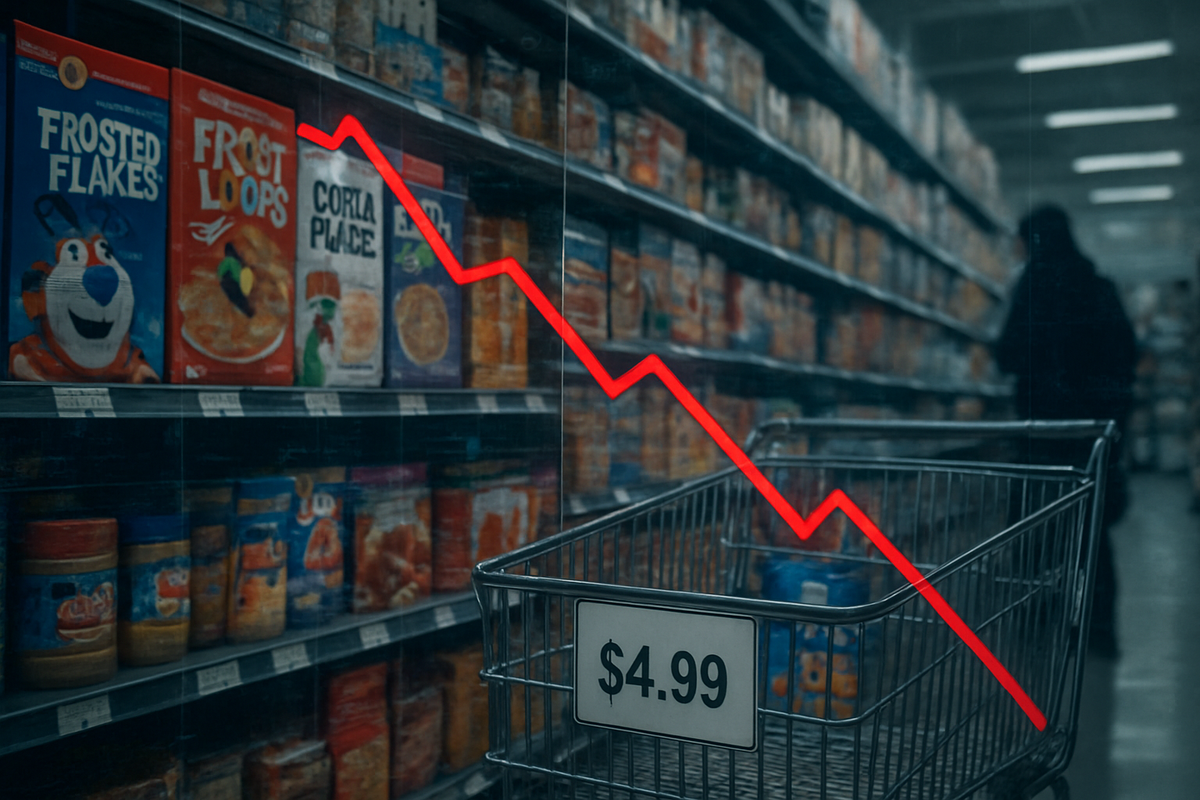
Shares of consumer powerhouse General Mills (NYSE: GIS) plummeted more than 7% in early trading on February 18, 2026, after the company issued a stark warning regarding its fiscal 2026 performance. The Minneapolis-based food giant significantly lowered its guidance for both top-line growth and profitability, signaling a deepening crisis for branded consumer staples as inflation-weary shoppers pivot toward cheaper alternatives.
The sudden revision has sent shockwaves through the broader market, dragging down competitors and raising fundamental questions about the pricing power of legacy food brands. With organic net sales now expected to decline between 1.5% and 2% and adjusted earnings per share (EPS) projected to crater by 16% to 20%, the update marks one of the most significant downward adjustments for the company in recent memory, reflecting a consumer environment that management described as increasingly "volatile."
A Drastic Reset at CAGNY 2026
The announcement came during the annual Consumer Analyst Group of New York (CAGNY) conference, a high-profile industry event where executives typically showcase growth strategies. Instead, General Mills CEO Jeff Harmening delivered a sobering assessment of the current retail climate. The company’s previous forecast of relatively flat sales has been replaced by a contraction, as the "remarkability" playbook—focused on premium innovation and brand differentiation—struggles to gain traction against a backdrop of shrinking household budgets.
General Mills attributed the guidance cut to a "unique combination" of pressures that intensified throughout the early part of the year. According to the company, the cumulative effect of multi-year inflation, rising housing costs, and the sharp reduction in SNAP benefits has finally hit a breaking point for middle- and lower-income households. This has led to a measurable "volume recovery" gap, where the company must spend significantly more on promotions and discounts just to maintain its shelf space, eroding profit margins in the process.
The timeline leading to this moment has been a slow-motion collision with reality. While General Mills was able to push through aggressive price increases in 2024 and 2025 to offset rising input costs, the "elasticity" of consumer demand—how much shoppers are willing to pay before walking away—has finally snapped. Market analysts noted that the company is now facing $160 million to $165 million in restructuring and integration costs as it desperately tries to lean out its operations to protect what remains of its bottom line.
The Winners and Losers of the Value Shift
The immediate losers in this scenario are the "Big Food" incumbents that have relied on brand loyalty to sustain high margins. Alongside General Mills, shares of the Campbell Soup Company (NYSE: CPB) and Conagra Brands (NYSE: CAG) both saw sharp declines of 7% or more as investors feared the same "price cliffs" would haunt their upcoming earnings reports. Mondelez International (NASDAQ: MDLZ) and Kraft Heinz (NYSE: KHC) were also caught in the crossfire, dropping 4.3% and 3.5% respectively, as the sector-wide sell-off reflected a loss of confidence in the defensive nature of consumer staples.
Conversely, the clear "winners" in this environment are not found on the New York Stock Exchange floor, but in the aisles of discount grocers and private-label manufacturers. As Harmening noted, "value is no longer a temporary preference but a core expectation." This shift directly benefits retailers with strong store-brand programs, such as Walmart (NYSE: WMT) and Costco (NASDAQ: COST), as well as private-label specialists like TreeHouse Foods (NYSE: THS). These entities are capturing the market share that General Mills is bleeding, as shoppers realize that generic oats and flour provide the same utility at a 30% discount.
Furthermore, the rise of GLP-1 weight-loss medications is beginning to create a secondary tier of losers. Companies like PepsiCo (NASDAQ: PEP) and General Mills are seeing a measurable, albeit nascent, drag on consumption in high-calorie snack and cereal categories. While not the primary cause of today's guidance slash, the long-term threat of a shrinking "stomach share" among the American public is weighing heavily on the valuation multiples of these traditional food stocks.
Broader Significance: The End of the Pricing Power Era
The General Mills retreat is a "canary in the coal mine" for the broader economy, indicating that the post-pandemic era of "greedflation" or price-led growth has reached its conclusion. For several years, consumer staples were viewed as a safe haven because people "always have to eat." However, the 2026 market is proving that while people must eat, they do not have to eat branded Cheerios or Blue Buffalo pet food.
This event fits into a wider industry trend of "bifurcation," where the market is splitting into two distinct groups. High-income consumers continue to buy premium, "better-for-you" products, but the massive middle-market is trading down aggressively. The ripple effects will likely force a wave of consolidation in the industry as smaller, debt-heavy brands become targets for larger conglomerates looking to buy growth they can no longer generate organically.
Historically, this resembles the "Private Label Surge" of the 2008 financial crisis, but with a modern twist. Today’s private labels are higher quality and better marketed than those of two decades ago, making the "brand moat" for companies like General Mills significantly shallower. Regulatory scrutiny on food pricing may also intensify, as the gap between manufacturer costs and shelf prices remains a point of contention for both policymakers and frustrated consumers.
What Comes Next: Strategic Pivots and Market Uncertainty
In the short term, General Mills must decide how aggressively it will fight to win back volume. If the company engages in a "price war" with private labels, margins will continue to contract, potentially leading to further EPS downgrades. Investors should watch for a shift in capital allocation, possibly moving away from dividends and buybacks toward deeper R&D or potential acquisitions of high-growth, "alt-staple" brands that appeal to the GLP-1 generation.
Long-term, the company may be forced to undergo a radical portfolio transformation. This could include divesting slower-growth categories to focus on "remarkability" in high-margin niches like specialized nutrition or global snacks. However, the path to recovery is narrow. As value-seeking behavior becomes entrenched, the "challenging backdrop" Harmening described may not be a temporary storm to weather, but a permanent change in the American retail landscape.
Wrap-Up: A Souring Sentiment for Investors
The 7% drop in General Mills shares is more than just a bad day on the market; it is a signal that the traditional playbook for consumer staples is broken. The combination of a 1.5-2% drop in organic sales and a near 20% collapse in EPS guidance suggests that the costs of maintaining a premium brand in a value-driven world are becoming unsustainable.
Moving forward, the market will be looking for signs of stabilization in volume, but the headwinds—inflation, SNAP reductions, and shifting health trends—remain formidable. For investors, the takeaway is clear: the safety once guaranteed by the "defensive" staples sector is currently under siege. In the coming months, all eyes will be on quarterly earnings from across the grocery aisle to see if General Mills was an outlier or the first domino to fall in a broader industry-wide reckoning.
This content is intended for informational purposes only and is not financial advice