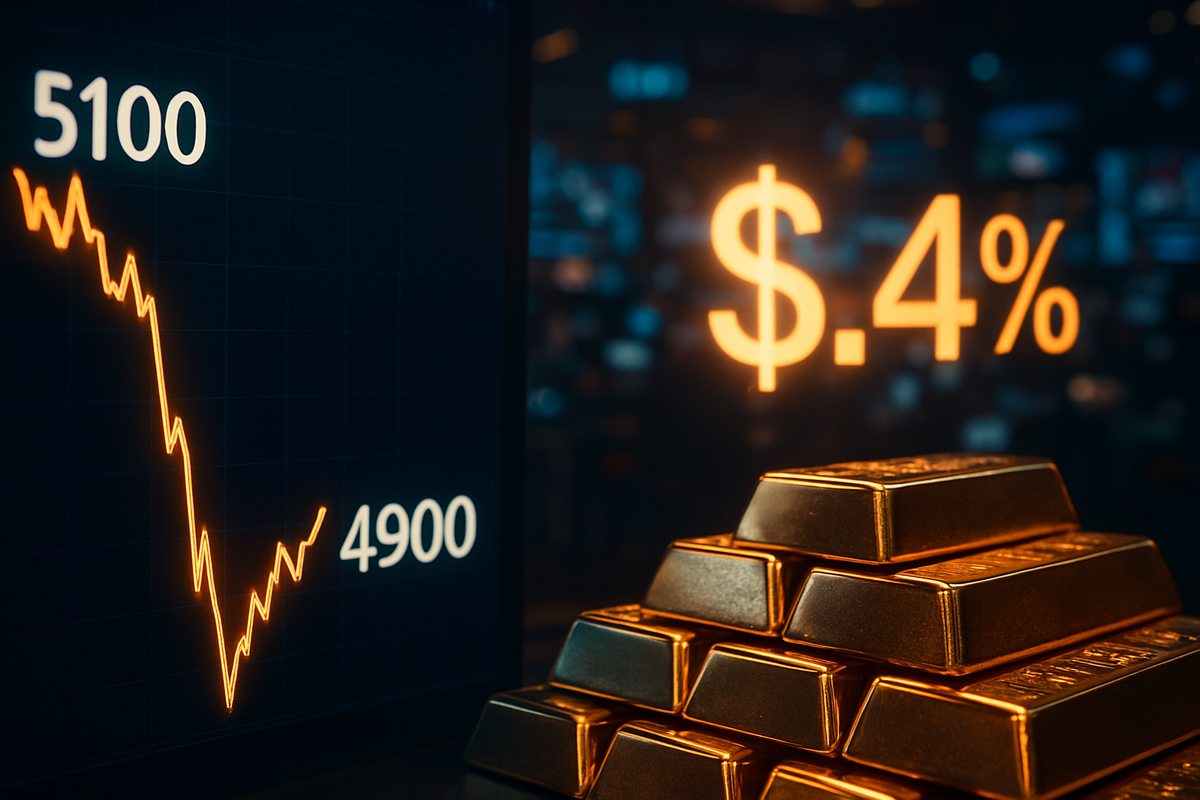
NEW YORK — The precious metals market is reeling from a week of extraordinary volatility that saw gold prices scale historic heights before a sudden, harrowing "flash crash" sent shockwaves through global trading floors. After touching a psychological milestone of $5,100 per ounce early in the month, gold spot prices plummeted toward the $4,900 mark in a matter of minutes, leaving investors questioning the stability of the long-running "everything rally." However, as of February 18, 2026, the yellow metal is staging a resilient recovery, buoyed by fresh U.S. Consumer Price Index (CPI) data that has signaled a potential shift in the Federal Reserve’s hawkish trajectory.
The current market turbulence marks a critical juncture for investors who have ridden the wave of a massive revaluation in hard assets. With inflation cooling to a four-year low of 2.4%, the narrative of "higher-for-longer" interest rates is being challenged by a cooling cost-of-living index, even as the U.S. labor market remains stubbornly robust. This push-and-pull between a decelerating CPI and a resilient workforce has created a "perfect storm" of volatility, where algorithmic trading and shifting geopolitical risk premiums have turned gold into a high-stakes battleground for bulls and bears alike.
The Anatomy of a Flash Crash: $5,100 to $4,900
The drama began in earnest on Thursday, February 12, 2026, when gold prices, which had been consolidating above the $5,100 level, suddenly buckled. In a move that market veterans described as a "liquidity vacuum," prices dropped nearly 4% in less than an hour, hitting a floor near $4,920. Analysts point to a convergence of "fat-finger" trades and systematic selling by Commodity Trading Advisors (CTAs) as the primary drivers. The selloff was reportedly exacerbated by contagion from the technology sector, specifically a sharp correction in artificial intelligence infrastructure stocks like Nvidia and Alphabet, which triggered a "risk-off" liquidation across multiple asset classes.
Compounding the technical breakdown was a sudden shift in geopolitical sentiment. News of a potential diplomatic breakthrough regarding trade and nuclear protocols in the Middle East led to an immediate contraction in the "war premium" that had been baked into gold prices since late 2025. This prompted a massive unwinding of safe-haven positions. However, the crash was short-lived. By the time the U.S. Bureau of Labor Statistics released the January CPI report on February 13, showing inflation had moderated to 2.4%—lower than the 2.5% consensus—the "dip-buyers" had already returned in force, viewing the $4,900 level as a generational entry point.
The recovery has been further supported by the Federal Reserve’s nuanced stance. While Fed Chair-nominee Kevin Warsh’s reputation as an inflation hawk initially sent the US Dollar Index (DXY) surging to 97.60, the 2.4% CPI print has "cleared the runway" for the Fed to maintain its current 3.50%–3.75% interest rate range without immediate pressure to hike. This stabilization in the 10-year Treasury yield, which retreated toward 4.02% following the inflation data, has significantly reduced the opportunity cost of holding non-yielding gold, allowing the SPDR Gold Shares (NYSE Arca: GLD) to claw back much of its recent losses.
Winners and Losers in the Volatility Storm
The primary beneficiaries of this price action remain the major gold producers, despite the heart-stopping volatility. Newmont Corporation (NYSE: NEM), the world’s largest gold miner, has seen its margins expand significantly even with the temporary dip to $4,900, as its all-in sustaining costs (AISC) remain well below current spot prices. Similarly, Barrick Mining Corporation (NYSE: B)—which famously changed its ticker from 'GOLD' to 'B' in 2025 to reflect its diversified copper and gold strategy—reported that its diversified portfolio acted as a natural hedge during the flash crash, with copper prices remaining relatively stable compared to the violent swings in precious metals.
On the losing side of the ledger are the "leveraged longs" and retail traders who were caught in the forced liquidations during the $200 drop. ETFs such as the iShares Silver Trust (NYSE Arca: SLV) saw even more dramatic swings than gold, suffering a temporary 35.6% plunge earlier in the month as silver's dual role as an industrial and precious metal left it exposed to the tech sector's AI-driven selloff. However, institutional demand for Agnico Eagle Mines (NYSE: AEM) has remained high, as the company’s low-risk jurisdictional profile in North America continues to attract capital from investors looking to exit more volatile emerging market mining plays.
Central banks, particularly in the "Global South," continue to be the silent winners in this environment. Reports suggest that during the flash crash to $4,900, several major central banks stepped in to increase their reserves, viewing the volatility as a distraction from the broader trend of de-dollarization. For these stakeholders, the 2.4% inflation figure in the U.S. confirms their long-term thesis that while inflation may be "tamed" in the short term, the structural debt levels in the West will continue to make gold the ultimate Tier-1 reserve asset.
The Everything Rally and the Shifting Dollar Correlation
This latest bout of volatility is a symptom of the broader "Everything Rally," a phenomenon where equities, bonds, and commodities have all climbed in tandem over the past year. Typically, a stronger U.S. dollar, as measured by the DXY, acts as a headwind for gold. However, in early 2026, this inverse correlation has frequently "broken down." Even as the dollar staged a "Warsh-led" rebound toward 97.20, gold has managed to hold its ground above $5,000 for much of the month. This decoupling suggests that gold is no longer just a "dollar-hedge," but is increasingly being traded as a "liquidity-hedge" against systemic financial risks.
The Fed's focus on a "resilient labor market" adds another layer of complexity. With 312,000 jobs added in January and unemployment holding steady at 3.7%, the U.S. economy appears to be achieving the elusive "soft landing." In previous cycles, such economic strength would have been bearish for gold. In 2026, however, the market view has shifted: a strong economy provides the Federal Reserve the flexibility to manage the "Everything Rally" without the panic of a recession, which paradoxically supports the long-term case for precious metals by ensuring a stable, albeit inflationary, growth environment.
Historically, gold has often experienced these "clearing events" where extreme over-positioning is washed out by a flash crash. Similar episodes in the early 2010s saw gold prices drop sharply before embarking on multi-year bull runs. The current scenario, characterized by 2.4% inflation and high real rates, mirrors the mid-cycle adjustments seen in the late 1990s, though at a much higher nominal price level due to the massive expansion of the global M2 money supply over the last decade.
Looking Ahead: The Path to $5,200
In the short term, all eyes remain on the upcoming Federal Open Market Committee (FOMC) minutes and further labor market indicators. If the Fed acknowledges that the 2.4% CPI figure justifies a "dovish pause," gold is likely to challenge the $5,200 resistance level before the end of the first quarter. Traders will be closely watching the $5,050 support level; a sustained close above this mark would signal that the flash crash was merely a technical correction rather than a fundamental change in trend.
Strategic pivots are already underway among institutional asset managers. Many are moving away from pure-play bullion and toward "royalty and streaming" companies, which offer exposure to gold prices with less operational risk than traditional miners. Additionally, the emergence of "AI-enabled" gold exploration technology is beginning to create a divide in the mining sector, where companies that can lower their exploration costs through advanced robotics and data modeling are expected to significantly outperform their legacy competitors.
The long-term outlook remains bullish, but the "easy money" phase of the rally may be over. Market participants should prepare for a regime of higher volatility where $100 daily swings become the new normal. As gold continues to integrate into the digital economy through tokenized assets and central bank digital currency (CBDC) backing, its role as a "stabilizer" in a chaotic financial system will only be amplified, regardless of temporary flash crashes.
Final Assessment: Volatility as the New Normal
The recent fluctuations in gold prices from $5,100 down to $4,900 and back serve as a stark reminder that even the most "stable" of safe havens is not immune to the mechanics of modern, high-frequency trading. The key takeaway for investors is that the fundamental drivers—cooling inflation at 2.4%, a steady Fed, and a resilient labor market—remain largely intact. The "flash crash" appears to have been a healthy, albeit painful, shakeout of excess leverage that has left the market on a firmer footing for its next leg higher.
Moving forward, the market's focus will shift from "inflation protection" to "growth sustainability." As the "Everything Rally" enters its next phase, the inverse correlation with the U.S. dollar may continue to weaken, as global investors seek out gold for its lack of counterparty risk rather than its relationship to the greenback. For the public companies involved, the current price levels represent a "golden era" of profitability, provided they can manage the rising costs of labor and energy in a still-resilient economy.
In the coming months, investors should watch for any signs of "labor market cracking." While the Fed currently views the strong job market as a pillar of strength, any sudden spike in unemployment could trigger a much more aggressive rate-cutting cycle, which would likely act as rocket fuel for gold prices, potentially pushing the metal toward the elusive $6,000 mark by 2027. For now, the "gold-standard" for investors is patience and an eye for quality amid the noise of the flash crashes.
This content is intended for informational purposes only and is not financial advice.