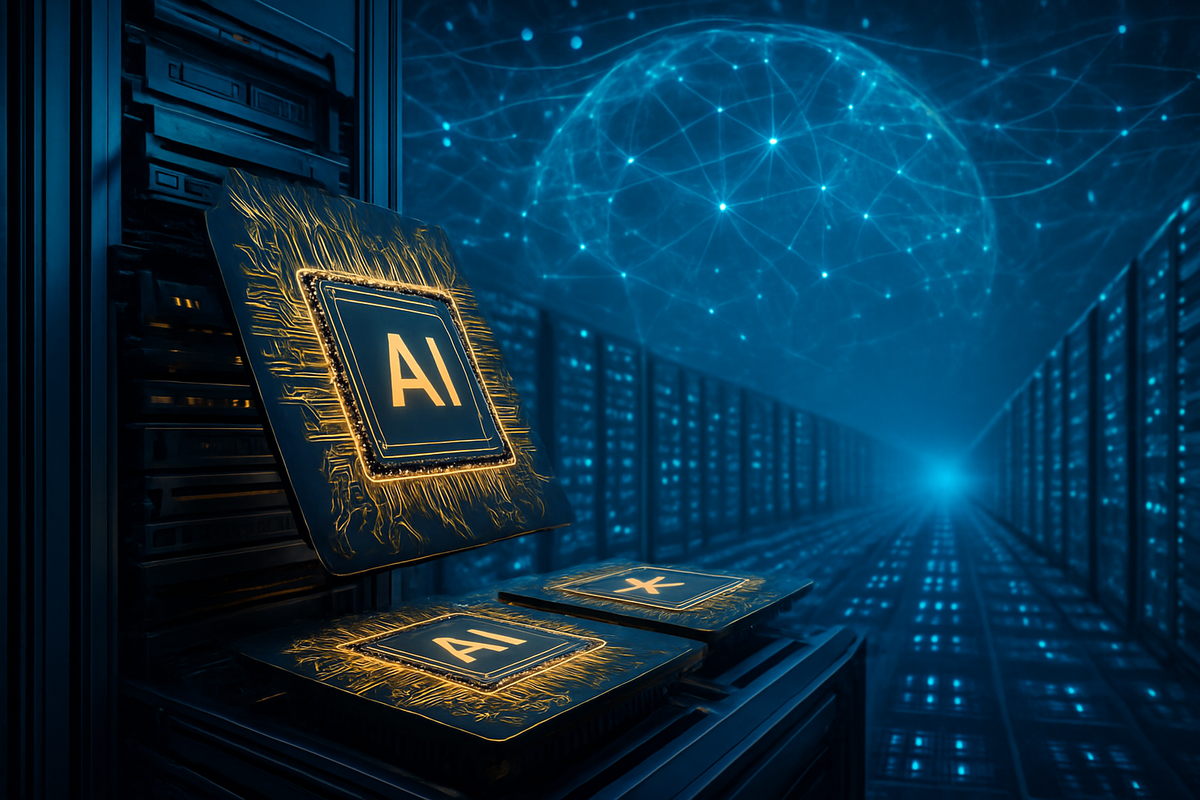
Nvidia Corp. (NASDAQ: NVDA) saw its shares climb to new record highs on Wednesday, February 18, 2026, following the announcement of a massive, multi-year partnership with Meta Platforms (NASDAQ: META). The deal, described by analysts as the largest single infrastructure commitment in the history of the semiconductor industry, will see Meta integrate millions of Nvidia’s next-generation Blackwell and Rubin-architecture chips into its global network of AI data centers. The news sent a shockwave through Wall Street, reasserting Nvidia’s position as the primary engine of the modern bull market.
The market reaction was immediate and decisive, with Nvidia’s stock jumping more than 5% in early trading, adding hundreds of billions of dollars to its already staggering market capitalization. For Meta, the move signals an aggressive push to dominate the "agentic AI" era, as it seeks to provide personalized superintelligence to its billions of users across WhatsApp, Instagram, and Facebook. "No one deploys AI at Meta's scale," remarked Nvidia CEO Jensen Huang during a joint appearance with Meta CEO Mark Zuckerberg. "This partnership isn't just about selling chips; it’s about co-designing the physical fabric of the future."
A New Frontier in Silicon Scale
The partnership finalized this Wednesday marks the culmination of a two-year collaborative effort to align Meta’s software ambitions with Nvidia’s rapid-fire hardware roadmap. Under the terms of the agreement, Meta has committed to a purchase volume that spans the current Blackwell Ultra (B300) series and the upcoming Rubin (R100) platform, which is slated for mass production in the second half of 2026. This commitment is part of Meta's massive 2026 capital expenditure budget, which is now projected to reach between $115 billion and $135 billion as the company races to finalize its "Llama 5" foundational models.
The timeline leading to this moment has been one of relentless escalation. Since early 2024, when Meta first announced its intention to acquire over 600,000 H100-equivalent GPUs, the social media giant has consistently doubled down on Nvidia’s ecosystem. By mid-2025, Meta became the first major hyperscaler to deploy Nvidia’s Grace CPUs at a global scale, moving away from traditional x86 architectures for its AI-driven recommendation engines. The current deal takes this relationship even further, involving "deep co-design" where Meta engineers work directly with Nvidia’s silicon teams to optimize the Rubin architecture for specific Mixture-of-Experts (MoE) workloads.
Initial market sentiment has been overwhelmingly bullish. Trading volume for Nvidia surpassed its 30-day average within the first hour of the market opening, dragging the S&P 500 (INDEXSP: .INX) higher alongside it. Traders noted that the sheer scale of the "millions of chips" mentioned in the press release effectively de-risks Nvidia’s revenue projections for the next 24 months, providing a clear floor for the company's fiscal 2027 performance.
The Winners and Losers of the AI Arms Race
Nvidia and Meta are the clear beneficiaries of this alliance, but the ripple effects are being felt across the entire technology sector. For Nvidia, the deal cements its status as the "S&P 500's North Star," with its weighting in the index now approaching 8%. This concentration of power means that as Nvidia goes, so goes the retirement accounts of millions of Americans. Meta, meanwhile, gains a significant competitive moat; by securing such a massive portion of Nvidia’s future supply, it effectively raises the "cost of entry" for any other social media or software company attempting to build its own sovereign AI models.
However, the news has cast a long shadow over competitors. Advanced Micro Devices (NASDAQ: AMD) and Intel Corp. (NASDAQ: INTC) both saw their shares trade lower as the Meta deal suggests that Nvidia’s dominance in the high-end data center market remains unchallenged. While AMD’s MI300 and MI400 series have found success with other cloud providers, the "exclusive" nature of the Meta-Nvidia co-design process makes it harder for rivals to break into the highest-tier AI clusters. Similarly, custom silicon efforts at other hyperscalers may face renewed scrutiny if they cannot match the performance-per-watt metrics of Nvidia's upcoming Rubin platform.
Secondary winners include the "pick and shovel" plays of the AI infrastructure world. Data center REITs like Equinix (NASDAQ: EQIX) and Digital Realty (NYSE: DLR) saw modest gains, as the deployment of "millions of chips" will require unprecedented levels of physical space, cooling, and power management. Furthermore, Taiwan Semiconductor Manufacturing Co. (NYSE: TSM), which manufactures Nvidia’s 3nm Rubin chips, remains an indispensable partner in this ecosystem, seeing its American Depository Receipts (ADRs) rise in tandem with Nvidia.
The Significance of the "Rubin" Era
This event marks a significant shift in the broader industry trend from "Generative AI" to "Agentic AI." While the Blackwell architecture focused on training massive models, the Rubin architecture—featuring the new R100 GPUs and Vera CPUs—is designed for the ultra-fast inference required by autonomous AI agents. These agents are expected to handle complex, multi-step tasks for users, necessitating the 22 TB/s memory bandwidth provided by the Rubin platform. The Nvidia-Meta deal is essentially a bet that the future of computing lies in these high-bandwidth, low-latency interactions.
Historically, this level of corporate synergy is rare. Analysts are drawing comparisons to the early days of the "Wintel" (Windows and Intel) monopoly that dominated the PC era, or the relationship between Apple (NASDAQ: AAPL) and its early component suppliers. However, the scale of the AI revolution dwarfs those previous cycles. The energy requirements alone for Meta's new clusters are expected to influence national energy policies, as the company explores dedicated nuclear and geothermal power solutions to keep its millions of Nvidia chips humming.
The regulatory implications of this partnership are also likely to come to the forefront. As Nvidia’s influence over the S&P 500 continues to grow, antitrust regulators in both the U.S. and the E.U. may look closer at "supply-side exclusivity." When one company controls the vast majority of the "intelligence" production capacity, it raises questions about market fairness and the ability of smaller startups to compete in an environment where compute is the most valuable currency.
Looking Ahead: Execution and the Power Grid
In the short term, the primary challenge for Nvidia and Meta will be execution. Building out data centers to house millions of chips is a monumental logistical feat. Supply chain constraints, particularly in High Bandwidth Memory (HBM4) and advanced liquid cooling systems, could still pose risks to the timeline. Investors will be closely watching Nvidia's quarterly earnings calls for any signs of "air pockets" in production as they transition from Blackwell to Rubin throughout late 2025 and early 2026.
Longer-term, the strategic pivot toward agentic AI will require a fundamental transformation of Meta's business model. If Meta can successfully deploy these chips to create an AI assistant that is indispensable to every WhatsApp user, the monetization potential is nearly limitless. However, if the "Hyperion" data center project fails to deliver a tangible return on the hundreds of billions of dollars in capital expenditure, it could lead to a massive market correction. The "CapEx vs. ROI" debate remains the most critical scenario for investors to monitor as we move toward 2027.
A Decisive Moment for Wall Street
The events of February 18, 2026, will likely be remembered as the moment the AI infrastructure phase reached its zenith. By securing Meta as a multi-year anchor customer for its most advanced silicon, Nvidia has effectively "sold out" its capacity for the foreseeable future. This deal reinforces the narrative that AI is not a bubble, but a foundational shift in global productivity, requiring an almost infinite supply of specialized compute power.
For the broader market, Nvidia remains the ultimate bellwether. Its ability to single-handedly lift the S&P 500 highlights a market that is increasingly concentrated but also driven by unprecedented fundamental growth. Investors should watch for further partnership announcements from other "Magnificent Seven" members, as the pressure to keep pace with Meta’s infrastructure spending will be immense. In the coming months, the focus will shift from "who is buying chips" to "who is actually turning those chips into profit."
This content is intended for informational purposes only and is not financial advice.