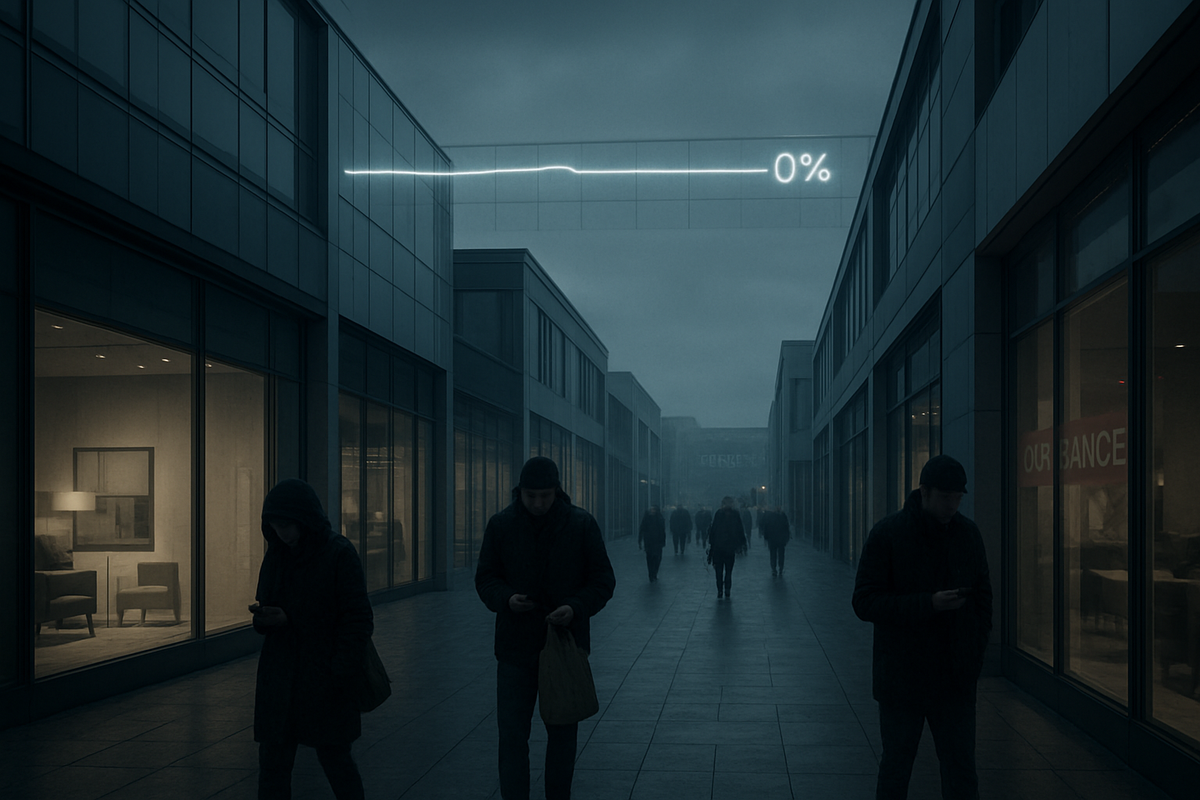
The American consumer, long heralded as the invincible engine of the global economy, appears to have finally hit a wall. Newly released data for December 2025 reveals that retail sales saw absolutely no growth, clocking in at a stagnant 0.0% month-over-month change. This "flatline" performance significantly underperformed the 0.4% expansion forecast by Wall Street economists, sending a chilling signal through the markets as we move into the first quarter of 2026.
The implications of this miss are profound, suggesting that the "post-holiday hangover" is more than just a seasonal dip; it is a structural exhaustion. With core retail sales—excluding automobiles and gasoline—actually contracting by 0.1%, the data confirms that the traditional holiday shopping "bump" failed to materialize in the final weeks of the year. As of February 18, 2026, the market is now grappling with the reality that high interest rates and cumulative inflation have finally eroded the discretionary "cushion" of the average American household.
The December retail report, published by the Department of Commerce in early February, served as a cold bucket of water for those hoping for a "soft landing." The timeline leading up to this moment was marked by a deceptive optimism; early November data had suggested a resilient consumer, buoyed by deep discounts during Black Friday. However, as December progressed, the momentum vanished. Year-over-year growth has now decelerated to a meager 2.4%, the lowest level seen since the height of the 2024 economic jitters.
Specific sector data paints an even grimmer picture of the "big-ticket" freeze. Furniture and home furnishing stores saw a 0.9% sequential decline, while electronics and appliance retailers dropped 0.4%. This pullback indicates that consumers are no longer willing—or able—to finance large purchases. The initial market reaction was one of immediate repricing, as Treasury yields dipped on the expectation that the Federal Reserve might be forced to pivot sooner than expected to prevent a broader recessionary spiral.
Key stakeholders, including major retail CEOs and Fed policymakers, are now forced to re-evaluate their 2026 outlooks. The data suggests a "mindful consumption" trend has taken hold, where shoppers are strictly adhering to budgets and eschewing the impulse purchases that typically drive December's surplus. The stagnation isn't just a lack of "want"; for many, it is a lack of "can," as record-high credit card debt and the "shelf shock" from early 2026 trade tensions begin to bite.
In this climate of exhaustion, a clear divide is emerging between the winners and losers on Wall Street. Walmart (NYSE: WMT) has emerged as a primary beneficiary of the "trade-down" effect. As even middle-income households seek value, Walmart’s dominance in groceries and essentials has allowed it to capture market share from more specialized retailers. Analysts expect Walmart to report a 5% year-over-year sales increase, as its "value + convenience" model becomes the safety net for the American pantry.
Conversely, Target (NYSE: TGT) finds itself on the losing end of the K-shaped spending curve. With a product mix heavily weighted toward discretionary items like home decor and apparel, Target is struggling to maintain foot traffic, which grew by a meager 0.7% in January. The company is now facing the prospect of a double-digit drop in earnings per share as it aggressively marks down inventory that failed to move during the stagnant December period.
The "big-ticket" casualties extend to the automotive and home improvement sectors. Ford Motor Company (NYSE: F) and Carvana (NYSE: CVNA) are facing a difficult financing environment, as the Fed maintains benchmark rates in the 3.5%–3.75% range. Meanwhile, furniture giants like Wayfair (NYSE: W) and The Home Depot (NYSE: HD) are seeing consumers opt for minor "refreshes" rather than major overhauls, leading to a spending plateau that could last well into the summer of 2026.
This stagnation is the clearest evidence yet of the "K-shaped" spending pattern that has come to define the mid-2020s economy. While the upper arm of the "K"—consisting of high-income households with significant equity in the stock market—continues to spend on luxury services and travel, the lower arm is being crushed. For the bottom 60% of earners, wage growth is currently lagging behind the cost of essential services like healthcare and insurance, leaving zero room for the furniture or auto upgrades that typically drive retail expansion.
Historically, such a sharp miss in December retail sales has often preceded a broader economic cooling. Comparing this to the retail environment of late 2024, the current situation is more precarious because the "excess savings" accumulated during the pandemic era have been entirely depleted. We are now seeing a "polycrisis" of debt fatigue and inflation burnout that is forcing a shift toward "no-shopping challenges" and a rejection of trend-chasing culture.
From a policy perspective, this retail freeze puts the Federal Reserve in a "nightmare scenario." Policymakers are trapped between a softening retail sector that desperately needs a rate cut and persistent service-sector inflation that prevents them from acting. The expiration of Chairman Jerome Powell's term in May 2026 only adds to the uncertainty, as the market wonders if a new leadership will prioritize growth over price stability in an attempt to jumpstart the stalled consumer engine.
Looking toward the remainder of 2026, the short-term outlook is one of continued "post-holiday hangover." Retailers will likely need to engage in a "race to the bottom" on pricing to clear out stagnant inventory, which could further squeeze profit margins across the board. The strategic pivot for many companies will involve moving away from "aspirational" marketing and toward "utility" marketing—emphasizing durability, longevity, and essential value over the latest trends.
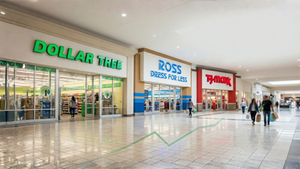
In the long term, we may be witnessing the birth of a more frugal American consumer. If interest rates remain "higher for longer" through 2026, the market for large-scale credit-dependent purchases like vehicles and major appliances may not recover until 2027. This provides a unique opportunity for "re-commerce" and discount platforms, but it poses a systemic challenge for the traditional mall-based retailers and high-end department stores that rely on discretionary exuberance.
The potential for a "hard landing" has moved from a tail risk to a central concern. If the stagnant retail data of December 2025 is followed by weak Q1 2026 numbers, the calls for aggressive federal intervention will become deafening. Investors should prepare for a volatile spring as the market recalibrates its expectations for corporate earnings in a world where the consumer is no longer willing to carry the load.
The December 2025 retail sales report is a cautionary tale of economic limits. The 0% growth rate is a stark reminder that even the most resilient consumers have a breaking point. As we stand in February 2026, the primary takeaway is that the "K-shaped" divide is no longer just a sociological observation—it is a dominant market force that is dictating which stocks will thrive and which will wither.
Moving forward, the market will be hyper-focused on credit delinquency rates and personal savings data. If consumers start defaulting on the debt they used to sustain their spending through 2025, the retail stagnation could quickly turn into a retail retreat. For investors, the mantra for 2026 must be "defensive and diversified." Watch the big-box value players like Walmart and stay wary of any company overly reliant on the "wants" of the lower-to-middle income bracket.
Ultimately, the significance of this event lies in its finality. The era of easy spending, fueled by pandemic-era stimulus and low-interest credit, is officially over. The "Great Exhaustion" is here, and the retail landscape will likely be navigating its consequences for years to come.
This content is intended for informational purposes only and is not financial advice.