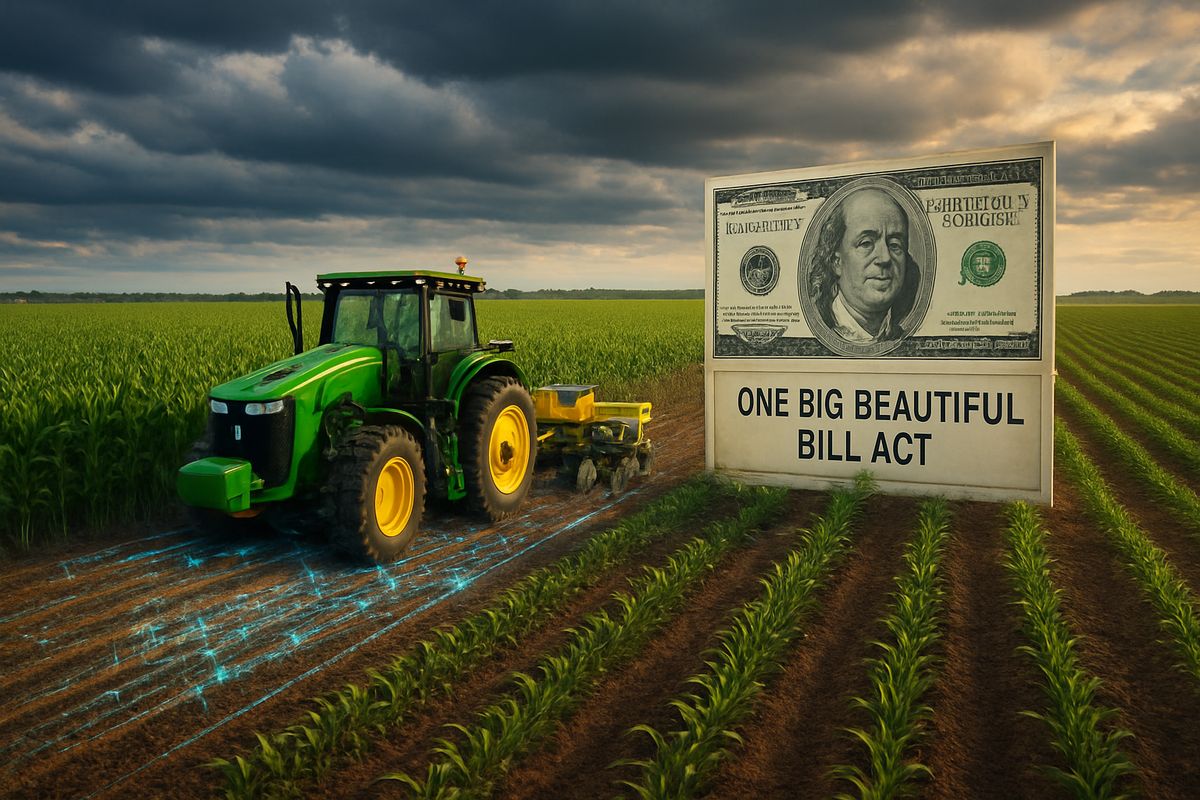
As the 2026 planting season approaches, American farmers are facing a paradox of record-low commodity prices and unprecedented government support. The centerpiece of this intervention is the newly minted Farm Bridge Assistance (FBA) program, an $11 billion emergency liquidity injection designed to keep the rural economy afloat following the passage of the "One Big Beautiful Bill Act" (OBBBA) in July 2025. By offering a staggering $44.36 per acre for corn—significantly higher than the $30.88 offered for soybeans—the federal government is effectively putting its thumb on the scale of the "acreage wars," potentially incentivizing a massive corn crop that the market simply does not need.
This high-stakes intervention comes at a delicate time. As of February 18, 2026, the U.S. agricultural sector is already drowning in a supply glut, with corn ending stocks reaching a seven-year high of 2.23 billion bushels. Critics argue that while the FBA provides essential cash flow for struggling family farms, it risks extending a multi-year surplus by masking bearish market signals. For investors and agribusinesses, the program creates a strange environment where policy mandates, rather than global demand, may dictate the landscape of the American Midwest this spring.
The Bridge to 2026: Policy Overpowering Price Signals
The current state of the market is the direct result of a legislative earthquake that occurred in the summer of 2025. The One Big Beautiful Bill Act (OBBBA) was a landmark reconciliation bill that redirected approximately $186 billion from the SNAP (nutrition) budget into a revamped farm safety net and agricultural tax relief. While the OBBBA raised statutory reference prices for corn to $4.10 per bushel, most of its permanent payments are not scheduled to reach bank accounts until October 2026. To bridge this "implementation gap," Agriculture Secretary Brooke Rollins announced the FBA in late December 2025, providing $11 billion in immediate ad hoc payments to farmers through the Commodity Credit Corporation.
The timeline leading to this February’s planting decisions has been fraught with tension. Following a record-breaking 2025 harvest of 17.02 billion bushels, corn prices plummeted, leaving many producers underwater. The FBA was intended to be a lifeline, but its specific payment structure—favoring corn at $44.36 per acre over wheat ($39.35) and soybeans ($30.88)—has skewed the economics of the 2026 crop year. While the market's corn-to-soybean price ratio would typically signal a shift toward more soybean acreage, the $13.48 per acre premium for corn under the FBA is acting as an artificial floor, keeping many farmers tied to corn despite a global surplus and high nitrogen fertilizer costs.
Winners and Losers in a Policy-Driven Market
The primary beneficiaries of this government-induced "corn bias" are the companies that supply the high-input requirements of the crop. John Deere (NYSE: DE) stands to gain as the FBA payments provide the necessary liquidity for farmers to service debt on existing equipment or invest in new precision planting technology. Similarly, Corteva (NYSE: CTVA) and Bayer (OTC: BAYRY), which together control the vast majority of the high-margin corn seed market, are likely to see their volumes protected by the government’s preference for corn acreage.
The fertilizer sector is also eyeing the $44.36 payment with optimism. Because corn is significantly more nitrogen-intensive than soybeans, companies like CF Industries (NYSE: CF) and Nutrien (NYSE: NTR) are positioned to capture the demand generated by the federal subsidy. However, the processing and trading giants like Archer-Daniels-Midland (NYSE: ADM) and Bunge (NYSE: BG) face a more complex reality. While the "ABCD" traders benefit from high volumes, the persistent supply glut keeps margins razor-thin, and the ongoing uncertainty regarding the 45Z Clean Fuel Production Credit has tempered the demand for the soybean oil that usually balances their portfolios.
Distorting the "Acreage War" and Global Trade
The FBA intervention represents a significant shift in U.S. agricultural policy, moving toward a more protectionist and direct-support model. By redirecting nearly $200 billion from nutrition programs to production, the OBBBA has essentially declared that "Big Ag" is a matter of national security. However, this fits into a broader, more dangerous trend of global overproduction. As U.S. farmers are incentivized to plant more corn, Brazil’s 2026 soybean and corn production is also projected to hit record levels (180 MMT for soy), creating a global race to the bottom in terms of commodity pricing.
The historical precedent for such intervention often points toward a "long tail" of market recovery. During previous periods of ad hoc support, such as the Market Facilitation Program (MFP) during the trade wars of the late 2010s, the U.S. saw similar acreage distortions that took years to unwind. By ignoring the current 2.23-billion-bushel stockpile, the FBA may be setting the stage for a 2027 season that is even more oversupplied, potentially requiring even larger government bailouts in the future.
Looking Ahead: The March Intentions Report and 45Z
The next several months will be critical for determining whether the FBA’s "corn bias" fully materializes. Market participants are looking toward the USDA’s Prospective Plantings report in late March as the first true measure of farmer sentiment. If the FBA successfully "buys" corn acres, the market may have to brace for sub-$4.00 corn prices through the end of 2026. Conversely, if high input costs—such as the projected $33 per acre increase in nitrogen—outpace the $44.36 subsidy, we could see a late-season pivot to soybeans, which require fewer nutrients.
In the long term, the industry must prepare for the full implementation of the OBBBA in late 2026. The addition of 30 million new "base acres" will allow more land to qualify for permanent federal support, potentially institutionalizing the oversupply issues currently being managed by the FBA. Strategic pivots for the "Big Ag" companies will likely focus on "carbon-smart" agriculture and biofuels, provided that the regulatory environment for credits like 45Z finally stabilizes and offers a demand-side solution to the supply problem.
Summary: A Safety Net with Strings Attached
The 2026 planting season is shaping up to be a case study in the unintended consequences of government largesse. The Farm Bridge Assistance program has achieved its primary goal of providing liquidity to a cash-strapped rural America, but it has done so by creating an artificial incentive for corn that defies market logic. For the individual farmer, the $44.36 per acre is a necessary relief; for the market at large, it is a "Band-Aid" that may be making the underlying wound worse.
As we move forward, investors should watch for any shifts in USDA planting projections and the progress of the OBBBA’s rollout. The massive supply glut is not going away, and while government checks can sustain farmers through a season, they cannot create demand in a saturated global market. The "One Big Beautiful Bill Act" has fundamentally changed the agricultural landscape, and its true impact on the sustainability of the American farm economy will not be fully understood until the grain starts hitting the elevators in the fall of 2026.
This content is intended for informational purposes only and is not financial advice.