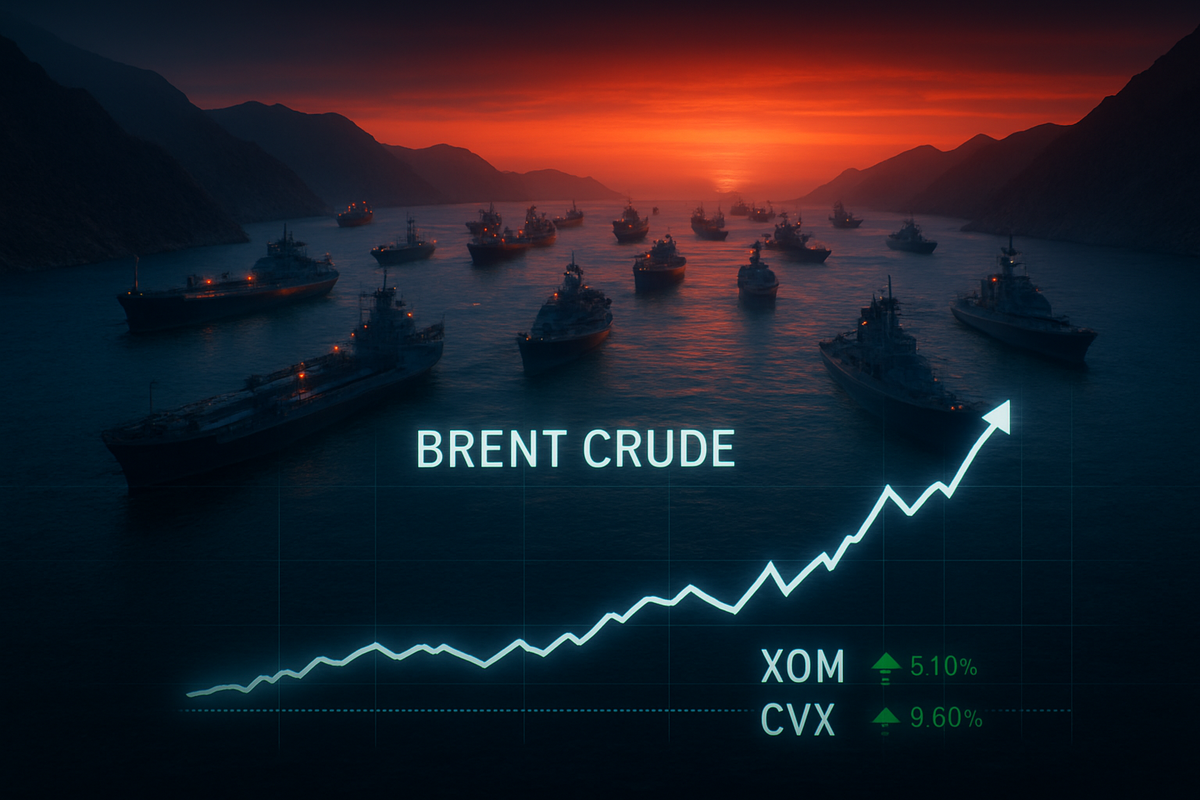
HOUSTON, TX — Global energy markets are bracing for a period of extreme volatility as crude oil prices surged past $95 per barrel this week, fueled by a dramatic escalation in geopolitical tensions between Western powers and Iran. The threat of a military conflict in the Persian Gulf has moved from a lingering concern to a clear and present danger, with Tehran renewing threats to block the Strait of Hormuz—a vital maritime chokepoint through which roughly 21 million barrels of oil flow daily.
Investors are flocking to energy majors as a defensive hedge, driving significant price action in shares of industry titans. The immediate implication for the global economy is a renewed inflationary pressure that threatens to undo months of stabilizing consumer prices. As the United States and its allies increase their naval presence in the region, the market is pricing in a "war premium" not seen since the height of the regional instabilities in the mid-2010s.
The Road to Escalation: From "Midnight Hammer" to the Current Standoff
The current crisis did not emerge in a vacuum. It is the culmination of a deteriorating security environment that saw a massive spike in June 2025, following "Operation Midnight Hammer." During that event, coordinated strikes targeted several sensitive facilities within Iran, leading to a temporary but sharp interruption in regional diplomacy. Since then, the Islamic Revolutionary Guard Corps (IRGC) has transitioned from shadow warfare to more overt "state piracy," frequently detaining foreign-flagged tankers under the guise of technical violations.
On February 15, 2026, the situation took a darker turn when the Iranian parliament formally authorized the military to "restrict transit" through the Strait of Hormuz for any vessels associated with "hostile nations." This legislative move was met with an immediate response from the Pentagon, which has deployed a second carrier strike group to the Gulf of Oman. The timeline of the last 48 hours has been marked by a series of near-miss encounters between Iranian fast-attack boats and commercial tankers, causing maritime insurance premiums to skyrocket by nearly 400%.
Key stakeholders, including OPEC+ leadership and the International Energy Agency (IEA), are in emergency sessions. While global inventories had been relatively stable throughout late 2025 due to record production from non-OPEC nations, the sudden threat to the world’s most critical oil artery has created a vacuum of certainty. Market participants are now watching for any sign of a physical blockade, which analysts warn could send Brent crude into the triple digits within days.
Energy Titans as a Haven: The Impact on XOM and CVX
In the wake of this instability, Exxon Mobil Corporation (NYSE: XOM) has emerged as a primary beneficiary of the shifting capital flows. Exxon’s strategic pivot over the last two years toward "advantaged" assets—specifically its massive offshore projects in Guyana and its dominant position in the Permian Basin—has insulated it from direct Middle Eastern supply disruptions. With Brent crude climbing, Exxon’s high-margin production is generating record-level free cash flow, allowing the company to maintain its aggressive $20 billion annual share buyback program.
Similarly, Chevron Corporation (NYSE: CVX) is seeing renewed investor interest. Following its successful integration of Hess Corporation in late 2024, Chevron has significantly bolstered its domestic production profile. The company’s focus on short-cycle Permian assets allows it to ramp up production more quickly than traditional deepwater projects, making it a flexible player in a high-price environment. While Chevron has maintained a disciplined capital expenditure budget of $18–$19 billion for 2026, the current price surge may provide the windfall necessary to exceed its dividend growth targets.
However, the gains for these energy giants come with a caveat. While higher prices boost top-line revenue, the broader economic fallout of $100 oil could eventually lead to demand destruction. If high fuel costs trigger a global recession, the initial windfall for XOM and CVX might be offset by a subsequent collapse in consumption. For now, however, both companies are viewed by Wall Street as essential hedges against the geopolitical "black swan" unfolding in the Gulf.
A New Era of Energy Security and Policy
This event marks a significant shift in the global energy narrative, which for several years focused primarily on the transition to renewables. The 2026 Gulf crisis has underscored a hard truth for policymakers: the world remains profoundly dependent on fossil fuel flows through vulnerable geographical chokepoints. This realization is expected to spark a new wave of policy changes aimed at enhancing domestic energy security in the U.S. and Europe, likely resulting in expedited permits for pipeline infrastructure and LNG export terminals.
Historically, crises in the Strait of Hormuz—such as the "Tanker War" of the 1980s—have led to long-term structural changes in how oil is traded. We are already seeing the emergence of "shadow fleets" and a bifurcation of the oil market, where non-Western aligned nations seek to bypass the Strait via overland pipelines or alternative routes. This fragmentation complicates the efforts of the IEA to coordinate global supply releases, as the traditional levers of market stability are being tested by geopolitical polarization.
Furthermore, the ripple effects are being felt by competitors and partners alike. Independent refiners are struggling with the rising cost of feedstock, while airline stocks have plummeted on fears of surging jet fuel prices. The regulatory environment is also shifting; there is growing pressure on the U.S. administration to halt any remaining plans for Strategic Petroleum Reserve (SPR) replenishments and instead pivot back to emergency releases to cap the price spiral.
Navigating the Uncharted Waters Ahead
In the short term, the market's trajectory will depend entirely on the next move in the Persian Gulf. If Iran attempts a physical blockade, even a temporary one, the price of crude is expected to gap up to $120 per barrel. Conversely, if diplomatic backchannels—reportedly being mediated by Oman and Qatar—can secure a de-escalation, a significant portion of the current risk premium could evaporate as quickly as it appeared.
Strategic pivots are already underway among the major oil companies. We may see a shift in capital allocation back toward exploration and production (E&P) if prices remain elevated, potentially slowing the momentum of "Green Energy" investments in the short term. For investors, the challenge will be distinguishing between a temporary price spike and a long-term structural shift in energy costs. Scenarios ranging from a "contained standoff" to a "regional conflict" are being modeled by analysts, with the latter potentially requiring a multi-national naval coalition to escort tankers through the Strait.
Summary for the Markets
The crisis in the Persian Gulf has re-centered the global financial conversation on geopolitical risk and energy security. The immediate beneficiaries remain the large-cap integrated oil companies like Exxon Mobil (XOM) and Chevron (CVX), which offer production stability in an increasingly unstable world. However, the broader market remains vulnerable to the inflationary shock of rising energy costs.
As we move through the first quarter of 2026, investors should keep a close watch on two critical metrics: the "war premium" reflected in maritime insurance rates and the volume of crude flowing through the Strait of Hormuz. While the current prices offer a boon for energy stocks, the lasting impact of this crisis may be a permanent reassessment of the risks associated with global supply chains. The coming months will determine whether this is a fleeting spike or the beginning of a new, high-cost energy era.
This content is intended for informational purposes only and is not financial advice.