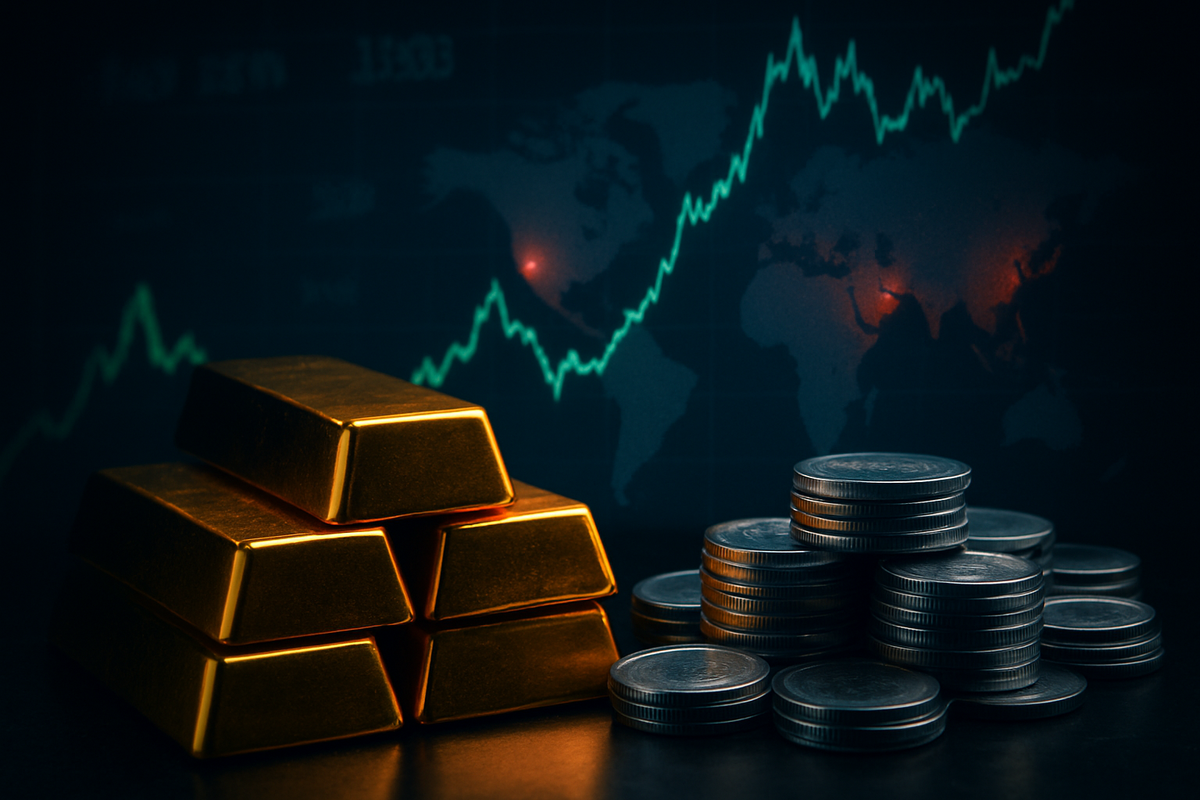
The global financial landscape reached a fever pitch this month as gold and silver values ascended to unprecedented heights, driven by a perfect storm of geopolitical brinkmanship and monetary uncertainty. Gold reached a staggering record of $5,598.09 per ounce, while silver climbed to $121.7, marking a transformative era for hard assets as investors flee traditional equities and currencies in favor of "safe-haven" security.
This historic rally reflects a world on edge, as military tensions in the Middle East and a widening diplomatic chasm between the United States and its European allies have dismantled the relative stability of the early 2020s. With the Federal Reserve in the midst of a high-stakes leadership transition and inflation concerns lingering, the surge in precious metals represents more than just a price spike; it is a profound vote of no confidence in the prevailing global order.
The Ascent to the Summit: A Timeline of Volatility
The journey to these historic peaks began in late January 2026, following a year of steady appreciation. The momentum accelerated into a vertical climb during the final week of January, as gold shattered the $5,000 ceiling and silver broke through $100 for the first time in history. By January 29, prices hit their apex—$5,598.09 for gold and $121.7 for silver—before a technical correction, exacerbated by the CME Group (NASDAQ: CME) raising margin requirements, triggered a temporary but "spectacular" flash crash on January 30. Despite this volatility, prices have remained at elevated plateaus throughout February 2026, with gold stabilizing near the $5,000 mark.
The primary catalyst for this vertical move was the sudden escalation of the "Stena Imperative" incident on February 3, 2026. Iranian Revolutionary Guard Corps (IRGC) gunboats attempted to seize a U.S.-flagged tanker in the Strait of Hormuz, nearly drawing the USS McFaul into a direct naval engagement. This followed the "12-day war" of 2025, keeping the risk of a full-scale US-Iran conflict at a "50-50" tipping point. Simultaneously, the "Greenland Rupture" saw the U.S. threaten 10% import tariffs on European allies who opposed American strategic interests in the North Atlantic, leading to the most severe rift in NATO’s history.
Investors have also been navigating a leadership vacuum at the Federal Reserve. With the transition from Jerome Powell to the more hawkish Kevin Warsh, the market has been gripped by uncertainty regarding the future of interest rates. While the FOMC held rates steady at 3.5%–3.75% in its most recent meeting, the lack of a clear downward trajectory for rates, combined with fears of a "Greenland-induced" trade war, has made physical bullion the only perceived sanctuary for institutional capital.
The Mining Giants: A New Golden Age of Margins
The meteoric rise in spot prices has fundamentally restructured the balance sheets of the world’s largest mining operations. Newmont (NYSE: NEM), the world’s leading gold producer, has seen its stock deliver a staggering 182% return over the last twelve months. Under the leadership of CEO Natascha Viljoen, who took the helm on January 1, 2026, Newmont has capitalized on the rally by maintaining a "margin-first" strategy. While gold prices have more than doubled, the company’s All-In Sustaining Costs (AISC) have remained relatively stable between $1,400 and $1,600 per ounce, resulting in profit margins nearing 70%.
Barrick Gold (NYSE: GOLD) has similarly thrived, reporting a doubling of net earnings to approximately $5 billion for the 2025 fiscal year. The company’s focus on Tier One assets has allowed it to act as a primary vehicle for institutional investors looking for leveraged exposure to the gold price. However, the rally has not been without its losers. Smaller exploration firms and high-debt miners have struggled to keep up with the soaring costs of diesel and specialized equipment, which have risen alongside the commodity boom, creating a wider gap between the "majors" and the "juniors."
In the silver sector, Wheaton Precious Metals (NYSE: WPM) emerged as a standout performer, posting a 20% year-to-date increase. The company recently finalized a massive $4.3 billion silver stream acquisition from BHP (NYSE: BHP), positioning itself to capture the full upside of the silver surge without the direct operational risks of mining. However, analysts warn that the sheer speed of silver's climb to $121.7 has left the market vulnerable to massive liquidations if geopolitical tensions show any sign of cooling.
Geopolitical Realignment and the De-Dollarization Trend
The wider significance of this rally lies in the shifting tectonic plates of global power. The "Greenland Rupture" is no longer just a diplomatic spat; it has led to a major restructuring of NATO, with the U.S. handing over command of Joint Force Command Norfolk to the United Kingdom. This fragmentation of the Western alliance has prompted European nations to seek "strategic autonomy," including a move away from dollar-denominated assets. Gold, as a neutral reserve asset, has become the primary beneficiary of this move toward a multipolar financial system.
Historically, gold rallies of this magnitude are preceded by extreme systemic stress, similar to the stagflationary environment of the late 1970s. However, the 2026 surge is unique due to the speed of information and the role of automated trading. The fact that silver quadrupled in value in less than a year suggests a "short squeeze" of global proportions, as industrial users of silver—essential for the green energy transition—scramble to secure physical supply amidst the trade barriers and tariffs being erected between the U.S. and the EU.
Furthermore, the Federal Reserve's policy ambiguity has created a "no-win" scenario for traditional bonds. If the Fed cuts rates to support the economy during a trade war, inflation will likely spiral, benefiting gold. If they hold rates high to support the dollar, they risk a deep recession, which also drives investors toward the safety of precious metals. This "Goldilocks" environment for bullion has effectively broken the traditional inverse correlation between the U.S. Dollar and gold.
The Road Ahead: Stabilization or Second Surge?
As we move deeper into 2026, the market is bracing for two possible scenarios. In the short term, the high-stakes negotiations in Geneva and Muscat between U.S. and Iranian representatives could provide a "peace dividend" that brings gold back down toward the $4,500 level. However, most analysts believe that the structural damage to the U.S.-Europe relationship is permanent, meaning the geopolitical premium baked into metal prices is unlikely to evaporate anytime soon.
The long-term outlook depends heavily on the incoming Fed Chair, Kevin Warsh. If his administration pivots toward a more aggressive "inflation-first" mandate, we may see a period of forced deleveraging that could pull silver back below $100. Conversely, if the Greenland crisis escalates into a full-scale trade war with 25% tariffs by June, $6,000 gold may be a conservative estimate. Investors must remain agile, as the "spectacular crash" of late January proved that even in a bull market, liquidity can vanish in an instant.
Market participants should also keep a close eye on the physical supply chain. With silver reaching $121, industrial recycling and the reopening of dormant "high-cost" mines will begin to hit the market. This supply response typically takes 6-12 months to materialize, suggesting that the current scarcity premium could remain high through the summer of 2026.
Summary: Navigating the New Commodity Supercycle
The climb of gold to $5,598 and silver to $121 represents a watershed moment for the global economy. It marks the end of the era of low-volatility and the beginning of a period where geopolitical risk is the primary driver of asset pricing. Key takeaways from this month's events include the exceptional resilience of major miners like Newmont and Barrick Gold, the fracturing of the NATO alliance as a long-term catalyst for de-dollarization, and the reality that precious metals have reclaimed their status as the ultimate hedge against both inflation and war.
Moving forward, the market will be hyper-sensitive to any developments in the Strait of Hormuz and the scheduled tariff hikes in June. Investors should watch the CME margin requirements as a leading indicator of potential liquidations. In a world where the old alliances are breaking and the rules of monetary policy are being rewritten, the historic highs of 2026 may be just the beginning of a long-term revaluation of tangible assets.
This content is intended for informational purposes only and is not financial advice.