SANTIAGO, Chile / WASHINGTON D.C. — February 19, 2026 — As the global race for mineral sovereignty reaches a fever pitch, the United States has intensified its multi-billion-dollar strategy to dismantle China’s long-standing monopoly over the rare earth supply chain. Central to this effort is a new wave of "friend-shoring" initiatives and the rise of sustainable extraction technologies, exemplified by the recent strategic pivot of Aclara Resources (TSX:ARA). By securing key deposits of heavy rare earth elements (HREEs) in South America and planning a state-of-the-art separation facility in Louisiana, Aclara is positioning itself as the cornerstone of a Western "mine-to-magnet" ecosystem.
The immediate implications are profound: for the first time in decades, Western manufacturers of electric vehicles (EVs) and defense systems have a credible roadmap to source Dysprosium (Dy) and Terbium (Tb) outside of Chinese influence. This shift follows a turbulent 2025 that saw Beijing tighten export licenses for these specific "heavy" elements, which are critical for high-temperature permanent magnets. With the U.S. government now deploying "creative" financing—ranging from direct equity to massive strategic loans—the geopolitical map of energy transition materials is being fundamentally redrawn.
The 'HREE Bottleneck' and the Rise of Circular Mineral Harvesting
Throughout 2025 and into early 2026, the primary focus of U.S. industrial policy has shifted from general rare earth production to solving the "Heavy Rare Earth Element (HREE) Bottleneck." While domestic leaders like MP Materials (NYSE: MP) have successfully stabilized the supply of light rare earths from their Mountain Pass facility, the heavier, more critical elements remained elusive. Aclara Resources CEO Ramón Barúa Costa has been a vocal proponent of a "creative" approach to bridge this gap, emphasizing that the West cannot simply copy China’s environmentally destructive mining methods if it hopes to win the ESG-conscious consumer market.
Aclara’s flagship project, the Carina Module in Goiás, Brazil, achieved a major milestone in late 2025 by securing the world’s first NI 43-101 mineral reserves for ionic clay rare earths. Unlike traditional hard-rock mining, Aclara’s "Circular Mineral Harvesting" technology requires no blasting or crushing. Instead, it uses a closed-loop system that recycles 95% of its water and 99% of its chemical reagents. Speaking at a recent industry summit, Barúa Costa noted that this sustainable profile was the key to unlocking "creative" funding from the U.S. International Development Finance Corporation (DFC), which recently committed millions toward the project's feasibility, with a $1.5 billion comprehensive funding package currently under review by the Department of Energy (DOE) and Department of Defense (DOD).
The timeline of this escalation began in earnest in January 2025 with Executive Order 14154, which mandated federal agencies to prioritize the reshoring of HREE processing. This was followed by the launch of "Project Vault" in late 2025—a $12 billion initiative by the U.S. Export-Import Bank (EXIM) to establish a Strategic Critical Minerals Reserve. The market reaction has been one of cautious optimism; while rare earth prices remained volatile in 2025 due to Chinese supply manipulation, the entry of technologically advanced players like Aclara has provided a floor for investor confidence in Western supply security.
The Corporate Winners and the Search for Midstream Security
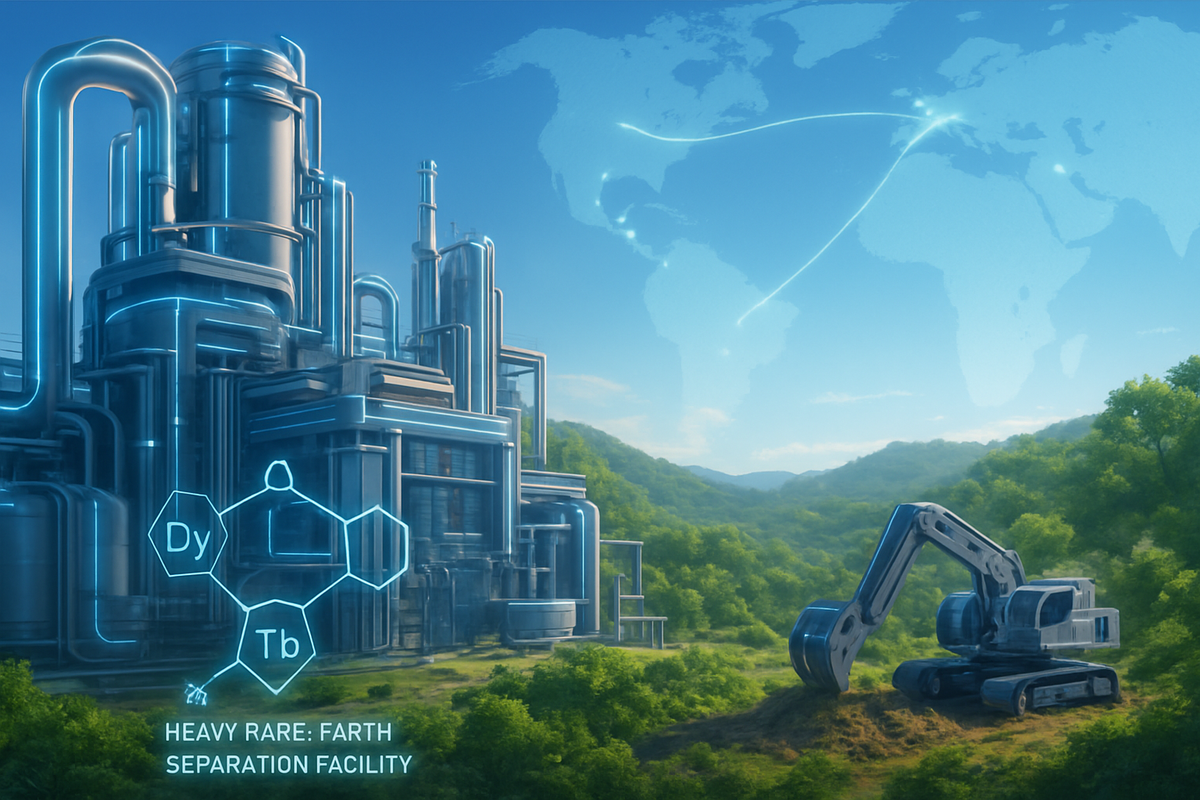
The shift toward a Western-centric supply chain has created a distinct set of winners. Aclara Resources is arguably the most notable, as its plan to build a $277 million HREE separation plant in Louisiana—supported by the U.S. Department of Commerce—marks the first dedicated facility of its kind in the Western Hemisphere. By processing Brazilian and Chilean clays on American soil, Aclara effectively bypasses the geopolitical risks of trans-Pacific shipping and Chinese refining.
Other major players are also recalibrating. MP Materials (NYSE: MP), having completed its transition away from Chinese sales in April 2025, is now expanding its own HREE separation capabilities and is on track to open a massive magnet factory in Fort Worth, Texas, by 2028. Meanwhile, Lynas Rare Earths (ASX:LYC) remains a formidable incumbent; it achieved the first production of separated Dysprosium at its Malaysian facility in May 2025 and is set to begin Samarium production in April 2026. However, Aclara’s unique ionic clay model gives it a cost and ESG advantage over the more energy-intensive hard-rock operations of its peers.
On the losing side are the Chinese state-owned enterprises that have historically dictated global prices. As Western OEMs like Apple (NASDAQ: AAPL), Tesla (NASDAQ: TSLA), and General Motors (NYSE: GM) increasingly demand "clean" minerals to satisfy tightening ESG regulations, the traditional Chinese "dirty" mining model is losing its luster. Furthermore, the decoupling trend is likely to hit mid-tier Chinese processors who lack the advanced, low-waste technology now being pioneered by Aclara and its partners at Argonne National Laboratory.
A New Paradigm: National Security Meets Environmental Stewardship
The significance of Aclara’s strategy extends far beyond a single company’s balance sheet. It represents a broader industry trend where mineral extraction is no longer viewed solely through a commercial lens, but as a pillar of national security. The U.S. strategy to fund projects in Chile and Brazil—countries with strong mining traditions but growing environmental movements—shows a sophisticated understanding of "friend-shoring." By emphasizing sustainable development, the U.S. is helping these nations develop their resources without the social backlash that often accompanies traditional mining.
This event also mirrors historical precedents, such as the U.S. effort to secure rubber supplies during World War II or the strategic oil reserves established in the 1970s. However, the 2026 context adds an AI-driven layer of complexity. In January 2026, Aclara partnered with Virginia Tech and Argonne to develop an AI-enabled "digital twin" of their separation process. This allows for real-time optimization of reagent use, further reducing costs and environmental impact—a move that sets a new regulatory and technical benchmark for any future projects seeking U.S. federal support.
The Road to 2028: Scenarios and Strategic Pivots
Looking ahead, the next 24 months will be critical for the execution of this strategy. Aclara’s Carina project in Brazil is expected to receive its final environmental permits by April 2026, with a Final Investment Decision (FID) shortly thereafter. If successful, the company targets full-scale production by 2028, aiming to supply roughly 11% of the world’s current Dysprosium and Terbium needs. However, the primary challenge remains the speed of permitting in Chile for the Penco Module, which, despite its "Strategic Project" status, still faces a rigorous final environmental review.
In the short term, investors should expect more "creative" funding announcements. We may see the first instances of the U.S. government taking direct equity stakes in critical mineral firms to prevent hostile takeovers or to ensure project completion during market downturns. Strategically, companies like Aclara may need to pivot toward even deeper integration with magnet manufacturers, potentially forming joint ventures with European firms like Vacuumschmelze (VAC) to ensure a guaranteed end-market for their Louisiana-processed materials.
Wrap-Up: A Strategic Pivot for the Global Market
The U.S. strategy to secure a Western supply of rare earths is no longer a set of policy papers; it is a functioning industrial machine. Aclara Resources, under the leadership of Ramón Barúa Costa, has demonstrated that "creative" funding and sustainable technology are the dual engines required to break a decades-old monopoly. By focusing on the heavy rare earth "bottleneck" and leveraging ionic clay deposits in friendly jurisdictions, the West is finally building a supply chain that is both resilient and ethically sound.
For the market, the message is clear: the "rare earth wars" have entered a phase of high-stakes execution. Investors should keep a close watch on the progress of Aclara’s Louisiana facility and the upcoming environmental rulings in Chile and Brazil. As "Project Vault" begins to fill its reserves, the era of absolute Chinese dominance over the world's most critical minerals appears to be drawing to a close. The coming months will determine if this new Western supply chain can scale fast enough to meet the voracious demands of the green energy transition.
This content is intended for informational purposes only and is not financial advice.