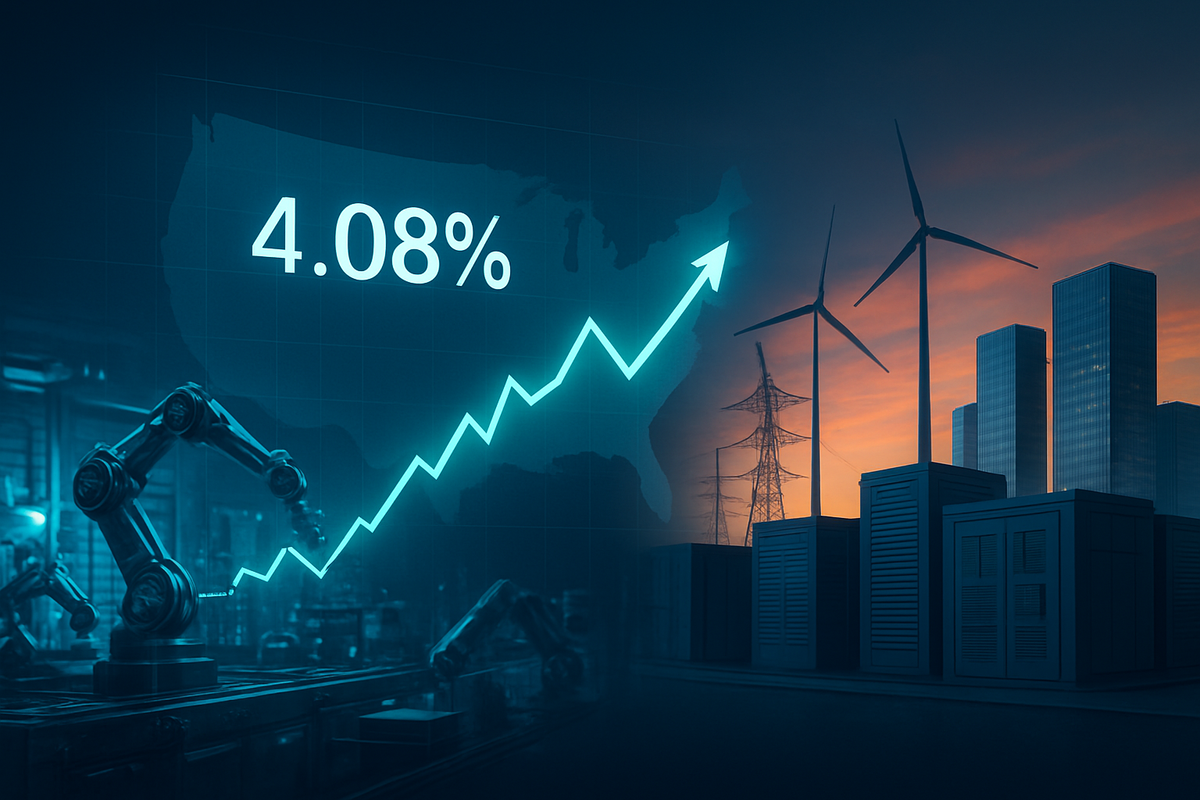
The U.S. bond market experienced a significant jolt this week as the yield on the benchmark 10-year Treasury climbed to 4.08%, up from 4.05% just days prior. This upward trajectory was fueled by a blowout industrial production report that suggests the American economy is not only weathering high interest rates but potentially accelerating. As the 10-year yield hits these critical psychological levels, the narrative of an imminent Federal Reserve "pivot" is being replaced by a "higher-for-longer" reality that is reshaping investment strategies across the board.
The immediate implications are being felt most acutely in the fixed-income markets, where bond prices fall as yields rise. Investors who had bet on aggressive rate cuts in the first half of 2026 are now recalibrating their portfolios. This shift in sentiment is driven by the realization that the "neutral rate"—the interest rate that neither stimulates nor restrains the economy—may be higher than previously estimated, given the persistent strength in manufacturing and infrastructure spending.
Industrial Strength Sparks a Yield Regime Shift
The catalyst for the latest spike was the release of January 2026 industrial production data, which showed a robust 0.7% monthly increase—the strongest performance in nearly a year. Manufacturing output specifically rose by 0.6%, led by a significant recovery in cyclical sectors such as machinery and motor vehicles. This data, arriving on February 18 and 19, 2026, effectively silenced whispers of a looming recession. Instead, it painted a picture of an economy that remains hungry for capital, despite the Federal Reserve's restrictive monetary policy stance over the past several years.
Further complicating the bond market's stability was a lackluster auction of 20-year Treasury bonds. The auction "tailed" by 2.0 basis points, a technical term indicating that the government had to offer higher yields than expected to attract enough buyers. This weak demand suggests that institutional investors are hesitant to lock in long-term rates when the economic data continues to run hot. Key stakeholders, including primary dealers and pension fund managers, are now pricing in a "terminal rate" that could stay above 4% for the foreseeable future, moving the goalposts for the first expected rate cut from March to at least June or September of 2026.
Winners and Losers in a Volatile Rate Environment
The rise in yields has traditionally been a death knell for interest-rate-sensitive sectors like Utilities and Real Estate Investment Trusts (REITs). However, the market in early 2026 is displaying a surprising level of nuance. NextEra Energy (NYSE: NEE) has emerged as a standout performer, with its stock up over 13% year-to-date. Despite the headwind of higher borrowing costs, NextEra is benefiting from an insatiable demand for renewable energy to power AI-driven data centers. Its ability to pass on costs and its massive pipeline of clean energy projects have made it a favorite for investors seeking defensive growth.
In contrast, more traditional utilities like Duke Energy (NYSE: DUK) are feeling the squeeze of debt-servicing costs. Duke recently announced a massive $103 billion capital plan to modernize its grid, but with yields at 4.08%, the cost of financing that expansion has increased significantly. Meanwhile, the real estate sector is seeing a massive divide. American Tower (NYSE: AMT), which operates cell towers, is navigating the volatility by focusing on 5G densification, which has seen a 20% year-over-year increase in application volumes. Conversely, logistics giant Prologis (NYSE: PLD) hit a 52-week high of $141.95 this month, as it successfully pivots into data center development, proving that specialized real estate can still thrive if it aligns with secular growth trends like artificial intelligence.
The AI Infrastructure Boom and the New Macro Normal
This current spike in yields fits into a broader industry trend where the "Old Economy" (manufacturing and utilities) is being revitalized by the "New Economy" (AI and high-speed connectivity). The resilience of the U.S. industrial sector is largely a byproduct of massive investments in domestic chip manufacturing and the energy infrastructure required to support the AI revolution. This creates a feedback loop: high demand for infrastructure keeps the economy strong, which keeps inflation sticky, which in turn prevents the Federal Reserve from lowering interest rates.
Historically, a 10-year yield of 4% would have been seen as a precursor to a market slowdown. However, the current environment mirrors the late 1990s, where productivity gains from technology allowed the economy to function efficiently even with higher nominal rates. The policy implications are clear: the Fed is likely to remain on hold longer than the market anticipates, as the "One Big Beautiful Bill Act" (OBBBA) of 2025 continues to provide fiscal stimulus that offsets the impact of high interest rates on corporate balance sheets.
Looking Ahead: Navigation in the 4% Era
In the short term, investors should prepare for a "range-trading" environment where the 10-year yield oscillates between 3.8% and 4.2%. Any signs of cooling in the labor market or a sudden drop in consumer spending could send yields back toward the bottom of that range, but the industrial data suggests the "ceiling" might be higher than once thought. Companies will likely need to engage in strategic pivots, much like Prologis and NextEra, moving away from low-margin legacy operations toward high-growth infrastructure plays that can justify higher cost-of-capital.
The primary challenge moving forward will be the "crowding out" effect, where high government borrowing needs compete with private sector investment. If the Treasury continues to see weak demand for its auctions, yields could push toward 4.5%, a level that would significantly test the resilience of the broader S&P 500. Investors must remain vigilant for any cracks in the credit markets, particularly in lower-rated corporate debt that may struggle to refinance at these elevated levels.
Market Outlook and Final Thoughts
The jump to a 4.08% yield is more than just a minor statistical fluctuation; it is a signal that the U.S. economy remains in a robust, albeit high-cost, expansion phase. The key takeaway for the market is that "good news" for the economy (strong industrial production) remains "bad news" for bond prices, as it delays the easing cycle many had hoped for. The resilience of manufacturing and the burgeoning AI energy demand are providing a floor for yields that may persist throughout 2026.
Moving forward, investors should watch the Federal Reserve’s upcoming March meeting for any changes in the "dot plot" projections. If the central bank signals that it is comfortable with the 4% yield range, it could provide a period of stability for the equity markets. However, if inflation (currently hovering around 2.7%) fails to trend lower, the risk of "higher-for-longer" turning into "higher-forever" becomes a tangible concern. For now, the focus remains on quality: companies with strong cash flows and exposure to the ongoing infrastructure build-out are the only ones truly equipped to navigate this high-yield landscape.
This content is intended for informational purposes only and is not financial advice.