Retail giant Walmart Inc. (NYSE: WMT) reported its fourth-quarter fiscal 2026 earnings on February 19, 2026, delivering a performance that exceeded analyst expectations on both revenue and earnings. Despite reaching a historic milestone of e-commerce profitability and announcing a massive $30 billion share repurchase program, the company’s stock faced downward pressure during Tuesday’s trading session. Investors appeared increasingly focused on a conservative profit forecast for the upcoming fiscal year, reflecting broader concerns over a "stretched" consumer base and potential macroeconomic volatility.
The disconnect between Walmart’s current operational strength and its future guidance highlights a pivotal moment for the world’s largest retailer. While the company continues to gain market share among high-income households and rapidly expands its high-margin advertising and automated fulfillment businesses, management’s cautious tone suggests that the tailwinds of the post-inflationary recovery may be tapering. As the retail landscape enters a period of structural reset, Walmart is positioning itself as a technology-led "flywheel" business, yet the market remains wary of the headwinds cited for fiscal 2027.
Record Revenues and a Profitable Digital Pivot
For the quarter ending January 31, 2026, Walmart posted adjusted earnings per share (EPS) of $0.74, narrowly surpassing the consensus estimate of $0.73. Total revenue climbed 5.6% year-over-year to $190.7 billion, ahead of the $190.4 billion projected by Wall Street. This growth was underpinned by a robust 4.6% increase in U.S. comparable sales, excluding fuel. The company’s ability to drive traffic—up 2.3% in the U.S. during the quarter—demonstrates its continued dominance in the grocery sector and its successful expansion into discretionary categories like fashion and home goods.
A significant highlight of the report was the performance of Walmart’s e-commerce division. Global digital sales surged 24%, with U.S. e-commerce growth leading the charge at 27%. For the first time in the company's history, the e-commerce segment was reported as profitable on a standalone basis. Management attributed this breakthrough to the scaling of automated fulfillment centers and the rapid growth of "Walmart Connect," the company’s retail media arm, which saw a 37% global revenue jump. E-commerce now accounts for roughly 23% of Walmart's total sales mix, up from the low teens just a few years ago.
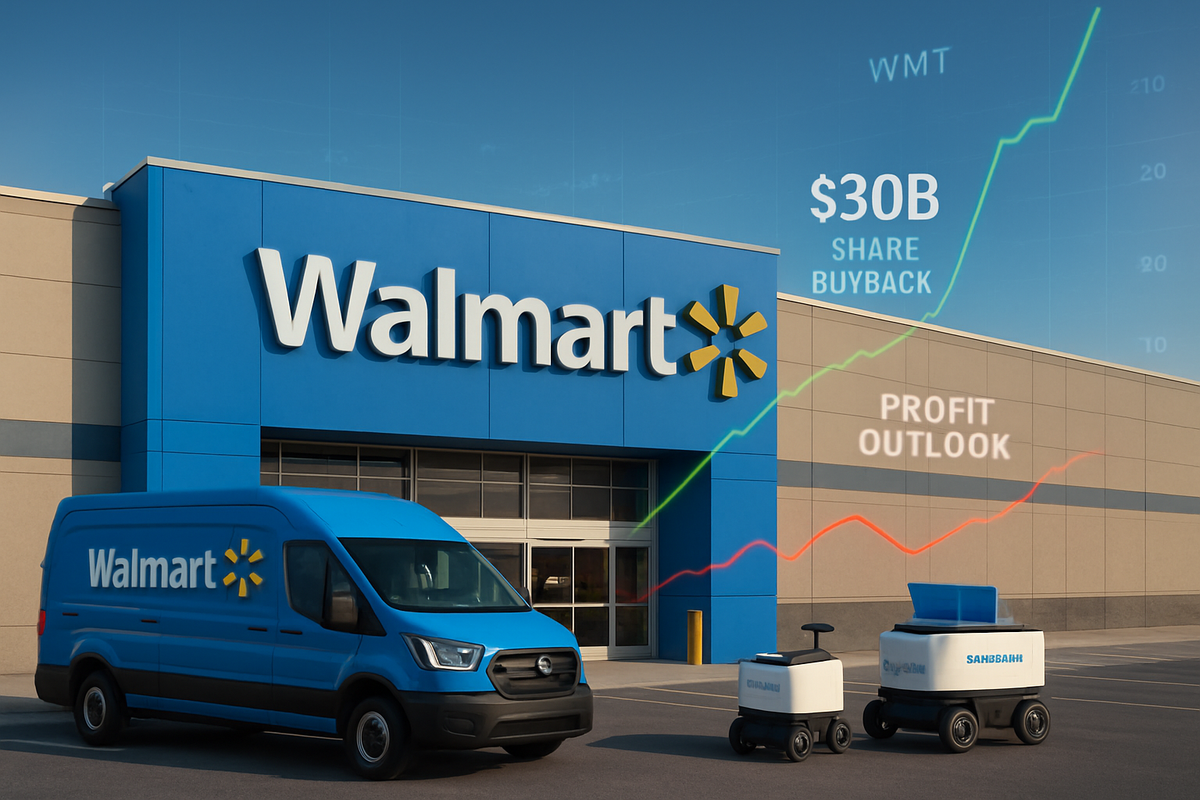
In a bold move to return value to shareholders, Walmart’s board authorized a new $30 billion share repurchase program. This authorization replaces the remaining portion of a $20 billion program initiated in late 2022. During the 2026 fiscal year alone, Walmart spent $8.1 billion to buy back approximately 85 million shares. The new, larger program signals management's confidence in the company's long-term cash flow generation and its "flywheel" strategy, which leverages retail traffic to fuel higher-margin services like advertising, membership, and fulfillment-as-a-service.
A Retail Landscape Divided: Winners and Losers
Walmart’s cautious outlook for fiscal 2027 sent ripples through the retail sector, as the company identified a persistent "K-shaped" consumer recovery. According to CEO John Furner, while households earning over $100,000 remain resilient and are increasingly choosing Walmart for its "Bettergoods" private label and convenience, lower-income cohorts are feeling the squeeze of higher living costs. This observation has direct implications for competitors like Target Corporation (NYSE: TGT), which has struggled with declining foot traffic as middle-income shoppers prioritize essentials over the discretionary items that comprise much of Target's inventory.
In the high-income and bulk-buying space, Costco Wholesale Corporation (NASDAQ: COST) remains a formidable peer, maintaining industry-leading membership retention rates. However, Walmart’s aggressive expansion of Sam’s Club and its enhanced Walmart+ membership—which reached 28.4 million members this quarter—is beginning to encroach on Costco’s core demographic. Conversely, discount retailers like Dollar General Corporation (NYSE: DG) find themselves in a precarious position. While they traditionally benefit from "trade-down" behavior, Walmart’s "Everyday Low Price" investments have successfully siphoned off traffic from the dollar stores, leaving them to manage a customer base that is increasingly living paycheck to paycheck.
The battle for the future of retail continues to pit Walmart against Amazon.com, Inc. (NASDAQ: AMZN). For the first time, Amazon has officially surpassed Walmart in total annual revenue, bringing in $716.9 billion compared to Walmart’s $713.2 billion. While Amazon still dominates the U.S. retail media market, Walmart is using its acquisition of Vizio Holding Corp. (NYSE: VZIO) to challenge Amazon’s advertising supremacy. By integrating SmartCast data with in-store purchase history, Walmart is offering advertisers a unique "omnichannel" view that Amazon’s digital-first model struggles to match.
Industry Trends and the Tech-Driven Reset
The 2026 fiscal report underscores a broader industry trend: the transition from volume-driven growth to margin-driven automation. Walmart is currently in the midst of a massive technological arms race, with plans to have 65% of its stores serviced by automated fulfillment centers by the end of the year. This shift is expected to reduce unit handling costs by 20%, a necessary move to protect margins as labor costs and logistical complexities continue to rise. This mirrors a wider trend across the S&P 500 retail sector, where companies are prioritizing capital expenditures on robotics and artificial intelligence over traditional store expansions.
Walmart's pivot toward becoming a "platform" rather than just a "store" is also visible in its use of generative AI. The company recently debuted an AI-powered "event planner" that helps customers curate entire shopping lists for birthdays or holidays based on a single prompt. This move into "intent-based" shopping is part of a strategy to deepen customer loyalty and increase the stickiness of the Walmart+ ecosystem. By moving beyond simple transactions, Walmart is attempting to insulate itself from the cyclical nature of retail and build a more predictable, service-oriented revenue stream.
However, the "K-shaped" consumer reality remains a significant headwind for the entire industry. As inflation in the grocery aisle cools to a range of 1.1% to 1.3%, consumers are not necessarily pocketing the savings; instead, they are redirecting funds away from higher-margin electronics and home goods toward basic necessities. This shift in the "sales mix" is a primary reason for Walmart’s conservative guidance, as the company expects its margins to be pressured by the ongoing preference for lower-margin grocery items over more profitable discretionary goods.
Looking Ahead: Tariffs, Tighter Margins, and Tactical Shifts
The road through fiscal 2027 appears fraught with tactical challenges. Walmart’s EPS guidance of $2.75 to $2.85 fell short of the $2.94 to $2.97 range analysts had anticipated. One of the primary drivers for this conservative stance is the potential for new trade volatility and tariffs. Executives warned that if supply chain adjustments cannot be made quickly enough, tariff-related costs could pressure margins. Additionally, new pharmacy legislation regarding Maximum Fair Pricing for certain drugs is expected to create a 100-basis-point headwind for the full year, a factor that will affect any retailer with a significant healthcare footprint.
To navigate these waters, Walmart is likely to double down on its high-margin revenue streams. Investors should expect a more aggressive integration of the Vizio ecosystem into Walmart Connect, as well as an expansion of third-party marketplace services. The goal is to create a "profit cushion" that can absorb the shocks of a slowing consumer economy or rising trade costs. The company's strategic pivot toward fulfillment-as-a-service for third-party sellers also represents a major growth opportunity, as it looks to monetize its massive physical infrastructure in a way that rivals Amazon’s "Logistics by Amazon" (LBA).
In the short term, the market will be closely watching for signs of further "breaking" in the low-income consumer segment. If the labor market softens more than expected in mid-2026, even Walmart’s value proposition may not be enough to offset a significant decline in transaction volume. Conversely, if the company can successfully continue its "high-income trade-down" momentum, it may find itself in a position to raise its guidance later in the year. The primary challenge will be balancing the $30 billion buyback with the heavy capital investments required to maintain its technological lead.
Summary and Final Investor Outlook
Walmart’s Q4 fiscal 2026 earnings report serves as a complex snapshot of a retail titan in transition. While the beats on revenue and EPS, combined with the profitability of e-commerce, signal a company that is executing its digital strategy with precision, the cautious outlook and subsequent stock slide reveal the fragility of the current economic environment. The $30 billion buyback is a massive vote of confidence from the board, but it was not enough to distract investors from the reality of a "stretched" consumer and looming regulatory and trade-related headwinds.
Moving forward, investors should keep a sharp eye on two key metrics: the growth of Walmart Connect and the pace of automated fulfillment implementation. These are the engines that will determine if Walmart can transcend its "big-box retailer" roots to become a high-margin technology platform. Additionally, any shifts in consumer spending patterns—specifically a return to discretionary categories—would be a major bullish signal for the stock. For now, Walmart remains a defensive powerhouse, but one that is preparing for a year of moderated growth and tactical adaptation.
As the retail sector continues to diverge into distinct winners and losers, Walmart's ability to capture the high-end trade-down while managing the struggles of its core low-income base will be the defining story of fiscal 2027. Whether the $30 billion repurchase program will be remembered as a masterstroke of timing or a premature bet in a cooling economy remains to be seen.
This content is intended for informational purposes only and is not financial advice.