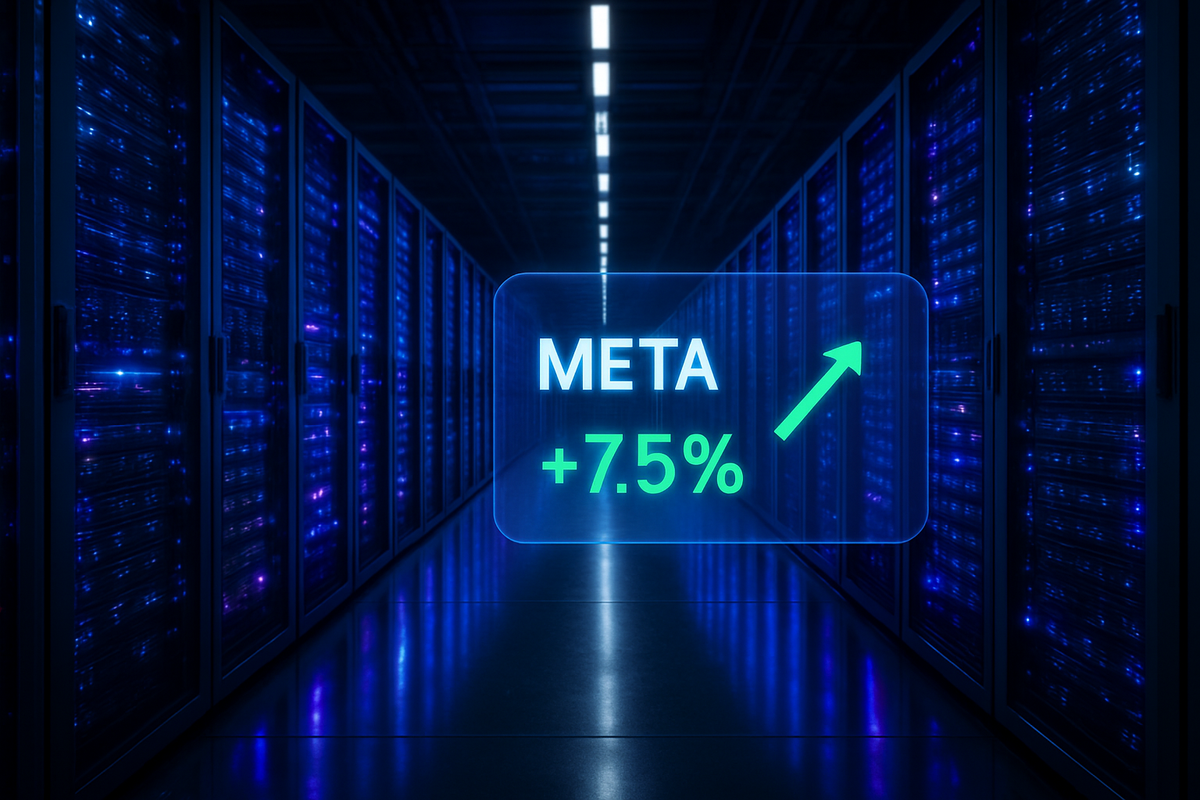
In a definitive display of market dominance, Meta Platforms (NASDAQ: META) saw its shares surge over 7% in early trading on February 2, 2026, following a blowout fourth-quarter earnings report that shattered analyst expectations. The social media titan, which has successfully rebranded itself as an industrial-scale AI powerhouse, reported a staggering 24% year-over-year revenue increase to $59.89 billion, proving that its massive investments in artificial intelligence are beginning to pay significant dividends in both advertising efficiency and user engagement.
Beyond the immediate financial beat, the primary catalyst for the stock’s upward trajectory was CEO Mark Zuckerberg’s audacious 2026 roadmap. Meta announced it will ramp up its capital expenditure (CapEx) to a record-breaking range of $115 billion to $135 billion this year. This aggressive spending plan, aimed at building out what the company calls "Meta Superintelligence Labs," signals a profound shift in the Big Tech landscape, as Meta moves to vertically integrate its entire AI stack from custom silicon to nuclear-powered data centers.
The Numbers Behind the AI Surge
The fourth-quarter results, released late last week, painted a picture of a company firing on all cylinders. Meta reported earnings per share (EPS) of $8.88, comfortably beating the consensus estimate of $8.16. This profitability was underpinned by a resurgence in the digital ad market, where AI-driven "Advantage+" tools have significantly lowered acquisition costs for advertisers. The market’s enthusiasm was further bolstered by Meta’s Q1 2026 revenue guidance, which projected a range of $53.5 billion to $56.5 billion—representing a robust 30% growth rate at the midpoint.
The timeline leading to this moment has been defined by a relentless pivot. Following the "Year of Efficiency" in 2023 and the foundational model releases of 2024 and 2025, Meta has entered a "scaling phase." The $135 billion budget for 2026 nearly doubles the $72.2 billion spent in 2025, a move that Zuckerberg characterized during the earnings call as "essential for achieving personal superintelligence for our 3.5 billion users." This infrastructure will power the next generation of Llama models, internally code-named Avocado and Mango, designed to offer agentic AI capabilities that transcend simple chat interfaces.
Initial market reaction was swift. Investors, who had previously been wary of Meta's heavy spending, appear to have been won over by the clear correlation between CapEx and revenue growth. Institutional traders noted that while the spending is immense, Meta’s 2025 operating cash flow of over $116 billion allows it to fund this expansion through its own "cash fountain" rather than taking on the high-interest debt that plagued tech booms of the past.
The Winners and Losers of the $135 Billion Bet
Meta’s massive spending spree is creating a "rising tide" effect across the technology and industrial sectors, with several key companies positioned as major beneficiaries. Arista Networks (NYSE: ANET) has emerged as a standout winner, as its 1.6T Ethernet switches become the backbone of Meta's new "Titan Clusters." With Meta and Microsoft now accounting for over half of Arista’s business, the $135 billion guidance serves as a direct catalyst for Arista’s future revenue upgrades.
In the semiconductor space, the impact is more nuanced. While Meta is aggressively deploying its own custom chip, the Meta Training and Inference Accelerator (MTIA), it remains a voracious buyer of third-party hardware. Nvidia (NASDAQ: NVDA) continues to see massive orders for its Blackwell GB200 and upcoming GB300 systems, though analysts are closely watching Meta’s increasing reliance on Broadcom (NASDAQ: AVGO), its primary design partner for custom silicon. Broadcom is expected to capture a lion's share of the custom AI processor market by 2027, thanks to Meta's "silicon sovereignty" initiative.
The infrastructure requirements of 2026 have also pushed traditional industrial players into the spotlight. Corning (NYSE: GLW) recently signed a multi-year fiber-optic deal worth up to $6 billion with Meta to secure the high-speed cabling required for global data center expansions. Furthermore, the shift toward high-density computing has benefitted liquid cooling specialists like Vertiv Holdings (NYSE: VRT) and Dell Technologies (NYSE: DELL), as Meta transitions away from traditional air-cooling methods to manage the intense heat generated by AI training clusters.
The Broader AI Arms Race and Structural Shifts
Meta’s $135 billion investment is a landmark moment that draws comparisons to the 1990s fiber-optic boom, yet with a distinct financial profile. Unlike the debt-fueled infrastructure build-out of the dot-com era, the 2026 AI cycle is being driven by the sheer profitability of the companies leading it. However, this level of spending has not escaped regulatory notice. The European Union’s AI Act, which enters a more stringent enforcement phase in August 2026, has already labeled Meta’s high-capability Llama models as "systemic risks," mandating unprecedented levels of transparency and risk management.
Energy consumption has also become a central policy issue. Meta’s move to secure 6.6 gigawatts of nuclear power through agreements with providers like GE Vernova (NYSE: GEV) and uranium producer Cameco (NYSE: CCJ) reflects a new reality: energy availability is now the primary bottleneck for AI scaling. Regulators in the U.S. and EU are increasingly scrutinizing the "water stewardship" and carbon footprints of these massive data centers, potentially leading to new efficiency mandates that could complicate Meta's rapid expansion.
Furthermore, the Department of Justice and the FTC are shifting their focus toward "regulatory capture." There is a growing concern among policy experts that the astronomical cost of AI infrastructure—now exceeding $100 billion annually for a single player—will create a permanent moat that smaller competitors and startups cannot hope to cross. This "industrialization of AI" may lead to new antitrust theories focused on how dominant platforms use their hardware-software vertical integration to exclude rivals from emerging AI services.
The Path to 2027: Superintelligence and Sovereignty
Looking ahead, Meta’s strategic pivot suggests a future where the company is as much a utility and hardware provider as it is a social network. In the short term, investors will be watching for the release of Llama 4 and the integration of AI "agents" into WhatsApp and Instagram, which Meta hopes will unlock new monetization streams through business messaging. The long-term goal is "Personal Superintelligence," an AI that understands a user's entire digital life and can act on their behalf across the internet.
However, this path is fraught with potential pivots. As Meta scales its internal silicon (MTIA), it may eventually reduce its billion-dollar outlays to Nvidia, a move that could reshape the entire semiconductor supply chain. Additionally, the company's "open-source" strategy—offering its models to the public to set industry standards—remains a double-edged sword. While it fosters a massive ecosystem of developers, it also invites intense scrutiny from security hawks who worry about the potential for these models to be misused by bad actors once their guardrails are stripped.
A New Era of Big Tech Dominance
The market's 7% vote of confidence in Meta underscores a fundamental realization: the era of "lean tech" is over. We have entered an era of "Industrial AI," where the winners are defined by their ability to deploy tens of billions of dollars in capital at lightning speed. Meta’s Q4 beat and its $135 billion guidance for 2026 prove that the company is not just participating in the AI race—it is attempting to build the very track everyone else will run on.
For investors, the key takeaways are clear. Meta has successfully transitioned its business model to one where AI is the primary engine of both growth and efficiency. Moving forward, the market will be hyper-focused on Meta’s "return on assets." While the revenue growth is currently supporting the spending, the pressure to monetize "Personal Superintelligence" will only intensify as the CapEx bills come due.
In the coming months, Wall Street will be watching for two critical indicators: the pace of Meta’s nuclear energy rollouts and any shift in advertising margins as the new infrastructure comes online. For now, Mark Zuckerberg has reclaimed the mantle of the ultimate "Big Tech" visionary, proving that in the world of 2026, the only thing more valuable than data is the massive, light-speed infrastructure required to process it.
This content is intended for informational purposes only and is not financial advice.