Shares of Comfort Systems USA (NYSE: FIX) surged to a new all-time high of $1,468.18 on February 20, 2026, following a blowout fourth-quarter earnings report that underscored the company's emergence as a premier play in the artificial intelligence (AI) and industrial infrastructure boom. The Houston-based mechanical and electrical services giant reported “unprecedented demand” across its core sectors, particularly in the high-stakes construction of hyperscale data centers and advanced manufacturing plants.
The record-breaking performance has solidified Comfort Systems’ position as a critical linchpin in the U.S. "industrial supercycle." As technology giants scramble to build out the physical "AI factories" required for next-generation computing, the complex cooling and electrical systems provided by Comfort Systems have moved from the periphery of the construction industry to the very center of the global technology race.
A Milestone Year: The Numbers Behind the Surge
The primary catalyst for the recent stock rally was a stunning fourth-quarter and full-year 2025 earnings report released on February 19, 2026. Comfort Systems USA (NYSE: FIX) reported a quarterly earnings per share (EPS) of $9.37, a staggering 129% increase from the $4.09 reported in the same period a year prior, and well above the analyst consensus of $6.75. Revenue for the quarter hit $2.65 billion, representing a 41.7% year-over-year increase. For the full year 2025, the company crossed a historic threshold, surpassing $1 billion in both net income and operating cash flow for the first time in its history.
The stock’s ascent to record territory has been steady over the past several months, beginning with an 18% jump in October 2025 following a strong third quarter. The momentum was further accelerated by the company’s inclusion in the S&P 500 (INDEXSP: .INX) in late December 2025, which forced institutional buying and raised its profile among retail investors. By early February 2026, the stock had already breached the $1,200 mark, with the latest earnings news providing the final push toward the $1,500 psychological barrier.
Management’s commentary during the earnings call highlighted a fundamental shift in the company’s revenue mix. CEO Brian Lane noted that the technology sector—specifically AI-ready data centers—now accounts for 45% of total revenue, up from 33% just a year ago. Combined with advanced industrial manufacturing, these two sectors now represent over 67% of the company's total volume. This shift has not only driven revenue growth but has also expanded gross margins to 25.5%, as the technical complexity of cooling high-density AI server racks commands premium pricing compared to standard commercial HVAC work.
Winners and Losers in the Infrastructure Landgrab
The "unprecedented demand" cited by Comfort Systems is creating a clear divide in the infrastructure services market. While Comfort Systems USA (NYSE: FIX) has emerged as a clear winner, its primary competitors are also jockeying for position in a market where capacity, rather than price, is the primary constraint. EMCOR Group (NYSE: EME) remains a formidable rival, boasting its own record-breaking backlog of $11.75 billion. However, Comfort Systems’ aggressive pivot into modular construction—where cooling and electrical "skids" are built off-site in controlled environments—has given it a distinct advantage in project speed and labor efficiency.
Other winners include specialty firms like Sterling Infrastructure (NASDAQ: STRL), which has successfully transformed from a traditional civil engineering firm into a high-margin data center specialist. On the power side, Quanta Services (NYSE: PWR) is reaping the benefits of the data center boom by providing the high-voltage grid connections and substations necessary to power these massive facilities. These firms collectively represent the "Blue-Collar AI" trade, offering investors exposure to the digital revolution through tangible, physical infrastructure.
Conversely, the losers in this environment are primarily smaller, localized mechanical contractors who lack the capital to invest in prefabrication facilities or the engineering expertise to handle liquid-to-chip cooling systems. Furthermore, major HVAC equipment manufacturers with heavy exposure to the residential market, such as Carrier Global (NYSE: CARR) and Trane Technologies (NYSE: TT), have faced headwinds. While their data center divisions are thriving, their stock prices have at times been weighed down by a sluggish residential housing market and high interest rates, making them less "pure-play" infrastructure bets than specialized contractors like FIX.
The AI Power Shift and the Regulatory Landscape
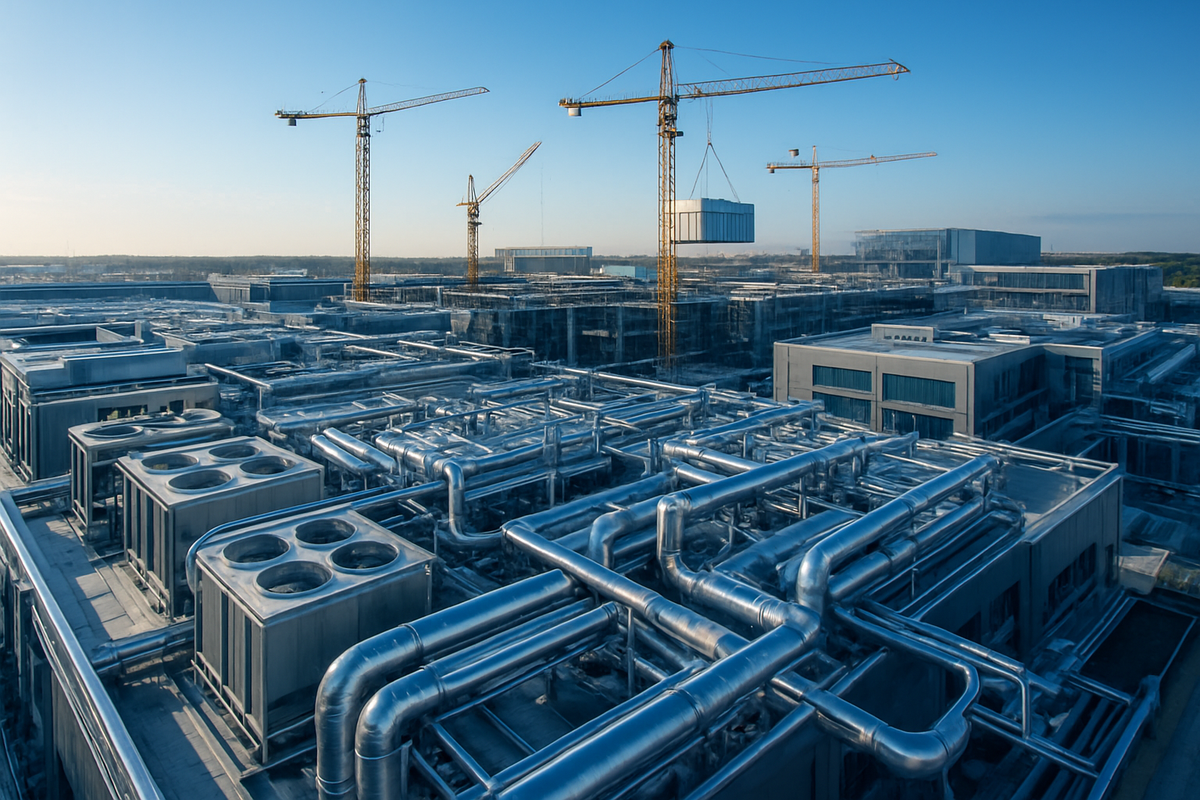
The broader significance of Comfort Systems’ rise lies in the evolving physical requirements of the AI era. Standard air-cooled data centers are rapidly becoming obsolete as AI clusters generate heat loads that exceed traditional cooling capacities. This has forced a shift toward liquid cooling and immersion technologies—fields where Comfort Systems has invested heavily. This transition is not just a technological upgrade; it is a fundamental reconfiguration of how data centers are built, shifting the value proposition from the shell of the building to the intricate mechanical systems inside.
This boom is also occurring against a backdrop of industrial "reshoring" in the United States, fueled by federal initiatives like the CHIPS and Science Act and the Inflation Reduction Act. The demand for domestic semiconductor manufacturing and battery plants has created a multi-year tailwind for industrial HVAC services. However, this growth is facing significant regulatory and environmental hurdles. A major emerging risk is the phasedown of PFAS-based coolants and sealants, which are widely used in specialized cooling systems. Companies that can navigate these "forever chemical" regulations while maintaining system efficiency will likely capture the next wave of market share.
Furthermore, geographic constraints are beginning to reshape the industry. Traditional hubs like Northern Virginia are facing severe power grid bottlenecks, leading to project delays and cancellations. This has triggered a migration of data center construction to "Tier-2" markets in the Midwest and South—regions where Comfort Systems has a strong existing footprint and modular delivery capabilities, allowing them to bypass some of the localized labor shortages and grid constraints of established hubs.
The Road Ahead: A $12 Billion Backlog
Looking toward the remainder of 2026 and into 2027, the primary story for Comfort Systems is its massive $11.94 billion backlog. This figure, which has nearly doubled in the past twelve months, provides a multi-year cushion of guaranteed work and exceptional visibility for investors. Management has already signaled plans to expand its modular manufacturing capacity from 3 million to 4 million square feet by the end of 2026 to meet the demand.
The short-term challenge for the company will be execution. With such a massive backlog, the primary risk is no longer finding work, but managing the labor and supply chain logistics required to deliver it. The industry faces a projected shortfall of hundreds of thousands of skilled tradespeople by late 2026. Comfort Systems’ ability to leverage its off-site fabrication model will be the deciding factor in whether it can maintain its industry-leading margins as wage inflation persists.
Strategic acquisitions are also expected to continue. The company has a history of "bolt-on" acquisitions, such as the recent purchases of Feyen Zylstra and Meisner, which bring specialized electrical and mechanical talent into the fold. With nearly $1 billion in cash on hand, Comfort Systems is well-positioned to continue consolidating the fragmented MEP (mechanical, electrical, plumbing) landscape, further widening the gap between itself and smaller competitors.
Final Assessment: An Infrastructure Powerhouse
The ascent of Comfort Systems USA (NYSE: FIX) to record highs is a clear signal that the market finally recognizes the company not just as a construction firm, but as an essential infrastructure provider for the digital age. The "industrial supercycle" is no longer a theoretical concept; it is reflected in the record profits, surging backlogs, and expanding margins of the firms tasked with building the foundation of the AI economy.
For investors, the key takeaways are the company's dominant 45% revenue exposure to the tech sector and its strategic use of modular construction to mitigate labor shortages. While the stock's rapid appreciation may invite some caution regarding valuation, the sheer scale of the $11.9 billion backlog suggests that the growth story has significant "runway" remaining.
As we move through 2026, the market will be watching for any signs of cooling in data center capital expenditures or shifts in federal industrial policy. However, given the mission-critical nature of the services provided by Comfort Systems, it appears that the company is uniquely positioned to remain a primary beneficiary of the ongoing transformation of the American industrial landscape.
This content is intended for informational purposes only and is not financial advice.