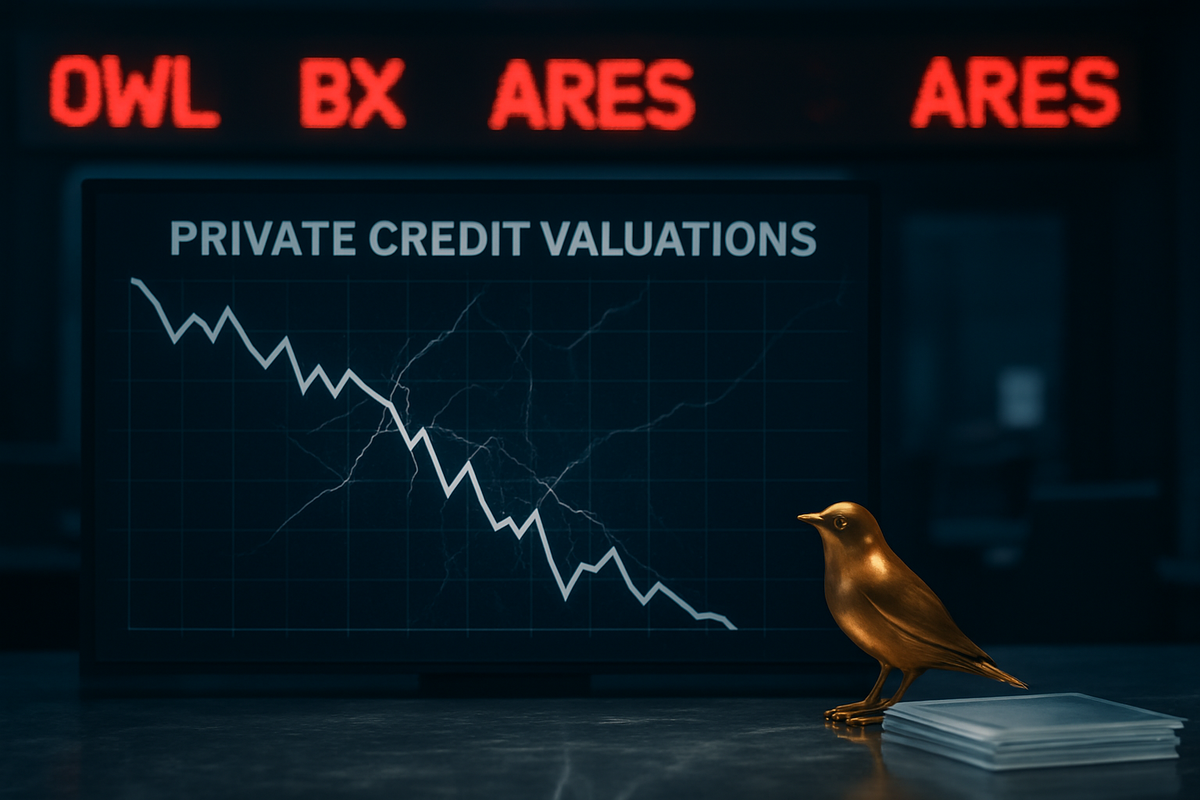
The trillion-dollar private credit market, long touted as a stable alternative to volatile public bonds, faced a significant reckoning this week. Blue Owl Capital (NYSE: OWL) sent shockwaves through the industry on February 19, 2026, when it announced a fundamental shift in how it handles investor withdrawals for its retail-focused flagship funds. The decision to effectively end standard quarterly redemptions in favor of a structured capital return model has reignited fears of a liquidity mismatch, leading to a sharp decline in share prices for the world’s largest alternative asset managers.
The immediate market reaction was swift and unforgiving. Shares of Blue Owl Capital plunged as much as 10% following the news, hitting a two-and-a-half-year low. The contagion spread rapidly to its peers, with Ares Management (NYSE: ARES) and Blackstone (NYSE: BX) both seeing declines of approximately 5% to 6%. Investors are now questioning whether the "semi-liquid" promise of private credit vehicles—offering retail investors an exit from inherently illiquid assets—is finally hitting a breaking point.
A Structural Shift: The End of Quarterly Redemptions
The catalyst for the current turmoil was Blue Owl’s announcement regarding Blue Owl Capital Corp. II (OBDC II), a $1.6 billion non-traded Business Development Company (BDC). For years, these vehicles allowed investors to request redemptions for up to 5% of their holdings each quarter. However, citing a desire to "accelerate" liquidity rather than gate it, Blue Owl transitioned the fund to a "return of capital" model. Under this new framework, the firm plans to distribute 30% of the fund’s Net Asset Value (NAV) to all shareholders by late March 2026, effectively winding down the legacy vehicle.
This move did not happen in a vacuum. The timeline of the crisis began in late 2025 when Blue Owl attempted to merge OBDC II with its larger publicly traded fund. That plan was scrapped after fierce investor backlash; the public fund was trading at a significant discount to its NAV, meaning private investors would have been forced to accept an immediate 20% paper loss. By early 2026, redemption requests across Blue Owl’s tech-focused funds had surged to over 15%, forcing management to sell $1.4 billion in direct lending assets at 99.7% of par to generate the necessary cash for payouts.
Winners and Losers in the Aftermath
In the short term, the clear "losers" are the major alternative asset managers who have staked their growth on the democratization of private credit. Blue Owl Capital (NYSE: OWL) faces the steepest uphill battle, as it must now prove to its institutional and retail base that its valuation "marks" are accurate despite the secondary market’s skepticism. Blackstone (NYSE: BX) and Ares Management (NYSE: ARES), while more diversified, have seen their premium valuations compressed as investors price in the risk of similar redemption hurdles in their own private credit and real estate vehicles.
Conversely, the "winners" may be the large, traditional institutional investors and distressed debt funds waiting on the sidelines. As firms like Blue Owl are forced to sell high-quality loan portfolios to meet redemption demands, these buyers can pick up "par-value" assets at slight discounts from forced sellers. Additionally, some analysts, including those at Raymond James, argue that the sell-off is an overreaction. They suggest that firms like Blue Owl are actually acting responsibly by proactively managing a legacy fund’s exit rather than allowing a slow-motion "run on the bank" through repeated 5% proration cycles.
The Transparency Trap and Broader Implications
The Blue Owl event has pulled back the curtain on the "transparency gap" that has long worried regulators. Unlike public markets, where prices are discovered daily, private credit valuations are often determined by the managers themselves. This "marking their own homework" has come under intense scrutiny following recent moves by BlackRock (NYSE: BLK), which marked down one of its private debt funds by 19% just last month. The fear is that the underlying loans—many of which are concentrated in the software and SaaS sectors—are worth far less than reported, especially as Artificial Intelligence begins to disrupt legacy business models.
This event mirrors historical precedents, most notably the 2007-08 "canary-in-the-coalmine" moments where specialized credit vehicles first showed signs of stress. While the current system is better capitalized, the rapid growth of private credit into a $1.8 trillion behemoth means any systemic "gating" of funds could have massive ripple effects. The Securities and Exchange Commission (SEC) has already responded by designating private credit and retail-facing illiquid products as a top examination priority for the 2026 fiscal year, signaling that the era of light-touch regulation for these "shadow banks" may be coming to an end.
The Road Ahead: Strategic Pivots and Market Reality
Looking forward, the private credit industry faces a mandatory strategic pivot. The "semi-liquid" model—the golden goose of the last five years—may need to be redesigned with longer lock-up periods or more stringent redemption caps to prevent liquidity mismatches during periods of high interest rates or economic uncertainty. We may see a shift toward "closed-end" structures where capital is committed for the life of the fund, reducing the risk of forced asset sales but potentially slowing the influx of retail capital.
In the short term, investors should prepare for continued volatility as other major players report their quarterly NAVs. If firms like Apollo Global Management (NYSE: APO) or KKR & Co. Inc. (NYSE: KKR) follow suit with similar structural changes or asset sales, the narrative of a "liquidity crisis" will become even harder to shake. However, for those with long horizons, this shakeout could provide a necessary "cleansing" of the market, separating managers with superior underwriting skills from those who simply rode the wave of easy money.
Conclusion: A Market Moving Toward Maturity
The jitters currently felt in the private credit market are more than just a momentary panic; they represent a fundamental maturation of an asset class that has grown too large to remain opaque. Blue Owl’s decision to limit withdrawals and return capital is a pragmatic, albeit painful, response to a retail base that is increasingly looking for the exits. While the share price declines for OWL, ARES, and BX are significant, they reflect a necessary repricing of risk in a world where "liquid" and "private" are no longer easily compatible terms.
As we move into the second half of 2026, the key metric for investors to watch will be the "default rate" versus "recovery rate" on these private loans. If the underlying collateral holds its value, the current liquidity crunch will be remembered as a structural hiccup. If, however, the asset sales reveal deeper rot in the valuations, the private credit market may be facing its first true cyclical test. For now, the message to the market is clear: transparency is no longer optional—it is a requirement for survival.
This content is intended for informational purposes only and is not financial advice.